
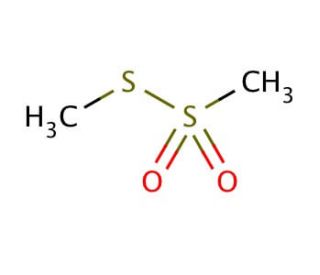

Molecular structure of Methyl Methanethiosulfonate, CAS Number: 2949-92-0
Methyl Methanethiosulfonate (CAS 2949-92-0)
Alternate Names:
MMTS
Application:
Methyl Methanethiosulfonate is a reagent for the modification of sulfhydryl groups of enzymes
CAS Number:
2949-92-0
Molecular Weight:
126.20
Molecular Formula:
C2H6O2S2
Supplemental Information:
This is classified as a Dangerous Good for transport and may be subject to additional shipping charges.
For Research Use Only. Not Intended for Diagnostic or Therapeutic Use.
* Refer to Certificate of Analysis for lot specific data.
QUICK LINKS
Ordering Information
Description
Technical Information
Safety Information
SDS & Certificate of Analysis
Methyl Methanethiosulfonate (MMTS) is used for the rapid and selective modification of sulfhydryl groups of enzymes and useful for mapping the pore-lining regions of the ryanodine receptor. It acts as an oxidizing agent and can react with metal ions. It has been used to probe the activity of enzymes, to study the effects of reactive oxygen species, and to assess the effects of oxidative stress. In addition, MMTS has been utilized to investigate the effects of metal ions on DNA structure and function.
Methyl Methanethiosulfonate (CAS 2949-92-0) References
- The zinc-binding domain of mammalian prolyl-tRNA synthetase is indispensable for catalytic activity and organism viability. | Vasu, K., et al. 2021. iScience. 24: 102215. PMID: 33748704
- Organic mercury solid phase chemoselective capture for proteomic identification of S-nitrosated proteins and peptides. | Doulias, PT., et al. 2021. Nitric Oxide. 117: 1-6. PMID: 34536587
- Importance of the Cyclic Cystine Knot Structural Motif for Immunosuppressive Effects of Cyclotides. | Hellinger, R., et al. 2021. ACS Chem Biol. 16: 2373-2386. PMID: 34592097
- In vivo Characterization of Endogenous Protein Interactomes in Drosophila Larval Brain, Using a CRISPR/Cas9-based Strategy and BioID-based Proximity Labeling. | Uçkun, E., et al. 2022. Bio Protoc. 12: PMID: 35937934
- Quantitative Mass Spectrometry by SILAC in Haloferax volcanii. | Couto-Rodriguez, RL., et al. 2022. Methods Mol Biol. 2522: 255-266. PMID: 36125755
- Reduced hydrogen sulfide production contributes to adrenal insufficiency induced by hypoxia via modulation of NLRP3 inflammasome activation. | Zhang, N., et al. 2023. Redox Rep. 28: 2163354. PMID: 36661247
- Quantitative proteomics analysis of COVID-19 patients: Fetuin-A and tetranectin as potential modulators of innate immune responses. | Alghanem, B., et al. 2023. Heliyon. 9: e15224. PMID: 37064481
- Suspension TRAPping Filter (sTRAP) Sample Preparation for Quantitative Proteomics in the Low µg Input Range Using a Plasmid DNA Micro-Spin Column: Analysis of the Hippocampus from the 5xFAD Alzheimer's Disease Mouse Model. | Thanou, E., et al. 2023. Cells. 12: PMID: 37174641
- Chronic exposure to multiple stressors alters the salivary proteome of piglets. | Prims, S., et al. 2023. PLoS One. 18: e0286455. PMID: 37235602
- Electrostatic potential of the acetylcholine binding sites in the nicotinic receptor probed by reactions of binding-site cysteines with charged methanethiosulfonates. | Stauffer, DA. and Karlin, A. 1994. Biochemistry. 33: 6840-9. PMID: 8204619
- Role of the charge pair aspartic acid-237-lysine-358 in the lactose permease of Escherichia coli. | Dunten, RL., et al. 1993. Biochemistry. 32: 3139-45. PMID: 8457574
- Molecular basis of charge movement in voltage-gated sodium channels. | Yang, N., et al. 1996. Neuron. 16: 113-22. PMID: 8562074
- Structure of the NMDA receptor channel M2 segment inferred from the accessibility of substituted cysteines. | Kuner, T., et al. 1996. Neuron. 17: 343-52. PMID: 8780657
- Methanethiosulfonate derivatives inhibit current through the ryanodine receptor/channel. | Quinn, KE. and Ehrlich, BE. 1997. J Gen Physiol. 109: 255-64. PMID: 9041453
Ordering Information
| Product Name | Catalog # | UNIT | Price | Qty | FAVORITES | |
Methyl Methanethiosulfonate, 1 g | sc-211882 | 1 g | $128.00 | |||
Methyl Methanethiosulfonate, 10 g | sc-211882A | 10 g | $237.00 |