
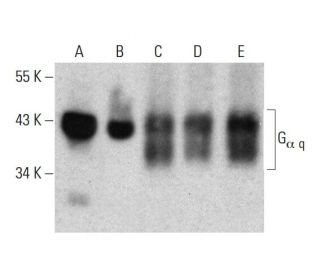
Anticorps Gα q (10): sc-136181
- L'Anticorps Gα q (10) est un monoclonal de souris IgG1 κ, cité dans 25 publications, fourni en 200 µg/ml
- dirigé contre les acides aminés 22-31 de Gα q d'origine human
- recommandé pour la détection de Gα q d'origine mouse, rat, human et canine par WB, IP et IF
- disponible conjugué à l'agarose pour IP; et à l'HRP pour WB, IHC(P) et ELISA
- 1 BP-HRP">m-IgG1 BP-HRP est le réactif de détection secondaire préféré pour l'anticorps Gα q (10) pour les applications WB. Ce réactif est désormais proposé en association avec l'anticorps Gα q (10)(voir les informations relatives à la commande ci-dessous).

ACCÈS RAPIDE AUX LIENS
L'anticorps Gα q (10) est un anticorps monoclonal IgG1 κ de souris Gα q (également désigné comme anticorps de la sous-unité GNAQ de la protéine G) qui détecte les Gα q de souris, de rat et d'origine humaine par WB, IP et IF. L'anticorps Gα q (10) est disponible sous forme d'anticorps anti-Gα q conjugué et non conjugué. Les protéines G hétérotrimériques ont pour fonction de relayer l'information des récepteurs de la surface cellulaire aux effecteurs intracellulaires. Chacun des très nombreux récepteurs détecte spécifiquement un stimulus extracellulaire (photon, phéromone, odorant, hormone ou neurotransmetteur) tandis que les effecteurs (par exemple, l'adénylcyclase), qui agissent pour générer un ou plusieurs messagers intracellulaires, sont moins nombreux. Chez les mammifères, les polypeptides α, β et γ de la protéine G sont codés par au moins 16, 4 et 7 gènes, respectivement. L'intérêt pour les protéines G s'est surtout concentré sur leurs sous-unités α, car ces protéines lient et hydrolysent le GTP et régulent de la façon la plus évidente l'activité des effecteurs les mieux étudiés. Quatre classes distinctes de sous-unités Ga ont été identifiées : Gs, Gi, Gq et Ga 12/13. La classe Gq comprend Gα 15, Gα 14, Gα 11 et Gα q, dont deux, Gα 11 et Gα q, sont abondantes dans le cerveau et le poumon et présentes à des niveaux plus faibles dans divers tissus.
Alexa Fluor® est une marque déposée de Molecular Probes Inc., OR., USA
LI-COR® et Odyssey® sont marques déposées de LI-COR Biosciences
Anticorps Gα q (10) Références:
- Distribution tissulaire sélective des sous-unités gamma de la protéine G, y compris une nouvelle forme des sous-unités gamma identifiée par clonage ADNc. | Cali, JJ., et al. 1992. J Biol Chem. 267: 24023-7. PMID: 1385432
- Diversité des sous-unités bêta des protéines hétérotrimériques de liaison au GTP: caractérisation d'un nouvel ADNc de sous-unité bêta. | von Weizsäcker, E., et al. 1992. Biochem Biophys Res Commun. 183: 350-6. PMID: 1543505
- La gustducine est une protéine G spécifique des cellules gustatives, étroitement liée aux transducines. | McLaughlin, SK., et al. 1992. Nature. 357: 563-9. PMID: 1608467
- Diversité des protéines G dans la transduction des signaux. | Simon, MI., et al. 1991. Science. 252: 802-8. PMID: 1902986
- Diversité des protéines G: une classe distincte de sous-unités alpha est présente chez les vertébrés et les invertébrés. | Strathmann, M. and Simon, MI. 1990. Proc Natl Acad Sci U S A. 87: 9113-7. PMID: 2123549
- La signalisation ADRA1A-Gαq potentialise la thermogenèse adipocytaire par l'intermédiaire de CKB et TNAP. | Rahbani, JF., et al. 2022. Nat Metab. 4: 1459-1473. PMID: 36344764
- Contrôle de la dynamique de signalisation Gαq et de la diaphonie GPCR par les GRK. | Xiang, G., et al. 2022. Sci Adv. 8: eabq3363. PMID: 36427324
- Démêler l'allostérie au sein du récepteur de l'angiotensine II de type 1 pour le couplage Gαq et β-arrestin. | Cao, Y., et al. 2023. Sci Signal. 16: eadf2173. PMID: 37552769
- Le mécanisme de régulation Gαq de l'hydrolyse PIP2 catalysée par PLCβ3. | Falzone, ME. and MacKinnon, R. 2023. Proc Natl Acad Sci U S A. 120: e2315011120. PMID: 37991948
- Composés outils recommandés: Application de YM-254890 et FR900359 pour interroger les voies de signalisation médiées par Gαq/11. | Voss, JH. 2023. ACS Pharmacol Transl Sci. 6: 1790-1800. PMID: 38093837
- L'inhibition optogénétique sélective de la signalisation Gαq ou Gαi par des domaines RGS minimaux perturbe la fonctionnalité et la formation des circuits. | Lockyer, JL., et al. 2024. Proc Natl Acad Sci U S A. 121: e2411846121. PMID: 39190348
- Éléments structurels des sous-unités G alpha qui interagissent avec les G bêta gamma, les récepteurs et les effecteurs. | Conklin, BR. and Bourne, HR. 1993. Cell. 73: 631-41. PMID: 8388779
Informations pour la commande
| Nom du produit | Ref. Catalogue | COND. | Prix HT | QTÉ | Favoris | |
Anticorps Gα q (10) | sc-136181 | 200 µg/ml | $322.00 | |||
Gα q (10): m-IgG1 BP-HRP Kit | sc-552893 | 200 µg Ab; 20 µg BP | $361.00 | |||
Anticorps Gα q (10) AC | sc-136181 AC | 500 µg/ml, 25% agarose | $424.00 | |||
Anticorps Gα q (10) HRP | sc-136181 HRP | 200 µg/ml | $322.00 |