
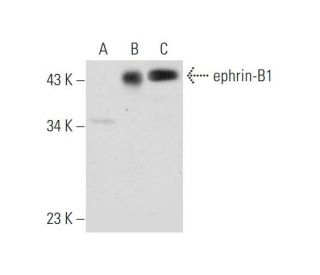
Pas de données CRISPR : l'image illustre la qualité de l'anticorps pour la visualisation des résultats de l'expérience CRISPR.
Pas de données CRISPR : l'image illustre la qualité de l'anticorps pour la visualisation des résultats de l'expérience CRISPR.
Plasmide CRISPR/Cas9 KO ephrin-B1 (h): sc-400873
- Espèces cibles: human
- 20 µg d'ADN plasmidique purifié et prêt à transfecter; Jusqu'à 20 transfections
- ephrin-B1 Le plasmide CRISPR/Cas9 Knockout (KO) (h) est un ensemble de plasmides, chacun codant pour la nucléase Cas9 et un ARN guide (gRNA) de 20 nt spécifique à la cible, conçu pour une efficacité de knockout maximale à l'aide de séquences issues de la bibliothèque GeCKO v2
- Les séquences d'ARN guide (gRNA) dirigent Cas9 pour induire des cassures double brin (DSB) spécifiques au site dans le locus génomique ephrin-B1, entraînant un knock-out génique par jonction non homologue (NHEJ)
- Les gènes de résistance à la puromycine et RFP sont flanqués de sites LoxP, permettant la suppression des marqueurs de sélection via la recombinase Cre (Cre Vector : sc-418923) après l'établissement de lignées cellulaires knock-out stables
- Après transfection, l'efficacité de knockout de gène peut être évaluée par WB, IF ou IHC en utilisant l'anticorps: ephrin-B1 Antibody (C-6): sc-515264

Informations pour la commande
| Nom du produit | Ref. Catalogue | COND. | Prix HT | QTÉ | Favoris | |
Plasmide CRISPR/Cas9 KO ephrin-B1 (h) | sc-400873 | 20 µg | $397.00 |
Présentation
EFNB1 code l’éphrine‑B1, un ligand ancré à la membrane des récepteurs tyrosine kinases Eph, qui assure une signalisation dépendante du contact contrôlant le positionnement cellulaire, la formation de frontières et la morphogenèse tissulaire. L’éphrine‑B1 participe à une signalisation bidirectionnelle Eph/éphrine, en s’intégrant à la régulation des GTPases de la famille Rho, au remodelage du cytosquelette d’actine et à la dynamique des jonctions adhérentes pour influencer la migration et l’adhérence. Par ces processus, elle contribue à l’angiogenèse, au guidage axonal et à l’organisation épithéliale, et son dérèglement a été associé à des anomalies du développement ainsi qu’à une altération de la communication cellule–cellule dans des voies liées au cancer. EFNB1 est également pertinent pour les études du dosage génique lié à l’X et du mosaïcisme, en offrant un modèle pour comprendre comment des interfaces locales de signalisation façonnent l’organisation des tissus.
Le plasmide CRISPR/Cas9 KO ephrin-B1 (h) est un ensemble de plasmides conçus pour la disruption ciblée du gène EFNB1 dans les lignées cellulaires human. Chaque plasmide co-exprime un ARN guide unique (sgRNA) ciblant un site distinct au sein du EFNB1, ainsi que la nucléase Cas9 de Streptococcus pyogenes. Les plasmides codent également pour la GFP, ce qui permet l'identification par fluorescence et l'enrichissement des cellules transfectées avec succès par microscopie à fluorescence ou cytométrie en flux.
La conception multi-guide augmente la probabilité de générer des insertions ou des délétions (indels) qui perturbent le cadre de lecture ouvert EFNB1 à la suite de la formation de cassures double brin médiées par Cas9. Les cassures d'ADN introduites par le système CRISPR/Cas9 sont réparées par des voies endogènes de jonction non homologue (NHEJ), ce qui entraîne fréquemment des mutations par décalage du cadre de lecture qui suppriment l'expression de la protéine ephrin-B1.
Ce système de knock-out CRISPR permet la génération efficace de modèles cellulaires déficients en EFNB1 pour l'étude de la signalisation de ephrin-B1, les études de génomique fonctionnelle, la recherche en biologie du cancer et l'évaluation des réponses thérapeutiques dans des lignées cellulaires humaines.
Caractéristiques principales
- sgRNA ciblant le ou les exons de EFNB1 essentiels à la fonction de ephrin-B1
Co-expression de SpCas9 et de sgRNA à partir d'un seul plasmide pour une administration simplifiée
Rapporteur GFP pour l'identification des cellules transfectées
Pool de plasmides ciblant plusieurs sites génomiques de EFNB1 pour améliorer l'efficacité du knock-out
Compatible avec l'administration par transfection
Variantes de conception
CRISPR +/- HDR
- Les gRNA codés par le ephrin-B1 plasmide CRISPR/Cas9 KO (h) et le ephrin-B1 plasmide CRISPR/Cas9 KO (h2) ciblent des sites distincts au sein du locus EFNB1. Une ou les deux conceptions de ciblage peuvent être disponibles. Voir les produits associés pour connaître la disponibilité.
Les constructions donneuses HDR codées par le ephrin-B1 plasmide HDR (h) et le ephrin-B1 (h2) contiennent une cassette de résistance à la puromycine et un rapporteur RFP flanqué de bras d'homologie EFNB1 pour permettre la réparation dirigée par homologie au niveau de sites cibles EFNB1 définis correspondant aux conceptions CRISPR/Cas9 KO. La disponibilité des donneurs HDR peut varier. Voir les produits associés pour connaître la disponibilité.
Réservé à la recherche. N'est pas destiné à un usage diagnostique ou thérapeutique.