
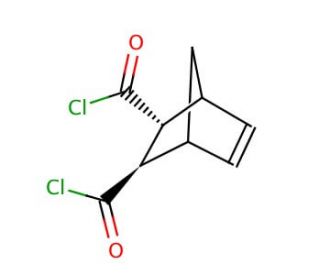

trans-3,6-Endomethylene-1,2,3,6-tetrahydrophthaloyl chloride (CAS 4582-21-2)
QUICK LINKS
trans-3,6-Endomethylene-1,2,3,6-tetrahydrophthaloyl chloride serves as a versatile reagent in organic synthesis. Its wide range of applications makes it an essential component in the synthesis of various organic compounds. Notably, it acts as a fundamental building block for heterocyclic compounds and finds utility in diverse fields such as pharmaceuticals, agrochemicals, and polymers. This compound is particularly valuable in the synthesis of cyclic and heterocyclic compounds, often employed as a coupling reagent in organic synthesis. Its versatility is further demonstrated by its use in the creation of pyridines, quinolines, indoles, polymers like polyurethanes and polyesters, as well as numerous pharmaceutical and agrochemical substances. Its mechanism of action relies on its ability to form covalent bonds with a range of organic compounds. Through a process called nucleophilic substitution, trans-3,6-Endomethylene-1,2,3,6-tetrahydrophthaloyl chloride forms a covalent bond with the carbon-carbon double bond of an organic compound. This bond can then be cleaved by the addition of a nucleophile. As a result, a diverse array of organic compounds can be synthesized, demonstrating the significance of trans-3,6-Endomethylene-1,2,3,6-tetrahydrophthaloyl chloride in organic chemistry research and applications.
Ordering Information
| Product Name | Catalog # | UNIT | Price | Qty | FAVORITES | |
trans-3,6-Endomethylene-1,2,3,6-tetrahydrophthaloyl chloride, 25 g | sc-237190 | 25 g | $220.00 |