
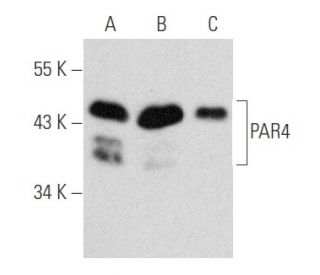


PAR4 Anticuerpo (3G9H7): sc-130078
- PAR4 Anticuerpo (3G9H7) es un monoclonal de ratón IgG1 κ, ver las 4 publicaciones, proporcionado como 200 µg/ml
- criado frente a una proteína recombinante correspondiente a los aminoácidos 1-330 de PAR4 de human origen
- recomendado para detectarPAR4 de mouse, rat y human origen, mediante WB, IP, IF, IHC(P) y ELISA
- Ver PAR4 (A-10): sc-1666 para PAR4 anticuerpos conjugados, incluyendo AC, HRP, FITC, PE, Alexa Fluor® 488, 594, 647, 680 y 790.
- 1 BP-HRP">m-IgG1 BP-HRP es el reactivo de detección secundario preferido para PAR4 Anticuerpo (3G9H7) para aplicaciones WB e IHC(P). Este reactivo se ofrece ahora en un paquete con PAR4 Anticuerpo (3G9H7)(véase la información de pedido más abajo).

ENLACES RÁPIDOS
VER TAMBIÉN ....
Los tejidos normales se caracterizan por un equilibrio entre la estasis celular, la proliferación celular, la diferenciación celular y la muerte celular. La regulación aberrante de cualquiera de estos procesos celulares puede resultar en cáncer. La muerte celular durante la embriogénesis, la atrofia del tejido y el recambio normal del tejido se llama apoptosis y se caracteriza por la condensación citoplasmática y nuclear, la desorganización nuclear y la fragmentación del ADN genómico en oligómeros de 180-200 pares de bases. Se han aislado cinco cDNAs complementarios inducibles por ionomicina, designados PAR1, 2, 3, 4 y 5, de la línea celular de cáncer de próstata AT-3. El secuenciamiento de nucleótidos identificó a PAR1 como el homólogo de rata de MKP-1, PAR2 como el gen inducible por lesión HB-EGF, y PAR3 como el gen inducido por suero Cyr61. No se encontraron secuencias de PAR4 y PAR5 que correspondieran a proteínas previamente descritas. PAR4 (respuesta de apoptosis de próstata 4) se expresa específicamente en células que entran en apoptosis y no se induce durante la estimulación de factores de crecimiento, el estrés oxidativo, la necrosis o la detención del crecimiento. El gen PAR4 codifica una proteína con una señal de localización nuclear putativa y un cierre de leucina terminal carboxi.
Alexa Fluor® es una marca registrada de Molecular Probes Inc., OR., USA
REIVEW LI-COR® y Odyssey® son marcas registradas de LI-COR Biosciences.
PAR4 Anticuerpo (3G9H7) Referencias:
- El análisis proteómico cuantitativo revela perfiles de liberación similares tras la estimulación específica de las plaquetas con PAR-1 o PAR-4. | van Holten, TC., et al. 2014. Cardiovasc Res. 103: 140-6. PMID: 24776597
- PAR-4: una posible nueva diana para las enfermedades relacionadas con la edad. | Qinan, W., et al. 2014. Expert Opin Ther Targets. 18: 917-27. PMID: 24890982
- Apoptosis selectiva del cáncer por el supresor tumoral par-4. | Hebbar, N., et al. 2014. Adv Exp Med Biol. 818: 155-66. PMID: 25001535
- La estimulación de PAR-1 o PAR-4 promueve un patrón similar de liberación de VEGF y endostatina y respuestas pro-angiogénicas mediadas por plaquetas humanas. | Etulain, J., et al. 2015. Platelets. 26: 799-804. PMID: 26082997
- Un viaje más allá de la apoptosis: nuevo enigma del control de la metástasis por el proapoptótico Par-4. | Rasool, RU., et al. 2016. Clin Exp Metastasis. 33: 757-764. PMID: 27568374
- Receptor 4 activado por proteasa (PAR4): A Promising Target for Antiplatelet Therapy. | Rwibasira Rudinga, G., et al. 2018. Int J Mol Sci. 19: PMID: 29443899
- El supresor tumoral Par-4 regula el factor del complemento C3 y la obesidad. | Araujo, N., et al. 2022. Front Oncol. 12: 860446. PMID: 35425699
- Actuar sobre PAR4 para reducir la aterosclerosis. | Barrett, TJ. 2023. Arterioscler Thromb Vasc Biol. 43: 2179-2182. PMID: 37767705
- La expresión génica elevada del receptor 4 activado por proteasa (PAR4) en la enfermedad de Alzheimer predice el deterioro cognitivo. | Winfree, RL., et al. 2024. Neurobiol Aging. 140: 93-101. PMID: 38761538
- El supresor tumoral Par-4 activa la ferroptosis dependiente de autofagia. | Subburayan, K., et al. 2024. Commun Biol. 7: 732. PMID: 38886572
Información sobre pedidos
| Nombre del producto | Número de catálogo | UNIDAD | Precio | CANTIDAD | Favoritos | |
PAR4 Anticuerpo (3G9H7) | sc-130078 | 200 µg/ml | $322.00 | |||
Paquete de PAR4 (3G9H7): m-IgG1 BP-HRP | sc-542635 | 200 µg Ab; 20 µg BP | $361.00 |