
Plásmido CRISPR de Activación (h) IL-10: sc-417060-ACT
- Especies Diana: human
- 20 µg de plásmido de ADN purificado listo para la trasfección; suficiente para 20 transfecciones máximo
- El Plásmdo de Activación CRISPR (h) IL-10 es un sistema de activación de la trascripción mediante una activación sinérgica (SAM), diseñado para incrementar la expresión de un gen concreto
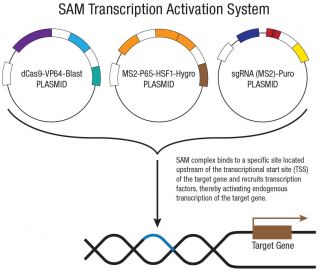
- Los Plásmdo de Activación CRISPR (h) IL-10 incluyen los siguientes tres plásmidos, con un radio 1:1:1 : plásmido codificador de la nucleasa Cas 9 desactivada (dCas9), (D10A y N863A) fusionadas al dominio de transactivación VP64 y el gen de resistencia a blasticidina; plásmido codificador de la proteína de fusión MS2-p65-HSF1 y el gen de resistencia a Higromicina; plásmido codificador de la secuencia diana específica de 20 nt de ARN y el gen de resistencia a puromicina.
- El complejo SAM resultante se une en un punto específico a unos 200 -250 nt aguas arriba del inicio de la transcripción del gen diana y ofrece un potente punto de reclutamiento de factores de transcripción para un eficiente incremento de la activación genica.
- Los gRNA codificados por el plásmido de activación CRISPR IL-10 (h) y el plásmido de activación CRISPR IL-10 (h2) se dirigen a regiones reguladoras distintas situadas aguas arriba del sitio de inicio de la transcripción de IL10. Puede que haya uno o ambos diseños disponibles
- Tras la transfección, la eficacia del knockout puede comprobarse mediante WB, IF ó IHC utilzando el anticuerpo: IL-10 Anticuerpo (E-10): sc-8438

Información sobre pedidos
| Nombre del producto | Número de catálogo | UNIDAD | Precio | CANTIDAD | Favoritos | |
Plásmido CRISPR de Activación (h) IL-10 | sc-417060-ACT | 20 µg | $397.00 | |||
Plásmido CRISPR de Activación (h2) IL-10 | sc-417060-ACT-2 | 20 µg | $397.00 |
El gen humano IL10 codifica la interleucina-10 (IL-10), una citocina inmunorreguladora pleiotrópica que limita las respuestas inflamatorias y promueve la homeostasis tisular. La IL-10 señaliza a través del complejo del receptor de IL-10 para activar programas transcripcionales dependientes de STAT3 mediadas por JAK1/TYK2, suprimiendo de forma amplia la producción de citocinas proinflamatorias, la presentación de antígenos y la activación de la inmunidad innata impulsada por NF-κB, a la vez que favorece fenotipos inmunitarios reguladores. Esta vía es fundamental para equilibrar la defensa del huésped y la inmunopatología; las alteraciones en la expresión de IL-10 se han asociado con inflamación crónica, autoinmunidad, evolución de enfermedades infecciosas y supresión inmunitaria asociada a tumores. La IL-10 se estudia habitualmente en macrófagos, células dendríticas, linfocitos T y compartimentos epiteliales para analizar la comunicación entre citocinas, los mecanismos de tolerancia y la resolución de la inflamación.
IL-10 El plásmido de activación CRISPR (h) proporciona un enfoque específico y no destructivo para regular al alza la expresión endógena de IL10 sin alterar la secuencia de ADN subyacente.
IL-10 El plásmido de activación CRISPR (h) es un sistema mediador de activación sinérgica (SAM) de tres plásmidos diseñado para la regulación al alza transcripcional altamente eficiente y específica del locus IL10 en líneas celulares humanas. El sistema se basa en una Cas9 catalíticamente inactiva (dCas9) que porta dos mutaciones inactivadoras (D10A y N863A) que eliminan la actividad nucleasa al tiempo que conservan la unión al ADN. Esta dCas9 se fusiona con VP64, un potente activador transcripcional, y se coexpresa con un gen de resistencia a la blasticidina para la selección. El segundo plásmido codifica la proteína de fusión MS2-p65-HSF1, un complejo activador secundario que actúa en conjunto con dCas9-VP64, junto con un gen de resistencia a la higromicina. El tercer plásmido codifica un ARN guía (sgRNA) específico del objetivo de 20 nt fusionado a dos aptámeros de ARN MS2 que reclutan el complejo MS2-p65-HSF1 al sitio de activación, acompañado de un gen de resistencia a la puromicina. Los tres plásmidos se administran en una proporción de masa de 1:1:1 para una expresión equilibrada de todos los componentes del sistema.
Una vez ensamblado en el locus diana, el complejo SAM se une aproximadamente 200 pb aguas arriba del sitio de inicio transcripcional IL10, donde VP64, p65 y HSF1 actúan de forma coordinada para reclutar la maquinaria transcripcional e impulsar la regulación al alza de la expresión endógena de IL-10. A diferencia de la Cas9 con actividad nucleasa, dCas9 no introduce roturas de doble cadena ni modifica la secuencia genómica, preservando el locus nativo IL10 y permitiendo el estudio de las respuestas transcripcionales dependientes de IL-10 en el locus endógeno, lo que la convierte en una herramienta valiosa para estudios funcionales, la identificación de genes diana y la modelización de la restauración de la vía IL-10 en células tumorales con expresión de IL10 silenciada o reducida.
Sólo para uso en investigación. No destinado a uso diagnóstico o terapéutico.