
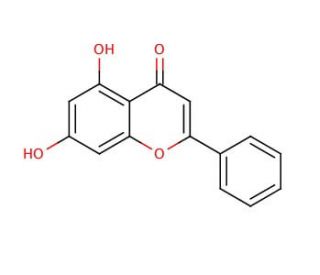

Chrysin (CAS 480-40-0)
Ver las publicaciones del producto (13)
ENLACES RÁPIDOS
La crisina, también denominada 5,7-dihidroxiflavona, es un flavonoide antioxidante natural presente en diversas plantas como la miel, el propóleo y la vid de la pasiflora. La investigación in vitro sobre la crisina ha revelado sus propiedades antioxidantes, antiinflamatorias, anticancerígenas y antidiabéticas, junto con su capacidad para modular la actividad de enzimas, hormonas y neurotransmisores específicos. Por ejemplo, ha demostrado su potencial para influir en la actividad de la aromatasa, una enzima implicada en la producción de estrógenos. Además, la crisina ha mostrado efectos inhibidores sobre el crecimiento de células cancerosas y la inflamación al influir en la actividad de enzimas y hormonas específicas. Se descubrió que la crisina inhibe el HIF-1α (factor inducible por hipoxia-1α) e induce la apoptosis.
Chrysin (CAS 480-40-0) Referencias
- La apoptosis inducida por la crisina está mediada por la activación de caspasas y la inactivación de Akt en células leucémicas U937. | Woo, KJ., et al. 2004. Biochem Biophys Res Commun. 325: 1215-22. PMID: 15555556
- [Preparación de un concentrado de precalicreína y determinación de su activador en derivados sanguíneos]. | Simonianová, E. 1992. Cesk Farm. 41: 8-9. PMID: 1586974
- Flavonoides dietéticos: efectos sobre el metabolismo de xenobióticos y carcinógenos. | Moon, YJ., et al. 2006. Toxicol In Vitro. 20: 187-210. PMID: 16289744
- La crisina inhibe la expresión del factor-1 alfa inducible por hipoxia mediante la reducción de la estabilidad del factor-1 alfa inducible por hipoxia y la inhibición de su síntesis proteica. | Fu, B., et al. 2007. Mol Cancer Ther. 6: 220-6. PMID: 17237281
- Crisina: Fuentes, actividades farmacológicas beneficiosas y mecanismo de acción molecular. | Mani, R. and Natesan, V. 2018. Phytochemistry. 145: 187-196. PMID: 29161583
- Impacto de la crisina en los mecanismos moleculares subyacentes a las complicaciones diabéticas. | Farkhondeh, T., et al. 2019. J Cell Physiol. 234: 17144-17158. PMID: 30916403
- Crisina: Propiedades farmacológicas y terapéuticas. | Naz, S., et al. 2019. Life Sci. 235: 116797. PMID: 31472146
- La Crisina Mejora los Trastornos del Metabolismo de la Glucosa y los Lípidos Regulando la Vía de Señalización AMPK/PI3K/AKT en Células HepG2 Resistentes a la Insulina y en Ratones C57BL/6J Inducidos por HFD/STZ. | Zhou, YJ., et al. 2021. J Agric Food Chem. 69: 5618-5627. PMID: 33979145
- Crisina: Perspectivas sobre la situación actual y posibilidades futuras como agente pro-salud. | Stompor-Gorący, M., et al. 2021. Nutrients. 13: PMID: 34198618
- La crisina induce la ferroptosis dependiente de la autofagia para aumentar la quimiosensibilidad a la gemcitabina dirigiéndose a CBR1 en células de cáncer de páncreas. | Zhou, L., et al. 2021. Biochem Pharmacol. 193: 114813. PMID: 34673014
- Propiedades Antidiabéticas de la Crisina Dietética: Una Revisión del Mecanismo Celular. | Dewi, RM., et al. 2022. Mini Rev Med Chem. 22: 1450-1457. PMID: 34720081
- Crisina: Una flavona poliédrica como herramienta para explorar nuevas aplicaciones fitoterapéuticas y el diseño de fármacos. | Falbo, F. and Aiello, F. 2023. Arch Pharm (Weinheim). 356: e2200347. PMID: 36316229
- Relaciones estructura-actividad antioxidante de flavonoides y ácidos fenólicos. | Rice-Evans, CA., et al. 1996. Free Radic Biol Med. 20: 933-56. PMID: 8743980
Información sobre pedidos
| Nombre del producto | Número de catálogo | UNIDAD | Precio | CANTIDAD | Favoritos | |
Chrysin, 1 g | sc-204686 | 1 g | $38.00 |