
Tyro3 CRISPR Activation Plasmid (h): sc-401412-ACT
- Zielspezies: human
- 20 µg transfektionsfertige, aufgereinigte Plasmid DNA; geeignet für 20 Transfektionen
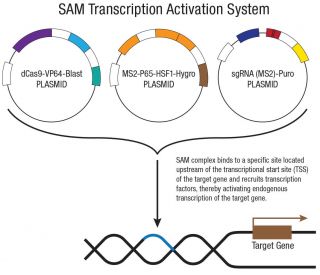
- Tyro3 CRISPR Activation Plasmid (h) ist ein Transkriptionsaktivierungs System (SAM) welches für die gezielte Verstärkung der Genexpression bestimmt ist
- Tyro3 CRISPR Aktivierungsplasmide (h) bestehen aus 3 Plasmiden im Massenverhältnis 1:1:1: ein Plasmid kodiert für die deaktivierte Cas9 (dCas9) Nuklease (D10A und N863A) fusioniert an die Transaktivierungsdomaine VP64 sowie ein Gen für die Blasticidin Resistenz; ein zweites Plasmid kodierend für das MS2-p65-HSF1 Fusionsprotein sowie ein Gen für die Hygromycin Resistenz; ein drittes Plasmid kodierd für die Ziel-spezifische 20 nt guide RNA fusioniert an zwei MS2 RNA Aptamere sowie ein Gen für die Puromycin Resistenz.
- Der entstehende SAM-Komplex (Mediator-Komplex zur synergistischen Gen-Aktivierung) bindet eine sequenzspezifische Region 200-250 nt upstream (in 5'-Richtung) des Transkriptionsstartsignals und rekrutiert dort ständig Transkriptionsfaktoren für eine verstärkte Gen-Aktivierung und Gen-Expression.
- Die vom Tyro3 CRISPR-Aktivierungsplasmid (h) und vom Tyro3 CRISPR-Aktivierungsplasmid (h2) kodierten gRNAs zielen auf unterschiedliche regulatorische Regionen stromaufwärts der TYRO3-Transkriptionsstartstelle ab. Eines oder beide Designs sind möglicherweise verfügbar
- Nach der Transfektion kann die Effizienz des Gen-Knockouts per Western Blot oder histologisch mit folgendem Antikörper überprüft werden: Tyro3: sc-166359

Bestellinformation
| Produkt | Katalog # | EINHEIT | Preis | ANZAHL | Favoriten | |
Tyro3 CRISPR Activation Plasmid (h) | sc-401412-ACT | 20 µg | $397.00 | |||
Tyro3 CRISPR Activation Plasmid (h2) | sc-401412-ACT-2 | 20 µg | $397.00 |
Das humane Gen **TYRO3** kodiert Tyro3, eine Rezeptor-Tyrosinkinase aus der TAM-Familie, die durch die vitamin-K-abhängigen Liganden **GAS6** und **PROS1** aktiviert wird und im Zusammenspiel mit phosphatidylserinbindenden Kontexten signalisiert. Nach Aktivierung reguliert Tyro3 Zellüberleben, Proliferation und Migration über Signalwege wie **PI3K–AKT**, **MAPK/ERK** und **STAT** und trägt über TAM-vermitteltes negatives Feedback zur **Efferzytose** sowie zur Dämpfung der angeborenen Immunantwort bei. Die TYRO3-Aktivität beeinflusst die zelluläre Homöostase in Immun- und Nervengeweben und wurde in mehreren Tumorkontexten mit veränderter inflammatorischer Signalgebung und onkogenen Phänotypen in Verbindung gebracht. Als Teil des TAM-Netzwerks mit **AXL** und **MERTK** ist Tyro3 außerdem an Rezeptor-Crosstalk beteiligt, der Zytokinantworten, phagozytische Clearance und Gewebe-Remodelling mitprägt.
Tyro3 Das CRISPR-Aktivierungsplasmid (h) bietet einen gezielten, nicht-destruktiven Ansatz zur Hochregulierung der endogenen TYRO3-Expression, ohne die zugrunde liegende DNA-Sequenz zu verändern.
Tyro3 Das CRISPR-Aktivierungsplasmid (h) ist ein aus drei Plasmiden bestehendes synergistisches Aktivierungsmediator-System (SAM), das für eine hocheffiziente, ortsspezifische transkriptionelle Hochregulation des TYRO3-Lokus in menschlichen Zelllinien entwickelt wurde. Das System basiert auf einem katalytisch inaktiven Cas9 (dCas9), das zwei inaktivierende Mutationen (D10A und N863A) trägt, welche die Nukleaseaktivität eliminieren, während die DNA-Bindung erhalten bleibt. Dieses dCas9 ist mit VP64, einem potenten Transkriptionsaktivator, fusioniert und wird zusammen mit einem Blasticidin-Resistenzgen zur Selektion koexprimiert. Das zweite Plasmid kodiert das MS2-p65-HSF1-Fusionsprotein, einen sekundären Aktivatorkomplex, der zusammen mit dCas9-VP64 wirkt, sowie ein Hygromycin-Resistenzgen. Das dritte Plasmid kodiert für eine zielspezifische 20-nt-sgRNA, die an zwei MS2-RNA-Aptamere fusioniert ist, welche den MS2-p65-HSF1-Komplex an die Aktivierungsstelle rekrutieren, begleitet von einem Puromycin-Resistenzgen. Die drei Plasmide werden im Massenverhältnis 1:1:1 verabreicht, um eine ausgewogene Expression aller Systemkomponenten zu gewährleisten.
Nach der Assemblierung am Zielort bindet der SAM-Komplex etwa 200 bp stromaufwärts der TYRO3-Transkriptionsstartstelle, wo VP64, p65 und HSF1 gemeinsam die Transkriptionsmaschinerie rekrutieren und die Hochregulation der endogenen Tyro3-Expression vorantreiben. Im Gegensatz zu nukleaseaktivem Cas9 verursacht dCas9 keine Doppelstrangbrüche und verändert die genomische Sequenz nicht, wodurch der native TYRO3-Locus erhalten bleibt und die Untersuchung von Tyro3-abhängigen Transkriptionsreaktionen am endogenen Locus ermöglicht wird. Dies macht es zu einem wertvollen Werkzeug für Funktionsstudien, die Identifizierung von Zielgenen und die Modellierung der Wiederherstellung des Tyro3-Signalwegs in Tumorzellen mit stillgelegtem oder reduziertem TYRO3-Ausdruck.
Nur für Forschungszwecke. Nicht für diagnostische oder therapeutische Zwecke bestimmt.