
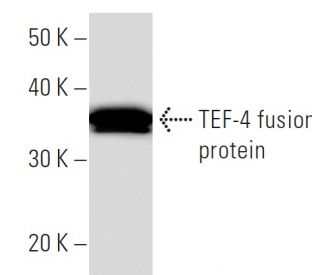
Dieser polyklonale Antikörper wird nicht mehr hergestellt. Wir empfehlen Ihnen unseren TEF-4 (404C5a) monoklonalen Antikörper (Beispielsdaten werden angezeigt).
TEF-4 Antikörper (H-50): sc-67115
4.2(6)
Produkt bewertenBitte stellen Sie eine Frage
TEF-4 Antikörper H-50 ist ein polyklonales IgG aus dem Kaninchen in einer Menge von 200 µg/ml
das Epitop entspricht der Aminosäuresequenz 181-230 lokalisiert innerhalb einer internen Region von TEF-4 aus der Spezies human
Hello,
Is this antibody ((sc-67115 X) available for ship to me, if I order it?
Thanks
Ram
Gefragt von: Ram Kumar
Thank you for your inquiry. sc-67115 X is discontinued, for more questions, please call us toll-free at (800) 457-3801 option 2, e-mail <scbt@scbt.com>, or use the live chat on our website.
Rated 5 von
5 von
Rohan aus
X form worked well in our ChIP assayX form worked well in our ChIP assay.
Veröffentlichungsdatum: 2015-10-23
Rated 5 von
5 von
AM aus
Single strong band at correct mw in IMRSingle strong band at correct mw in IMR-32 whole cell lysate. -SCBT QC
Veröffentlichungsdatum: 2015-05-13
Rated 3 von
5 von
SM aus
Worked well with transfected lysate by WBWorked well with transfected lysate by WB. -SCBT QC
Veröffentlichungsdatum: 2015-03-09
Rated 4 von
5 von
SF aus
This antibody was used in a publication forThis antibody was used in a publication for ICC and WB on murine skin squamous cell carcinoma cell lines - SCBT Publication Review
Veröffentlichungsdatum: 2015-01-07
Rated 4 von
5 von
SS aus
Publishable ChIP and WB data with mouse embryoPublishable ChIP and WB data with mouse embryo - SCBT Publication Review
Veröffentlichungsdatum: 2015-01-07
Rated 4 von
5 von
HC aus
ChIP publishable data with mouse embryonicChIP publishable data with mouse embryonic stem cell - SCBT Publication Review
