
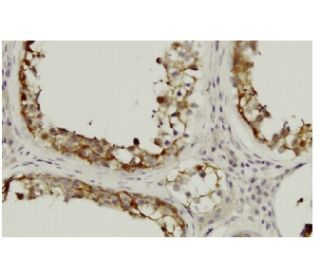


SDSL Antibody (73-K5): sc-100586
- SDSL Antibody (73-K5) is a mouse monoclonal mouse IgG2a κ κ provided at 100 µg/ml
- raised against recombinant SDSL of human origin
- recommended for detection of SDSL of human origin by WB, IP, IF, IHC(P) and ELISA
- At present, we have not yet completed the identification of the preferred secondary detection reagent(s) for SDSL Antibody (73-K5). This work is in progress.

QUICK LINKS
SEE ALSO...
SDSL Antibody (73-K5) is a mouse monoclonal IgG2a antibody that detects SDSL in human samples through various applications including western blotting (WB), immunoprecipitation (IP), immunofluorescence (IF), immunohistochemistry with paraffin-embedded sections (IHCP), and enzyme-linked immunosorbent assay (ELISA). SDSL, or Serine dehydratase-like, is a 329 amino acid protein that plays a crucial role in the metabolism of serine, functioning as a serine-specific dehydratase. SDSL utilizes pyridoxal phosphate as a cofactor, which is essential for enzymatic activity in converting L-serine into pyruvate and ammonia. Proper functioning of SDSL is vital for maintaining amino acid homeostasis and supporting various metabolic pathways, including those involved in protein metabolism. Dysregulation of SDSL activity can lead to metabolic disorders, highlighting the significance of studying SDSL in both health and disease contexts. Anti-SDSL antibody (73-K5) provides a reliable tool for researchers aiming to explore the biological functions and interactions of this important enzyme in human tissues.
Alexa Fluor® is a trademark of Molecular Probes Inc., OR., USA
LI-COR® and Odyssey® are registered trademarks of LI-COR Biosciences
SDSL Antibody (73-K5) References:
- SDSL-ESR-based protein structure characterization. | Strancar, J., et al. 2010. Eur Biophys J. 39: 499-511. PMID: 19669752
- Probing structural transitions in both structured and disordered proteins using site-directed spin-labeling EPR spectroscopy. | Longhi, S., et al. 2011. J Pept Sci. 17: 315-28. PMID: 21351321
- Mobility study of individual residue sites in the carbohydrate recognition domain of LSECtin using SDSL-EPR technique. | Wang, C., et al. 2012. Appl Biochem Biotechnol. 167: 2295-304. PMID: 22711492
- Peptide-Membrane Interactions by Spin-Labeling EPR. | Smirnova, TI. and Smirnov, AI. 2015. Methods Enzymol. 564: 219-58. PMID: 26477253
- Site-Directed Spin Labeling EPR for Studying Membrane Proteins. | Sahu, ID. and Lorigan, GA. 2018. Biomed Res Int. 2018: 3248289. PMID: 29607317
- Electron Paramagnetic Resonance as a Tool for Studying Membrane Proteins. | Sahu, ID. and Lorigan, GA. 2020. Biomolecules. 10: PMID: 32414134
- Effects of Fe2+/Fe3+ Binding to Human Frataxin and Its D122Y Variant, as Revealed by Site-Directed Spin Labeling (SDSL) EPR Complemented by Fluorescence and Circular Dichroism Spectroscopies. | Doni, D., et al. 2020. Int J Mol Sci. 21: PMID: 33348670
- Comprehensive analysis of mitochondrial dysfunction and necroptosis in intracranial aneurysms from the perspective of predictive, preventative, and personalized medicine. | Chen, B., et al. 2023. Apoptosis. 28: 1452-1468. PMID: 37410216
- Identification of cuproptosis-related genes and immune infiltration in dilated cardiomyopathy. | Lin, Y., et al. 2024. Int J Cardiol. 399: 131702. PMID: 38168558
- Machine learning and experimental validation of novel biomarkers for hypertrophic cardiomyopathy and cancers. | Dai, H., et al. 2024. J Cell Mol Med. 28: e70034. PMID: 39160643
Ordering Information
| Product Name | Catalog # | UNIT | Price | Qty | FAVORITES | |
SDSL Antibody (73-K5) | sc-100586 | 100 µg/ml | $339.00 |