
Date published: 2026-5-21

1-800-457-3801

SCBT Portrait Logo
Seach Input

SAK/STK18/PLK4 Antibody (19-Y7): sc-100413

4.7(3)
Write a reviewAsk a question

Datasheets
  • SAK/STK18/PLK4 Antibody (19-Y7) is a mouse monoclonal IgG1 κ SAK/STK18/PLK4 antibody, cited in 1 publications, provided at 100 µg/ml
  • raised against a partial recombinant protein mapping at the N-terminus of PLK4 of human origin
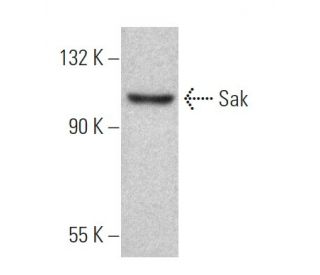
  • recommended for detection of PLK4 of human origin by WB, IP and ELISA
  • m-IgG1 BP-HRP is the preferred secondary detection reagent for SAK/STK18/PLK4 Antibody (19-Y7) for WB applications. This reagent is now offered in a bundle with SAK/STK18/PLK4 Antibody (19-Y7) (see ordering information below).
Gene Editing Promo Banner

QUICK LINKS

SEE ALSO...

PLK4 Antibody (19-Y7) is a mouse monoclonal IgG1 kappa light chain antibody that detects PLK4 protein of human origin by western blotting (WB), immunoprecipitation (IP), and enzyme-linked immunosorbent assay (ELISA). PLK4 (19-Y7) antibody is available as a non-conjugated format. PLK4, a member of the polo-like kinase family, plays a crucial role in cell cycle regulation, particularly during the transition from S phase to mitosis. A unique structure, characterized by a single polo box forming a dimer fold, enables PLK4 localization to key cellular structures such as nucleolus, centrosomes, and cleavage furrow. This localization ensures proper mitotic progression and accurate cell division. PLK4 expression gradually increases throughout the cell cycle with tightly regulated activity; dysregulation can lead to severe consequences, including increased apoptosis and anaphase arrest. Haploinsufficiency of PLK4 has been linked to spontaneous tumor development, particularly in the liver, highlighting PLK4′s importance in maintaining cellular integrity and preventing oncogenesis. PLK4′s ability to facilitate late mitotic progression and support embryonic development makes PLK4 critical for understanding cell proliferation and cancer biology.

For Research Use Only. Not Intended for Diagnostic or Therapeutic Use.

Alexa Fluor® is a trademark of Molecular Probes Inc., OR., USA

LI-COR® and Odyssey® are registered trademarks of LI-COR Biosciences

SAK/STK18/PLK4 Antibody (19-Y7) References:

  1. Late mitotic failure in mice lacking Sak, a polo-like kinase.  |  Hudson, JW., et al. 2001. Curr Biol. 11: 441-6. PMID: 11301255
  2. Polo-like kinase-2 is required for centriole duplication in mammalian cells.  |  Warnke, S., et al. 2004. Curr Biol. 14: 1200-7. PMID: 15242618
  3. Differential regulation of polo-like kinase 1, 2, 3, and 4 gene expression in mammalian cells and tissues.  |  Winkles, JA. and Alberts, GF. 2005. Oncogene. 24: 260-6. PMID: 15640841
  4. The Plk3-Cdc25 circuit.  |  Myer, DL., et al. 2005. Oncogene. 24: 299-305. PMID: 15640846
  5. Sak/Plk4 and mitotic fidelity.  |  Swallow, CJ., et al. 2005. Oncogene. 24: 306-12. PMID: 15640847
  6. SAK, a new polo-like kinase, is transcriptionally repressed by p53 and induces apoptosis upon RNAi silencing.  |  Li, J., et al. 2005. Neoplasia. 7: 312-23. PMID: 15967108
  7. Plk4 haploinsufficiency causes mitotic infidelity and carcinogenesis.  |  Ko, MA., et al. 2005. Nat Genet. 37: 883-8. PMID: 16025114
  8. The Polo kinase Plk4 functions in centriole duplication.  |  Habedanck, R., et al. 2005. Nat Cell Biol. 7: 1140-6. PMID: 16244668
  9. TRIM37 controls cancer-specific vulnerability to PLK4 inhibition.  |  Meitinger, F., et al. 2020. Nature. 585: 440-446. PMID: 32908304
  10. Sak, a murine protein-serine/threonine kinase that is related to the Drosophila polo kinase and involved in cell proliferation.  |  Fode, C., et al. 1994. Proc Natl Acad Sci U S A. 91: 6388-92. PMID: 8022793

Ordering Information

Product NameCatalog #UNITPriceQtyFAVORITES

SAK/STK18/PLK4 Antibody (19-Y7)

sc-100413
100 µg/ml
$339.00

SAK/STK18/PLK4 Antibody (19-Y7): m-IgG1 BP-HRP Bundle

sc-551564
100 µg Ab; 20 µg BP
$361.00

For Western Blot, is it recommended to use denatured or non-denatured conditions with Sak (19-Y7): sc-100413 antibody?

Asked by: TinTin
Thank you for your question. We recommend this antibody for use in denatured Western Blot conditions. It has not been validated for use in non-denatured conditions. Please contact our Technical Service Department for further details or inquiries.
Answered by: Technical Support
Date published: 2017-03-27
  • y_2026, m_5, d_21, h_10CST
  • bvseo_bulk, prod_bvqa, vn_bulk_3.0.46
  • cp_1, bvpage1
  • co_hasquestionsanswers, tq_1
  • loc_en_US, sid_100413, prod, sort_[SortEntry(order=LAST_APPROVED_ANSWER_SUBMISSION_TIME, direction=DESCENDING)]
  • clientName_scbt
  • bvseo_sdk, java_sdk, bvseo-4.0.0
  • CLOUD, getContent, 99ms
  • QUESTIONS, PRODUCT
Rated 5 out of 5 by from Good for Western BlotThis antibody has been used for western blotting in published research. -SCBT QC
Date published: 2023-09-14
Rated 5 out of 5 by from 不错按照说明书1:200,条带很清晰。。。。。。。。。。。。。。。。。。。。。。。。。。。。。。。。。。
Date published: 2017-09-01
  • y_2026, m_5, d_21, h_10
  • bvseo_bulk, prod_bvrr, vn_bulk_3.0.46
  • cp_1, bvpage1
  • co_hasreviews, tv_1, tr_2
  • loc_en_US, sid_100413, prod, sort_[SortEntry(order=SUBMISSION_TIME, direction=DESCENDING)]
  • clientName_scbt
  • bvseo_sdk, java_sdk, bvseo-4.0.0
  • CLOUD, getReviews, 8ms
  • REVIEWS, PRODUCT
SAK/STK18/PLK4 Antibody (19-Y7) is rated 4.7 out of 5 by 3.
  • y_2026, m_5, d_21, h_10
  • bvseo_bulk, prod_bvrr, vn_bulk_3.0.46
  • cp_1, bvpage1
  • co_hasreviews, tv_1, tr_2
  • loc_en_US, sid_100413, prod, sort_[SortEntry(order=SUBMISSION_TIME, direction=DESCENDING)]
  • clientName_scbt
  • bvseo_sdk, java_sdk, bvseo-4.0.0
  • CLOUD, getAggregateRating, 104ms
  • REVIEWS, PRODUCT
