
Perlecan Lentiviral Activation Particles (h): sc-400823-LAC
- Zielspezies: human
- 200 µl transduktionsfertige, hoch-titer CRISPR/dCas9 Lentivirale Aktivierungs-Partikel
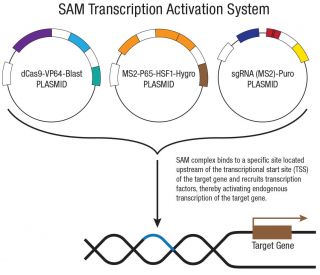
- Perlecan Lentiviral Activation Particles (h) sind ein SAM-Komplex (Mediator-Komplex zur synergistischen Gen-Aktivierung) gesteuertes System zur Transkriptionsaktivierung eines gewünschten Zielgens, um wirkungsvoll die spezifische Genexpression mittels lentiviraler Transduktion der Zellen zu erhöhen
- Perlecan Lentiviral Activation Particles (h) enthalten die folgenden SAM Aktivierungselemente: deaktivierte Cas9 (dCas9) Nuklease (D10A und N863A) fusioniert an die Transaktivierungs-Domäne VP64, ein MS2-p65-HSF1 Fusionsprotein und eine zielspezifische 20nt gRNA. Des Weiteren enthalten sind die Resistenzgene für blasticidin, hygromycin und puromycin
- Der entstehende SAM-Komplex (Mediator-Komplex zur synergistischen Gen-Aktivierung) bindet eine sequenzspezifische Region 200-250 nt upstream (in 5'-Richtung) des Transkriptionsstartsignals und rekrutiert dort ständig Transkriptionsfaktoren für eine verstärkte Gen-Aktivierung und Gen-Expression.
- Die von Perlecan Lentiviral Activation Plasmid (h) und Perlecan Lentiviral Activation Plasmid (h2) kodierten gRNAs zielen auf unterschiedliche regulatorische Regionen des HSPG2-Promotors ab. Eines oder beide Designs sind möglicherweise verfügbar
- Nach der Transfektion kann die Effizienz der Genaktivierung per Western Blot oder histologisch mit folgendem Antikörper überprüft werden: Perlecan Antibody (E-6): sc-377219

Bestellinformation
| Produkt | Katalog # | EINHEIT | Preis | ANZAHL | Favoriten | |
Perlecan Lentiviral Activation Particles (h) | sc-400823-LAC | 200 µl | $455.00 |
HSPG2 kodiert Perlecan, ein großes Heparansulfat-Proteoglykan der Basalmembranen und perizellulären Matrizen, das die Architektur der extrazellulären Matrix organisiert und die Zell‑Matrix‑Adhäsion reguliert. Durch die Bindung an Wachstumsfaktoren wie FGF2, VEGF und PDGF moduliert Perlecan Signalnetzwerke einschließlich FGF/FGFR-, VEGF- und integrinabhängiger Signalwege, die Proliferation, Migration und Angiogenese beeinflussen. Perlecan trägt außerdem zur Mechanotransduktion und zur Funktion von Filtrationsbarrieren in Geweben wie Knorpel, Gefäßen und den Nierenglomeruli bei. Eine veränderte HSPG2-Expression oder strukturelle Veränderungen von Perlecan stehen mit der Dysregulation der extrazellulären Matrix in Zusammenhang, wie sie bei Gefäßerkrankungen, Skelettdysplasien und beim Remodeling des Tumormikromilieus beobachtet wird, was HSPG2 zu einem relevanten Ziel für Studien der Matrixbiologie macht.
Perlecan Lentivirale Aktivierungspartikel (h) erfüllen diesen Bedarf, indem sie das vollständige Transkriptionsaktivierungssystem des Synergistic Activation Mediator (SAM) in transduktionsbereite, hoch-titrige lentivirale Partikel verpacken und so eine effiziente HSPG2-Hochregulation über ein breiteres Spektrum menschlicher Zelltypen ermöglichen.
Perlecan Lentivirale Aktivierungspartikel (h) liefern alle funktionellen Komponenten des Synergistic Activation Mediator (SAM)-Systems über lentivirale Transduktion. Das System umfasst drei Partikelpräparate, die gemeinsam in Zielzellen transduziert werden: eines, das für katalytisch inaktives dCas9 (Mutationen D10A und N863A) kodiert, das mit der VP64-Transaktivierungsdomäne und einem Blasticidin-Resistenzgen fusioniert ist; eines, das für das MS2-p65-HSF1-Fusionsprotein mit einem Hygromycin-Resistenzgen kodiert; und eines, das für eine zielspezifische 20-nt-sgRNA kodiert, die an zwei MS2-RNA-Aptamere mit einem Puromycin-Resistenzgen fusioniert ist. Nach der lentiviralen Transduktion und der genomischen Integration der Expressionskassetten werden die SAM-Komponenten stabil exprimiert und lagern sich am Zielort innerhalb der proximalen Promotorregion stromaufwärts der HSPG2-Transkriptionsstartstelle an, wo VP64, p65 und HSF1 kooperativ wirken, um endogene Transkriptionsmaschinerie zu rekrutieren und eine anhaltende Hochregulation der endogenen Perlecan-Expression zu bewirken. Die Verwendung von nuklease-inaktivem dCas9 verhindert die Einführung von Doppelstrangbrüchen in der DNA und bewahrt den nativen HSPG2-Genomlokus sowie die regulatorische Architektur.
Das lentivirale Format bietet mehrere praktische Vorteile: Die stabile genomische Integration unterstützt eine vererbbare Aktivierung über Zellteilungen hinweg; Partikelpräparate mit hohem Titer machen eine eigene Virusproduktion überflüssig; und die Kompatibilität mit primären, sich nicht teilenden und transfektionsresistenten Zelltypen erweitert die experimentellen Möglichkeiten. Eine erfolgreiche Transduktion kann durch eine dreifache Antibiotika-Selektion mit Puromycin, Hygromycin und Blasticidin bestätigt und verstärkt werden.
Nur für Forschungszwecke. Nicht für diagnostische oder therapeutische Zwecke bestimmt.