
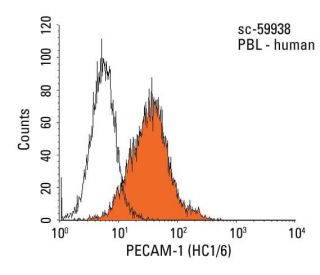


CD31/PECAM-1 Antikörper (HC1/6): sc-59938
- CD31/PECAM-1 Antikörper (HC1/6) ist ein Maus monoklonales IgG1 κ, verwendet in 1 wissenschaftlichen Veröffentlichungen, in einer Menge von 200 µg/ml
- gegen mit PMA behandelte Lymphomzellen mit Ursprung human
- Empfohlen für die Detektion von PECAM-1 aus der Spezies human per WB, IP, IF und FCM
- erhältlich als Konjugat entweder mit Phycoerythrin oder FITC für IF, IHC(P) und FCM
- Als Direktkonjugat zur Detektion von CD31/PECAM-1 wird CD31/PECAM-1 (H-3): sc-376764 angeboten; Primärantikörper konjugiert mit AC, HRP, FITC, PE, Alexa Fluor® 488, 594, 647, 680 und 790.
- 1 BP-HRP">m-IgG1 BP-HRP ist das bevorzugte sekundäre Nachweisreagenz für CD31/PECAM-1 Antikörper (HC1/6) für WB-Anwendungen. Dieses Reagenz wird jetzt in einem Paket mit CD31/PECAM-1 Antikörper (HC1/6) angeboten(siehe Bestellinformationen unten).

Direktverknüpfungen
Zelladhäsionsmoleküle sind eine Familie von eng miteinander verwandten Zelloberflächenglykoproteinen, die an Zell-Zell-Interaktionen während des Wachstums beteiligt sind und eine wichtige Rolle bei der Embryogenese und Entwicklung spielen sollen. Die Expression neuronaler Zelladhäsionsmoleküle (NCAM) wird in einer Vielzahl menschlicher Tumoren beobachtet, einschließlich Neuroblastomen, Rhabdomyosarkomen, Wilms-Tumoren, Ewing-Sarkomen und einiger primitiver myeloischer Malignome. Das intrazelluläre Adhäsionsmolekül-1 (ICAM-1), auch als CD54 bezeichnet, ist ein integrales Membranprotein der Immunoglobulinsuperfamilie und erkennt die β2/α1- und β2/αM-Integrine. PECAM-1 (Platelet/Endothelzell-Adhäsionsmolekül-1), auch als CD31 bezeichnet, ist ein Glykoprotein, das auf den Zelloberflächen von Monozyten, Neutrophilen, Thrombozyten und einer Untergruppe von T-Zellen exprimiert wird. VCAM-1 (Vascular Cell Adhesion Molecule-1) wurde zuerst als ein Adhäsionsmolekül identifiziert, das auf menschlichen Endothelzellen durch entzündungsfördernde Zytokine wie IL-1, Tumornekrosefaktor (TNF) und Lipopolysaccharid (LPS) induziert wird. Das KALIG-Gen codiert ein Nervenzelladhäsionsmolekül (NCAM)-ähnliches Protein und wird bei 66 % der Patienten mit Kallmanns Syndrom, Anosmie mit sekundärer Hypogonadismus, gelöscht.
Alexa Fluor® ist ein Markenzeichen von Molecular Probes Inc., OR., USA
LI-COR® und Odyssey® sind Markenzeichen von LI-COR Biosciences
CD31/PECAM-1 Antikörper (HC1/6) Literaturhinweise:
- PECAM-1 (CD31) fungiert als Reservoir für und Modulator von Tyrosin-phosphoryliertem Beta-Catenin. | Ilan, N., et al. 1999. J Cell Sci. 112 Pt 18: 3005-14. PMID: 10462517
- Beteiligung von humanem PECAM-1 an der Angiogenese und der In-vitro-Endothelzellmigration. | Cao, G., et al. 2002. Am J Physiol Cell Physiol. 282: C1181-90. PMID: 11940533
- Das Thrombozyten-Endothelzelladhäsionsmolekül 1 (PECAM-1/CD31) wirkt als Regulator der B-Zellentwicklung, der B-Zell-Antigenrezeptor (BCR)-vermittelten Aktivierung und von Autoimmunerkrankungen. | Wilkinson, R., et al. 2002. Blood. 100: 184-93. PMID: 12070026
- Expressionsmuster alternativ gespleißter PECAM-1-Isoformen in hämatopoetischen Zellen und Thrombozyten. | Wang, Y. and Sheibani, N. 2002. J Cell Biochem. 87: 424-38. PMID: 12397602
- Ein neuer endozytischer Signalweg, der durch die Anhäufung von endothelialem ICAM-1 oder PECAM-1 induziert wird. | Muro, S., et al. 2003. J Cell Sci. 116: 1599-609. PMID: 12640043
- Der inhibitorische Korezeptor PECAM-1 bietet einen schützenden Effekt bei der Unterdrückung von Kollagen-induzierter Arthritis. | Wong, MX., et al. 2005. J Clin Immunol. 25: 19-28. PMID: 15742154
- Eine neue Rolle für PECAM-1 bei der Megakaryozytose und der Wiederherstellung der Thrombozytenzahl bei thrombozytopenischen Mäusen. | Dhanjal, TS., et al. 2007. Blood. 109: 4237-44. PMID: 17234740
- Platelet endothelial cell adhesion molecule 1 (PECAM-1) und seine Wechselwirkungen mit Glykosaminoglykanen: 1. Studien zur molekularen Modellierung. | Gandhi, NS., et al. 2008. Biochemistry. 47: 4851-62. PMID: 18393439
- Ein Mangel an PECAM-1 in Knochenmarkmonozyten führt zu einer verstärkten Osteoklastogenese, was zu einem Verlust an Trabekelknochen führt. | Wu, Y., et al. 2009. J Immunol. 182: 2672-9. PMID: 19234161
- Monoklonale Antikörper gegen CD31 (PECAM-1) hemmen die tubuläre Regeneration nach Ischämie-Reperfusionsschäden bei Ratten. | Valentini, X., et al. 2011. Nephron Exp Nephrol. 118: e60-8. PMID: 21228600
- Das Fehlen des Thrombozyten-Endothelzell-Adhäsionsmoleküls 1, PECAM-1/CD31, in vivo erhöht die Resistenz gegen Salmonella enterica serovar Typhimurium bei Mäusen. | Lovelace, MD., et al. 2013. Infect Immun. 81: 1952-63. PMID: 23509149
- Expression des vaskulären endothelialen Wachstumsfaktors (VEGF) und des Thrombozyten-Endothelzelladhäsionsmoleküls (PECAM-1/CD31) bei intestinaler Tuberkulose. | More, S., et al. 2022. Tuberculosis (Edinb). 135: 102229. PMID: 35779496
Bestellinformation
| Produkt | Katalog # | EINHEIT | Preis | ANZAHL | Favoriten | |
CD31/PECAM-1 Antikörper (HC1/6) | sc-59938 | 200 µg/ml | $322.00 | |||
CD31/PECAM-1 (HC1/6): m-IgG1 BP-HRP Bundle | sc-542608 | 200 µg Ab; 20 µg BP | $361.00 | |||
CD31/PECAM-1 Antikörper (HC1/6) FITC | sc-59938 FITC | 200 µg/ml | $336.00 | |||
CD31/PECAM-1 Antikörper (HC1/6) PE | sc-59938 PE | 200 µg/ml | $349.00 |