
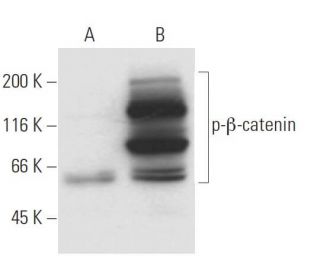

p-beta-catenin Antibody (1B11): sc-57533
- p-beta-catenin Antibody (1B11) is a mouse monoclonal IgG1, cited in 17 publications, provided at 50 µg/0.5 ml
- raised against a synthetic phosphopeptide of β-catenin of human origin
- recommended for detection of Tyr 654 phosphorylated β-catenin of mouse, rat, human and canine origin by WB and IP
- m-IgG Fc BP-HRP, m-IgG1 BP-HRP and m-IgGκ BP-HRP are the preferred secondary detection reagents for p-beta-catenin Antibody (1B11) for WB applications. These reagents are now offered in bundles with p-beta-catenin Antibody (1B11) (see ordering information below).

QUICK LINKS
SEE ALSO...
p-β-catenin Antibody (1B11) is a mouse monoclonal IgG1 kappa light chain antibody that detects phosphorylated β-catenin specifically at Tyr 654 in mouse, rat, human, and canine samples through western blotting (WB) and immunoprecipitation (IP). anti-p-β-catenin antibody (1B11) is available in a non-conjugated form, allowing for versatile applications in various experimental setups. Phosphorylated β-catenin plays a crucial role in regulating cellular adhesion and signaling pathways, particularly in Wnt signaling, which is vital for cell proliferation and differentiation. Phosphorylated β-catenin is primarily located in cytoplasm and nucleus, where this protein influences gene expression and cellular behavior. Interaction with E-cadherin is essential for maintaining epithelial integrity, and any dysregulation can lead to increased cellular motility and invasiveness, contributing to cancer progression. Notably, phosphorylation of β-catenin at specific residues, such as Tyr 654, can modulate stability and localization, impacting function in tumorigenesis. Additionally, β-catenin′s interaction with tumor suppressor protein APC is critical for degradation; however, when this interaction is disrupted, as seen in certain cancers, β-catenin accumulates and translocates to nucleus, promoting oncogenic transcription. Understanding dynamics of phosphorylated β-catenin and regulatory mechanisms is essential for elucidating role in cancer biology and developing targeted therapies.
Alexa Fluor® is a trademark of Molecular Probes Inc., OR., USA
LI-COR® and Odyssey® are registered trademarks of LI-COR Biosciences
p-beta-catenin Antibody (1B11) References:
- The F-box protein beta-TrCP associates with phosphorylated beta-catenin and regulates its activity in the cell. | Hart, M., et al. 1999. Curr Biol. 9: 207-10. PMID: 10074433
- Reduction of beta-catenin/T-cell transcription factor signaling by aspirin and indomethacin is caused by an increased stabilization of phosphorylated beta-catenin. | Dihlmann, S., et al. 2003. Mol Cancer Ther. 2: 509-16. PMID: 12813129
- Activation of c-Met in colorectal carcinoma cells leads to constitutive association of tyrosine-phosphorylated beta-catenin. | Herynk, MH., et al. 2003. Clin Exp Metastasis. 20: 291-300. PMID: 12856716
- Clinical significance of nuclear non-phosphorylated beta-catenin in acute myeloid leukaemia and myelodysplastic syndrome. | Xu, J., et al. 2008. Br J Haematol. 140: 394-401. PMID: 18217891
- APC is essential for targeting phosphorylated beta-catenin to the SCFbeta-TrCP ubiquitin ligase. | Su, Y., et al. 2008. Mol Cell. 32: 652-61. PMID: 19061640
- Accumulation of phosphorylated beta-catenin enhances ROS-induced cell death in presenilin-deficient cells. | Boo, JH., et al. 2009. PLoS One. 4: e4172. PMID: 19137062
- Phosphorylated β-catenin localizes to centrosomes of neuronal progenitors and is required for cell polarity and neurogenesis in developing midbrain. | Chilov, D., et al. 2011. Dev Biol. 357: 259-68. PMID: 21736876
- Lhcgr expression in granulosa cells: roles for PKA-phosphorylated β-catenin, TCF3, and FOXO1. | Law, NC., et al. 2013. Mol Endocrinol. 27: 1295-310. PMID: 23754802
- Wnt signalling induces accumulation of phosphorylated β-catenin in two distinct cytosolic complexes. | Gerlach, JP., et al. 2014. Open Biol. 4: 140120. PMID: 25392450
- Shikonin Inhibits the Migration and Invasion of Human Glioblastoma Cells by Targeting Phosphorylated β-Catenin and Phosphorylated PI3K/Akt: A Potential Mechanism for the Anti-Glioma Efficacy of a Traditional Chinese Herbal Medicine. | Zhang, FY., et al. 2015. Int J Mol Sci. 16: 23823-48. PMID: 26473829
Ordering Information
| Product Name | Catalog # | UNIT | Price | Qty | FAVORITES | |
p-beta-catenin Antibody (1B11) | sc-57533 | 50 µg/0.5 ml | $322.00 | |||
p-beta-catenin Antibody (1B11): m-IgG Fc BP-HRP Bundle | sc-537140 | 50 µg Ab; 10 µg BP | $361.00 | |||
p-beta-catenin Antibody (1B11): m-IgGκ BP-HRP Bundle | sc-534333 | 50 µg Ab; 40 µg BP | $361.00 | |||
p-beta-catenin Antibody (1B11): m-IgG1 BP-HRP Bundle | sc-545030 | 50 µg Ab; 20 µg BP | $361.00 |