
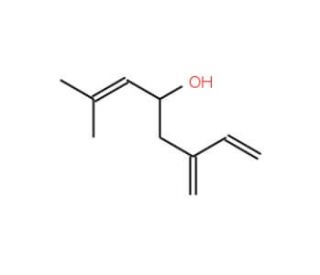

Molekülstruktur von Ipsdienol, CAS-Nummer: 14434-41-4
Ipsdienol (CAS 14434-41-4)
Alternative Namen:
Ipsdienol is also known as 2-Methyl-6-methyleneocta-2,7-dien-4-ol.
Anwendungen:
Ipsdienol ist ein Insektenpheromon, das den Südlichen Kiefernholzbohrer und die damit verbundenen Borkenkäfer anlocken kann.
CAS Nummer:
14434-41-4
Reinheit:
≥90%
Molekulargewicht:
152.236
Summenformel:
C10H16O
Ausschließlich für Forschungszwecke. Nicht Geeignet für Verwendung in Diagnostik oder Therapie.
* Schauen Sie auf das Analysezertifikat (CoA), um die genauen Daten (inkl. Wassergehalt) Ihrer Produktionscharge (Lot) zu sehen.
Direktverknüpfungen
Bestellinformation
Beschreibung
Hintergrundinformationen
Sicherheitshinweis
SDS (SDB) & Analysenzertifikate
Ipsdienol ist ein Insektenpheromon. Beide Enantiomere von Ipsdienol können durch die chirale Auflösung seines racemischen Vorstufe in hoher Reinheit und in präparativer Größenordnung hergestellt werden. Es wurde festgestellt, dass südliche Kiefernäscher und zugehörige Rindenkäfer von Ipsdienol in den Südosten der Vereinigten Staaten angezogen wurden. Ipsdienol wurde auch gezeigt, um Monochamus titillator und zugehörige große Kiefernholzbohrer anzuziehen, wiederum im Südosten der Vereinigten Staaten. Eine Pheromonkombination aus Ipsdienol, Ianierone und Ipsenol kann eine kostengünstige allgemeine Lockstoff für I. avulsus, I. grandicollis und I. pini sein.
Ipsdienol (CAS 14434-41-4) Literaturhinweise
- De novo-Biosynthese der Aggregationspheromone ipsenol und ipsdienol durch die Kiefernborkenkäfer Ips paraconfusus Lanier und Ips pini (Say) (Coleoptera: Scolytidae). | Seybold, SJ., et al. 1995. Proc Natl Acad Sci U S A. 92: 8393-7. PMID: 11607576
- Biochemie und Molekularbiologie der de novo Isoprenoid-Pheromonproduktion bei den Scolytidae. | Seybold, SJ. and Tittiger, C. 2003. Annu Rev Entomol. 48: 425-53. PMID: 12460936
- Ipsenol und Ipsdienol locken Monochamus titillator (Coleoptera: Cerambycidae) und damit verbundene große Kiefernholzbohrer im Südosten der Vereinigten Staaten an. | Miller, DR. and Asaro, C. 2005. J Econ Entomol. 98: 2033-40. PMID: 16539130
- Funktionelle Expression eines Borkenkäfer-Cytochroms P450, das Myrcen zu Ipsdienol hydroxyliert. | Sandstrom, P., et al. 2006. Insect Biochem Mol Biol. 36: 835-45. PMID: 17046597
- Myrcen-Hydroxylasen bestimmen nicht die enantiomere Zusammensetzung von pheromonalem Ipsdienol in Ips spp. | Sandstrom, P., et al. 2008. J Chem Ecol. 34: 1584-92. PMID: 19034575
- Pheromonproduktion bei Borkenkäfern. | Blomquist, GJ., et al. 2010. Insect Biochem Mol Biol. 40: 699-712. PMID: 20727970
- Die Rolle von ipsdienol, ipsenol und cis-verbenol in der chemischen Ökologie von Ips avulsus, Ips calligraphus und Ips grandicollis (Coleoptera: Curculionidae: Scolytinae). | Allison, JD., et al. 2012. J Econ Entomol. 105: 923-9. PMID: 22812131
- Enantiomere Zusammensetzung von Ipsdienol: Ein chemotaxonomisches Merkmal für nordamerikanische Populationen vonIps spp. aus der Untergattungsgruppe der Pini (Coleoptera: Scolytidae). | Seybold, SJ., et al. 1995. J Chem Ecol. 21: 995-1016. PMID: 24234415
- Reaktion von Dendroctonus brevicomis Le Conte (Coleoptera: Scolytidae) auf unterschiedliche Freisetzungsraten und -verhältnisse von Aggregationssemiochemikalien und die Hemmstoffe Verbenon und Ipsdienol. | Bertram, SL. and Paine, TD. 1994. J Chem Ecol. 20: 2931-41. PMID: 24241925
- Inter- und Intrapopulationsvariation des Pheromons ipsdienol, das von männlichen Kiefernstechern, Ips pini (Say) (Coleoptera: Scolytidae), produziert wird. | Miller, DR., et al. 1989. J Chem Ecol. 15: 233-47. PMID: 24271438
- Geschlechtsspezifische Produktion von Ipsdienol und Myrcenol durch Dendroctonus ponderosae (Coleoptera: Scolytidae), die Myrcendämpfen ausgesetzt sind. | Hunt, DW., et al. 1986. J Chem Ecol. 12: 1579-86. PMID: 24305835
- Ipsenol, Ipsdienol, Ethanol und α-Pinen: Fallenködermischung für Cerambycidae und Buprestidae (Coleoptera) in Kiefernwäldern des östlichen Nordamerikas. | Miller, DR., et al. 2015. J Econ Entomol. 108: 1837-51. PMID: 26470326
- Cytochrome P450: Entgiftung von Terpenen und Pheromonproduktion bei Borkenkäfern. | Blomquist, GJ., et al. 2021. Curr Opin Insect Sci. 43: 97-102. PMID: 33359166
Bestellinformation
| Produkt | Katalog # | EINHEIT | Preis | ANZAHL | Favoriten | |
Ipsdienol, 1 g | sc-295190 | 1 g | $474.00 |