
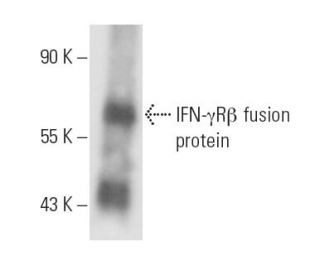

IFN-γRβ Antikörper (2 HUB 159): sc-53589
- IFN-γRβ Antikörper (2 HUB 159) ist ein monoklonaler IgG vom Armenischen Hamster, der unter 200 µg/ml bereitgestellt wird
- gegen die extrazelluläre Domäne von IFN-γRβ mit Ursprung human
- Empfohlen für die Detektion von IFN-γRβ aus der Spezies human per WB, IP und FCM
- erhältlich als Konjugat entweder mit Phycoerythrin oder FITC für IF, IHC(P) und FCM
- Aktuell testen wir noch unsere Sekundärantikörper um das beste Bindeprotein für diesen Primärantikörper IFN-γRβ (2 HUB 159) zu finden. Kontaktieren Sie uns bitte, wenn Sie Fragen hierzu haben sollten.

Direktverknüpfungen
Siehe auch...
Der IFN-γRβ-Antikörper (2 HUB 159) ist ein monoklonaler IgG-Antikörper vom Hamster, der IFN-γRβ in menschlichen Proben durch Anwendungen wie Western Blot (WB), Immunopräzipitation (IP) und Durchflusszytometrie (FCM) nachweist. IFN-γRβ, auch bekannt als die signalübertragende Komponente des Interferon-Gamma-Rezeptors, spielt eine entscheidende Rolle bei der Vermittlung der biologischen Wirkungen von Interferon-Gamma, einschließlich antiviraler, antiproliferativer und immunmodulatorischer Reaktionen. IFN-γRβ befindet sich hauptsächlich auf der Zelloberfläche, wo IFN-γRβ zusammen mit IFN-γRα einen funktionalen Rezeptorkomplex bildet. Beide Ketten sind für die Rezeptorsignaltransduktion unerlässlich und führen zur Aktivierung nachgeschalteter Signalwege, die die Genexpression als Reaktion auf IFN-γ regulieren. Die Interaktion von IFN-γRβ mit Januskinasen (JAK1 und JAK2) nach der Ligandenbindung löst Phosphorylierungsereignisse aus, die zur Kerntranslokation der Transkriptionsfaktoren Stat1α und Stat1β führen. Das Verständnis der Lokalisierung und Funktion von IFN-γRβ ist von entscheidender Bedeutung, da IFN-γRβ die Rolle des Rezeptors bei Immunantworten und mögliche Auswirkungen auf verschiedene Krankheiten, einschließlich Autoimmunerkrankungen und Infektionen, untermauert.
Alexa Fluor® ist ein Markenzeichen von Molecular Probes Inc., OR., USA
LI-COR® und Odyssey® sind Markenzeichen von LI-COR Biosciences
IFN-γRβ Antikörper (2 HUB 159) Literaturhinweise:
- Unterschiedliche Kernlokalisierung der Untereinheiten IFNGR-1 und IFNGR-2 des IFN-Gamma-Rezeptorkomplexes nach Aktivierung durch IFN-Gamma. | Larkin, J., et al. 2000. J Interferon Cytokine Res. 20: 565-76. PMID: 10888113
- Die Expression von Interferon-Gamma-Rezeptor 2 als entscheidender Faktor für die Proliferation oder den Tod menschlicher T-, B- und myeloischer Zellen. | Bernabei, P., et al. 2001. J Leukoc Biol. 70: 950-60. PMID: 11739558
- Einfluss einer Mutation im IFN-γ Rezeptor 2 (IFNGR2) in menschlichen Zellen auf die Bildung von Th17-Zellen in T-Gedächtniszellen. | Holzer, U., et al. 2013. Hum Immunol. 74: 693-700. PMID: 23459074
- Genetischer IFNGR2-Polymorphismus in Verbindung mit geschlechtsspezifischem Risiko für paranoide Schizophrenie. | Jemli, A., et al. 2017. Nord J Psychiatry. 71: 42-47. PMID: 27563937
- Die Kristallstruktur des menschlichen Interferon-&-Gamma-Rezeptors 2 offenbart die strukturelle Grundlage der Rezeptorspezifität. | Mikulecký, P., et al. 2016. Acta Crystallogr D Struct Biol. 72: 1017-25. PMID: 27599734
- 1-Methyl-L-Tryptophan fördert die Apoptose von hepatischen Stellatazellen, die durch Interferon-γ arretiert wurden, indem es die Expression von IFN-γRβ, IRF-1 und FAS erhöht. | Oh, JE., et al. 2017. Int J Mol Med. 40: 576-582. PMID: 28656203
- Identifizierung von RUNX1 und IFNGR2 als prognostisch relevante Biomarker, die mit der Immuninfiltration und der Subtypendifferenzierung von niedriggradigen Gliomen korrelieren. | Zhang, X., et al. 2023. Biomol Biomed. 23: 405-425. PMID: 36321611
- Auswirkungen der kodierenden Risikovariante IFNGR2 auf den B-Zell-intrinsischen IFN-γ Signalweg bei Multipler Sklerose. | Bogers, L., et al. 2024. J Autoimmun. 148: 103279. PMID: 38972102
- T-Zell-Klone des Sézary-Syndroms weisen T-Helfer-2-Zytokine auf und exprimieren den akzessorischen Faktor-1 (Interferon-Gamma-Rezeptor-Beta-Kette). | Dummer, R., et al. 1996. Blood. 88: 1383-9. PMID: 8695857
- Sézary-Syndrom, T-Helfer-2-Zytokine und akzessorischer Faktor-1 (AF-1). | Dummer, R., et al. 1998. Leuk Lymphoma. 28: 515-22. PMID: 9613981
Bestellinformation
| Produkt | Katalog # | EINHEIT | Preis | ANZAHL | Favoriten | |
IFN-γRβ Antikörper (2 HUB 159) | sc-53589 | 200 µg/ml | $322.00 | |||
IFN-γRβ Antikörper (2HUB-159) FITC | sc-53589 FITC | 200 µg/ml | $336.00 | |||
IFN-γRβ Antikörper (2HUB-159) PE | sc-53589 PE | 200 µg/ml | $349.00 |