
Date published: 2026-5-25

1-800-457-3801

SCBT Portrait Logo
Seach Input

GPD1 Antibody (E-7): sc-376219

3.5(4)
Write a reviewAsk a question

Datasheets
  • GPD1 Antibody (E-7) is a mouse monoclonal IgG1 κ GPD1 antibody, cited in 10 publications, provided at 200 µg/ml
  • specific for an epitope mapping between amino acids 321-347 at the C-terminus of GPD1 of human origin
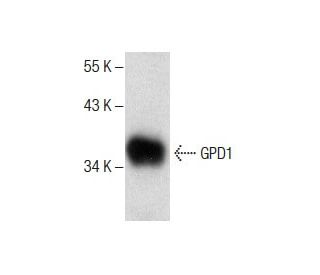
  • GPD1 Antibody (E-7) is recommended for detection of GPD1 of mouse, rat and human origin by WB, IP, IF, IHC(P) and ELISA
  • Anti-GPD1 Antibody (E-7) is available conjugated to agarose for IP; HRP for WB, IHC(P) and ELISA; and to either phycoerythrin or FITC for IF, IHC(P) and FCM
  • also available conjugated to Alexa Fluor® 488, Alexa Fluor® 546, Alexa Fluor® 594 or Alexa Fluor® 647 for WB (RGB), IF, IHC(P) and FCM, and for use with RGB fluorescent imaging systems, such as iBright™ FL1000, FluorChem™, Typhoon, Azure and other comparable systems
  • also available conjugated to Alexa Fluor® 680 or Alexa Fluor® 790 for WB (NIR), IF and FCM; for use with Near-Infrared (NIR) detection systems, such as LI-COR®Odyssey®, iBright™ FL1000, FluorChem™, Typhoon, Azure and other comparable systems
  • At present, we have not yet completed the identification of the preferred secondary detection reagent(s) for GPD1 Antibody (E-7). This work is in progress.
Gene Editing Promo Banner

QUICK LINKS

SEE ALSO...

GPD1 Antibody (E-7) is a mouse monoclonal IgG1 kappa light chain antibody that detects GPD1 protein of mouse, rat, and human origin by western blotting (WB), immunoprecipitation (IP), immunofluorescence (IF), immunohistochemistry with paraffin-embedded sections (IHCP), and enzyme-linked immunosorbent assay (ELISA). GPD1 (E-7) antibody is available in both non-conjugated and various conjugated forms, including agarose, horseradish peroxidase (HRP), phycoerythrin (PE), fluorescein isothiocyanate (FITC), and multiple Alexa Fluor® conjugates. Glycerol-3-phosphate dehydrogenase 1 (GPD1) plays a crucial role in cellular metabolism by catalyzing the conversion of sn-glycerol 3-phosphate and NAD+ into glycerone phosphate and NADH, which is essential for energy production and lipid metabolism. This 349 amino acid cytoplasmic protein is particularly important in cardiac tissue, where GPD1 influences the function of voltage-gated sodium channels that are vital for the depolarization phase of the cardiac action potential, thereby affecting the conduction of electrical signals through the heart. GPD1 exists as a homodimer and is inhibited by zinc ions and sulfate, with potential functional similarities to GPD1L (glycerol-3-phosphate dehydrogenase-1 like), a protein implicated in the trafficking of cardiac sodium currents to the cell surface. Mutations in the GPD1L gene have been associated with sudden infant death syndrome (SIDS), highlighting the importance of GPD1 in both metabolic processes and cardiac health.

For Research Use Only. Not Intended for Diagnostic or Therapeutic Use.

Alexa Fluor® is a trademark of Molecular Probes Inc., OR., USA

LI-COR® and Odyssey® are registered trademarks of LI-COR Biosciences

GPD1 Antibody (E-7) References:

  1. Phospholipase C interacts with Sgd1p and is required for expression of GPD1 and osmoresistance in Saccharomyces cerevisiae.  |  Lin, H., et al. 2002. Mol Genet Genomics. 267: 313-20. PMID: 12073033
  2. Crystal structures of human glycerol 3-phosphate dehydrogenase 1 (GPD1).  |  Ou, X., et al. 2006. J Mol Biol. 357: 858-69. PMID: 16460752
  3. GRB14, GPD1, and GDF8 as potential network collaborators in weight loss-induced improvements in insulin action in human skeletal muscle.  |  Park, JJ., et al. 2006. Physiol Genomics. 27: 114-21. PMID: 16849634
  4. Molecular and functional characterization of novel glycerol-3-phosphate dehydrogenase 1 like gene (GPD1-L) mutations in sudden infant death syndrome.  |  Van Norstrand, DW., et al. 2007. Circulation. 116: 2253-9. PMID: 17967976
  5. Mutation analysis of the glycerol-3 phosphate dehydrogenase-1 like (GPD1L) gene in Japanese patients with Brugada syndrome.  |  Makiyama, T., et al. 2008. Circ J. 72: 1705-6. PMID: 18762705
  6. Sequence conservation and structural organization of the glycerol-3-phosphate dehydrogenase promoter in mice and humans.  |  Gwynn, B., et al. 1990. Mol Cell Biol. 10: 5244-56. PMID: 2398890
  7. GPD1, which encodes glycerol-3-phosphate dehydrogenase, is essential for growth under osmotic stress in Saccharomyces cerevisiae, and its expression is regulated by the high-osmolarity glycerol response pathway.  |  Albertyn, J., et al. 1994. Mol Cell Biol. 14: 4135-44. PMID: 8196651

Ordering Information

Product NameCatalog #UNITPriceQtyFAVORITES

GPD1 Antibody (E-7)

sc-376219
200 µg/ml
$322.00

GPD1 Antibody (E-7) AC

sc-376219 AC
500 µg/ml, 25% agarose
$424.00

GPD1 Antibody (E-7) HRP

sc-376219 HRP
200 µg/ml
$322.00

GPD1 Antibody (E-7) FITC

sc-376219 FITC
200 µg/ml
$336.00

GPD1 Antibody (E-7) PE

sc-376219 PE
200 µg/ml
$349.00

GPD1 Antibody (E-7) Alexa Fluor® 488

sc-376219 AF488
200 µg/ml
$364.00

GPD1 Antibody (E-7) Alexa Fluor® 546

sc-376219 AF546
200 µg/ml
$364.00

GPD1 Antibody (E-7) Alexa Fluor® 594

sc-376219 AF594
200 µg/ml
$364.00

GPD1 Antibody (E-7) Alexa Fluor® 647

sc-376219 AF647
200 µg/ml
$364.00

GPD1 Antibody (E-7) Alexa Fluor® 680

sc-376219 AF680
200 µg/ml
$364.00

GPD1 Antibody (E-7) Alexa Fluor® 790

sc-376219 AF790
200 µg/ml
$364.00

GPD1 (E-7) Neutralizing Peptide

sc-376219 P
100 µg/0.5 ml
$69.00

Can this antibody detect saccharomyces cerevisiae GPD1 also?

Asked by: GPD1
Thank you for your question. We have not validated the GPD1 antibody for saccharomyces cerevisiae.
Answered by: BlakeJ
Date published: 2025-02-12

What application is the blocking peptide sc-376219 P appropriate for?

Asked by: jenniferc
Thank you for your question. The blocking peptide is intended for use as a negative control, by pre-adsorbing the mouse monoclonal antibody against the antigen. For full protocol details, please contact our Technical Services Department or view our online protocol here: https://www.scbt.com/scbt/resources/protocols/peptide-neutralization
Answered by: Technical Support
Date published: 2017-02-24
  • y_2026, m_5, d_24, h_14CST
  • bvseo_bulk, prod_bvqa, vn_bulk_3.0.46
  • cp_1, bvpage1
  • co_hasquestionsanswers, tq_2
  • loc_en_US, sid_376219, prod, sort_[SortEntry(order=LAST_APPROVED_ANSWER_SUBMISSION_TIME, direction=DESCENDING)]
  • clientName_scbt
  • bvseo_sdk, java_sdk, bvseo-4.0.0
  • CLOUD, getContent, 105ms
  • QUESTIONS, PRODUCT
Rated 1 out of 5 by from zu viele unspezifische BandenProteinbande von GPD1 wahrscheinlich sichtbar, aber im höheren Molekulargewichtsbereich zu viele unspezifische Banden
Date published: 2022-02-08
Rated 4 out of 5 by from Worked well with transfected lysate by WBWorked well with transfected lysate by WB. -SCBT QC
Date published: 2015-04-06
Rated 4 out of 5 by from Good band seen in WB using human thymus tissueGood band seen in WB using human thymus tissue extract. -SCBT QC
Date published: 2015-03-14
Rated 5 out of 5 by from Superb immunoperoxidase cytoplasmic and nuclearSuperb immunoperoxidase cytoplasmic and nuclear staining in formalin fixed, paraffin-embedded human kidney tissue. -SCBT QC
Date published: 2015-03-10
  • y_2026, m_5, d_24, h_14
  • bvseo_bulk, prod_bvrr, vn_bulk_3.0.46
  • cp_1, bvpage1
  • co_hasreviews, tv_0, tr_4
  • loc_en_US, sid_376219, prod, sort_[SortEntry(order=SUBMISSION_TIME, direction=DESCENDING)]
  • clientName_scbt
  • bvseo_sdk, java_sdk, bvseo-4.0.0
  • CLOUD, getReviews, 9ms
  • REVIEWS, PRODUCT
GPD1 Antibody (E-7) is rated 3.5 out of 5 by 4.
  • y_2026, m_5, d_24, h_14
  • bvseo_bulk, prod_bvrr, vn_bulk_3.0.46
  • cp_1, bvpage1
  • co_hasreviews, tv_0, tr_4
  • loc_en_US, sid_376219, prod, sort_[SortEntry(order=SUBMISSION_TIME, direction=DESCENDING)]
  • clientName_scbt
  • bvseo_sdk, java_sdk, bvseo-4.0.0
  • CLOUD, getAggregateRating, 115ms
  • REVIEWS, PRODUCT
