
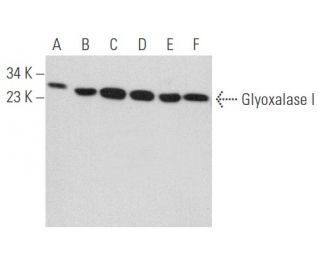
Glyoxalase I Antikörper (6F10): sc-101537
- Glyoxalase I Antikörper 6F10 ist ein monoklonales IgG2b aus der Ratte, verwendet in 5 wissenschaftlichen Veröffentlichungen, in einer Menge von 200 µg/ml
- gegen Glyoxalase I voller Länge mouse
- Empfohlen für die Detektion von Glyoxalase I aus der Spezies mouse, rat, human und monkey per WB, IP, IF und ELISA
- Aktuell testen wir noch unsere Sekundärantikörper um das beste Bindeprotein für diesen Primärantikörper Glyoxalase I (6F10) zu finden. Kontaktieren Sie uns bitte, wenn Sie Fragen hierzu haben sollten.

Direktverknüpfungen
Die Glyoxal-Pfadwege spielen eine Rolle bei der Entgiftung von Glucose-Degradationsprodukten (GDP). Glyoxalase I (GLO1), ein Mitglied der Glyoxalase-Familie, ist wirksam bei der Beseitigung von GDP. Die Überexpression oder Unterdrückung von Glyoxalase I im Gehirn von Mäusen deutet auf eine Assoziation zwischen Glyoxalase I und Angst hin. Glyoxalase I hat drei Isoformen, die aus zwei Allelen im Genom gebildet werden, die zwei Homodimere und ein Heterodimer bilden, wobei jede Untereinheit ein Zinkion bindet. Forschungen zeigen, dass die GLO1-Genexpression in Kolonkarzinomen induziert wird. Sowohl ein Insulin-Response-Element (IRE) als auch ein Zinkmetall-Response-Element (MRE) im Promotorbereich des GLO1-Gens wurden identifiziert.
Alexa Fluor® ist ein Markenzeichen von Molecular Probes Inc., OR., USA
LI-COR® und Odyssey® sind Markenzeichen von LI-COR Biosciences
Glyoxalase I Antikörper (6F10) Literaturhinweise:
- Glyoxalase-I-Inhibitoren in der Krebschemotherapie. | Creighton, DJ., et al. 2003. Biochem Soc Trans. 31: 1378-82. PMID: 14641067
- Methylglyoxal und Glyoxalase I bei Atherosklerose. | Hanssen, NM., et al. 2014. Biochem Soc Trans. 42: 443-9. PMID: 24646258
- Glyoxalase I (Glo1) und ihre Metaboliten bei Gefäßerkrankungen. | Wortmann, M., et al. 2014. Biochem Soc Trans. 42: 528-33. PMID: 24646273
- Jüngste Fortschritte bei der Glyoxalase-I-Hemmung. | Al-Balas, QA., et al. 2019. Mini Rev Med Chem. 19: 281-291. PMID: 30306863
- Glyoxalase I-4 ist der NAC72 nachgeschaltet, um die Resistenz gegen Falschen Mehltau bei der Weinrebe zu beeinflussen. | Li, T., et al. 2021. Plant J. 108: 394-410. PMID: 34318550
- Entwurf, Synthese und biologische Bewertung von 1,4-Benzenesulfonamid-Derivaten als Glyoxalase I-Inhibitoren. | Audat, SA., et al. 2022. Drug Des Devel Ther. 16: 873-885. PMID: 35378924
- Die Aktivität der Glyoxalase I beeinflusst die Empfindlichkeit von Arabidopsis gegenüber Ammoniumnahrung. | Borysiuk, K., et al. 2022. Plant Cell Rep. 41: 2393-2413. PMID: 36242617
- Triphenylbismutdichlorid hemmt menschliche Glyoxalase I und induziert Zytotoxizität in kultivierten Krebszelllinien. | Takasawa, R., et al. 2022. J Toxicol Sci. 47: 539-546. PMID: 36450498
- Die Rolle von Glyoxalase I und II in somatischen und spermatogenen Hodenzellen während der postnatalen Entwicklung der Hauskatze. | Braun, BC. and Müller, K. 2023. Theriogenology. 197: 10-15. PMID: 36462331
- Glyoxalase I ist ein neuartiges Ziel für die Prävention von Stoffwechselentgleisungen. | Miranda, ER. and Haus, JM. 2023. Pharmacol Ther. 250: 108524. PMID: 37722607
Bestellinformation
| Produkt | Katalog # | EINHEIT | Preis | ANZAHL | Favoriten | |
Glyoxalase I Antikörper (6F10) | sc-101537 | 200 µg/ml | $322.00 |