
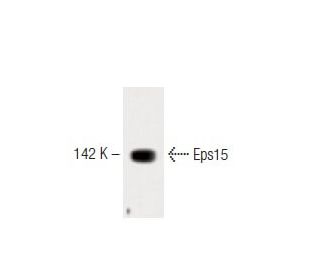

Eps15 Antikörper (17): sc-135898
- Eps15 Antikörper 17 ist ein monoklonales IgG2a aus der Maus in einer Menge von 50 µg/0.5 ml
- gezogen gegen die Aminosäuresequenz 694-888 von Eps15 aus der Spezies human
- Empfohlen für die Detektion von Eps15 aus der Spezies mouse, rat und human per WB, IP und IF; nicht empfohlen für IP
- Aktuell testen wir noch unsere Sekundärantikörper um das beste Bindeprotein für diesen Primärantikörper Eps15 (17) zu finden. Kontaktieren Sie uns bitte, wenn Sie Fragen hierzu haben sollten.

Direktverknüpfungen
Die Elucidation des Mechanismus, durch den Rezeptor-Tyrosinkinasen (RTKs) die zelluläre Physiologie im Antwort auf Stimuli modulieren, ist kritisch für das Verständnis der Wachstumsregulierung. Fehlleitungen in RTK-Signalwegen können zu zellulärer Transformation und letztendlich zu Krebs führen. Zwei neue EGF-Rezeptor-Substrate, bezeichnet als EGF-Rezeptor-Weg-Substrate 8 und 15, oder Eps8 und Eps15, wurden beschrieben. Eps8 und Eps15 werden tyrosinphosphoryliert nach EGF-Stimulation. Die Überexpression von Eps15 in NIH/3T3-Zellen führt zu zellulärer Transformation, was auf eine Beteiligung an der Regulierung der Zellproliferation hinweist. Eps15 ist in der Lage, die amino-terminale Portion von Crk über ein konserviertes prolinreiches Domain, charakteristisch für alle Crk-bindenden Proteine, zu binden. Die Überexpression von Eps8 in Fibroblasten und hematopoetischen Zellen führt zu einer erhöhten mitogenen Antwort auf EGF. Eps8 wurde gezeigt, dass es sich mit dem EGF-Rezeptor assoziiert, trotz seines Mangels an einem funktionellen SH2-Domain. Weitere Charakterisierungen deuten darauf hin, dass das Protein sowohl eine PH-Domain als auch eine SH3-Domain hat, deren funktionelle Bedeutung noch nicht bekannt ist.
Alexa Fluor® ist ein Markenzeichen von Molecular Probes Inc., OR., USA
LI-COR® und Odyssey® sind Markenzeichen von LI-COR Biosciences
Eps15 Antikörper (17) Literaturhinweise:
- Eps15 und Dap160 kontrollieren die synaptische Vesikelmembran und die Synapsenentwicklung. | Koh, TW., et al. 2007. J Cell Biol. 178: 309-22. PMID: 17620409
- Der endozytische Adaptor Eps15 steuert die Anzahl der B-Zellen in der Marginalzone. | Pozzi, B., et al. 2012. PLoS One. 7: e50818. PMID: 23226392
- p38-vermittelte Phosphorylierung des endozytischen Adaptorproteins Eps15. | Zhou, Y., et al. 2014. FEBS Lett. 588: 131-7. PMID: 24269888
- Die Überexpression von EPS15 ist ein günstiger prognostischer Faktor bei Brustkrebs. | Dai, X., et al. 2015. Mol Biosyst. 11: 2978-85. PMID: 26289382
- Redundante und nichtredundante Funktionen von EPS15 und EPS15L1 in Organismen. | Milesi, C., et al. 2019. Life Sci Alliance. 2: PMID: 30692166
- Zelluläre Funktionen und intrinsische Eigenschaften der ATP-bindenden Eps15-Homologiedomänen-enthaltenden Proteine. | Bhattacharyya, S. and Pucadyil, TJ. 2020. Protein Sci. 29: 1321-1330. PMID: 32223019
- Eps15/Pan1p ist ein Hauptregulator der späten Stadien des endozytischen Weges. | Enshoji, M., et al. 2022. J Cell Biol. 221: PMID: 35984332
- lncRNA EPS15-AS1 beeinflusst das biologische Verhalten von Leberkrebs-Stammzellen durch Regulierung der EPS15-Expression. | Liu, G., et al. 2022. Am J Transl Res. 14: 7324-7335. PMID: 36398248
- USP9X steuert das Schicksal des EGFR durch Deubiquitinierung des endozytischen Adaptors Eps15. | Savio, MG., et al. 2023. Curr Biol. 33: 5533. PMID: 38113830
- EPS15-AS1 hemmt die AKR1B1-Expression, um die Ferroptose in hepatozellulären Karzinomzellen zu verstärken. | Man, Q., et al. 2024. J Cancer. 15: 1030-1040. PMID: 38230218
Bestellinformation
| Produkt | Katalog # | EINHEIT | Preis | ANZAHL | Favoriten | |
Eps15 Antikörper (17) | sc-135898 | 50 µg/0.5 ml | $322.00 |