
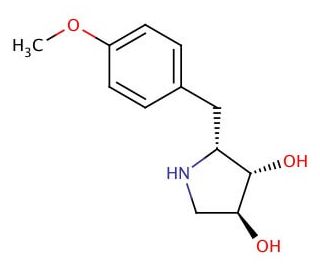

Deacetylanisomycin (CAS 27958-06-1)
QUICK LINKS
Deacetylanisomycin, identified by the CAS number 27958-06-1, is a derivative of anisomycin, a well-known antibiotic that functions as a protein synthesis inhibitor. This compound differs from anisomycin by the removal of an acetyl group, a modification that impacts its biological activity and interaction with cellular targets. Deacetylanisomycin operates by binding to the 60S ribosomal subunit, specifically influencing the peptidyl transferase center within the large ribosomal subunit. This binding disrupts the normal function of the ribosome, leading to the inhibition of peptide bond formation, which is a crucial step in the translation process of protein synthesis. Consequently, this interference effectively halts the elongation phase of protein synthesis, thereby inhibiting overall protein production in cells. In research contexts, deacetylanisomycin is utilized primarily to study the mechanisms of protein synthesis at the molecular level and to explore the cellular responses to inhibited translation such as stress response pathways, including the MAPK signaling pathway. Researchers also employ deacetylanisomycin to investigate the structural and functional aspects of ribosomal components, providing insights into how modifications in ribosome-targeting antibiotics affect their interaction with ribosomes and their subsequent biological activities. This research is crucial for understanding the fundamental processes that control cell growth and response to environmental stresses.
Deacetylanisomycin (CAS 27958-06-1) References
- Protein synthesis-dependent memory and neuronal enhancement in Hermissenda are contingent on parameters of training and retention. | Ramirez, RR., et al. 1998. Learn Mem. 4: 462-77. PMID: 10701872
- Stereodivergent syntheses of anisomycin derivatives from D-tyrosine. | Kim, JH., et al. 2005. J Org Chem. 70: 4082-7. PMID: 15876100
- Comparison of the in vitro activities of quassinoids with activity against Plasmodium falciparum, anisomycin and some other inhibitors of eukaryotic protein synthesis. | Ekong, RM., et al. 1990. Biochem Pharmacol. 40: 297-301. PMID: 2198027
- Inhibition of protein synthesis blocks long-term enhancement of generator potentials produced by one-trial in vivo conditioning in Hermissenda. | Crow, T. and Forrester, J. 1990. Proc Natl Acad Sci U S A. 87: 4490-4. PMID: 2352932
- Inhibition of protein synthesis prolongs Ca2+-mediated reduction of K+ currents in molluscan neurons. | Alkon, DL., et al. 1987. Proc Natl Acad Sci U S A. 84: 6948-52. PMID: 3477819
- (3H)anisomycin binding to eukaryotic ribosomes. | Barbacid, M. and Vazquez, D. 1974. J Mol Biol. 84: 603-23. PMID: 4601392
- Requirement for protein synthesis in the regulation of a circadian rhythm by serotonin. | Eskin, A., et al. 1984. Proc Natl Acad Sci U S A. 81: 7637-41. PMID: 6095312
- Protein synthesis requirement of the Aplysia circadian clock. Tested by active and inactive derivatives of the inhibitor anisomycin. | Jacklet, JW. 1980. J Exp Biol. 85: 33-42. PMID: 7373209
- Anisomycin selectively desensitizes signalling components involved in stress kinase activation and fos and jun induction. | Hazzalin, CA., et al. 1998. Mol Cell Biol. 18: 1844-54. PMID: 9528756
- Development and validation of a stability-indicating LC-UV and LC-MS/MS methods for quantitative analysis of anisomycin and identification of degradation products. | Tolić, et al. 2018. Brazilian Journal of Pharmaceutical Sciences. 54: e17491.
Ordering Information
| Product Name | Catalog # | UNIT | Price | Qty | FAVORITES | |
Deacetylanisomycin, 5 mg | sc-391507 | 5 mg | $327.00 |