
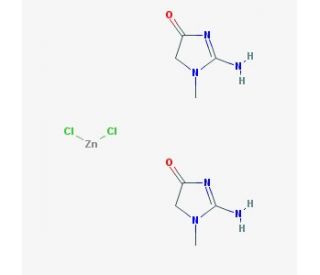

Molecular structure of Creatinine Zinc Chloride, CAS Number: 62708-52-5
Creatinine Zinc Chloride (CAS 62708-52-5)
Alternate Names:
2-Amino-1-methyl-2-imidazolin-4-one
CAS Number:
62708-52-5
Molecular Weight:
362.5
Molecular Formula:
(C4H7N3O)2•ZnCl2
For Research Use Only. Not Intended for Diagnostic or Therapeutic Use.
* Refer to Certificate of Analysis for lot specific data.
QUICK LINKS
Ordering Information
Description
Technical Information
Safety Information
SDS & Certificate of Analysis
Creatine zinc chloride is the end product of creatine catabolism. Normal constituent of urine; daily output about 25 mg/kg body weight. Increased amounts in the urine are typically associated with substantially impaired renal function. Also found together with creatine in muscle tissues and blood. Reacts with picric acid under alkaline conditions to form a Janovski complex. The rate of formation of the colored complex, measured at 480-520 nm is proportional to the creatinine concentration.
Creatinine Zinc Chloride (CAS 62708-52-5) References
1. Merck Index, 12th Ed., No. 2638. 2. Butler, A.R. and Glidewell, C., "Creatinine: an examination of its structure and some of its reactions by synergistic use of MNDO calculations and nuclear magnetic resonance spectroscopy." J. Chem. Soc. Perkin Trans., v. 2, 1465-1468 (1985). 3. Hirate, et al., "The effect of sacrificing method on the tissue concentration of exogeneous creatinine in rats." Chem. Pharm. Bull., v. 33(11), 5105-5107 (1985). 4. Kim, et al., "Sarcosine oxidase involved in creatinine degradation in Alcaligenes denitrificans subsp. denitrificans J9 and Arthrobacter spp. J5 and J11." Agric. Biol. Chem., v. 50(11), 2811-2816 (1986). 5. Nakamura, et al., "Creatones A and B. Revision of the structure for the product of oxidation of creatinine and creatine." Bull. Chem. Soc. Jpn., v. 63(5), 1540-1542 (1990). 6. Valcour, A.A. and Woodworth, R.C., J. Magn. Reson., v. 66, 536 (1986). 7. Welch, M.J., et al., "Determination of serum creatinine by isotope dilution mass spectrometry as a candidate definitive method." Anal. Chem., v. 58(8), 1681-1685 (1986) 8. Winquist, et al., "Determination of creatinine by an ammonia-sensitive semiconductor structure and immobilized enzymes." Anal. Chem., v. 58(1), 145-148 (1986). 9. Yokozawa, et al., "Changes in the urinary constituents in rats with chronic renal failure during oral administration of rhubarb extract." Chem. Pharm. Bull., v. 33(10), 4508-4514 (1985).Ordering Information
| Product Name | Catalog # | UNIT | Price | Qty | FAVORITES | |
Creatinine Zinc Chloride, 1 g | sc-294109 | 1 g | $71.00 | |||
Creatinine Zinc Chloride, 10 g | sc-294109A | 10 g | $112.00 |