
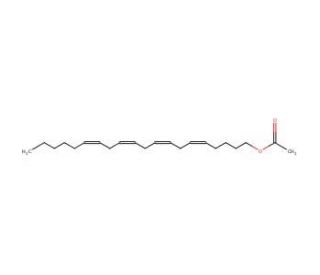

Arachidonyl acetate (CAS 56663-39-9)
Direktverknüpfungen
Arachidonylacetat mit der CAS-Nummer 56663-39-9 ist ein verestertes Derivat der Arachidonsäure, einer mehrfach ungesättigten Omega-6-Fettsäure, die ein lebenswichtiger Bestandteil von Zellmembranen und ein Vorläufer verschiedener Signalmoleküle ist. Bei dieser chemischen Modifikation wird die Arachidonsäure mit Acetat verestert, wodurch ihre lipophilen Eigenschaften verbessert und ihre Wechselwirkung mit biologischen Membranen verändert wird. In der Forschung wird Arachidonylacetat hauptsächlich zur Untersuchung des Lipidstoffwechsels und der biochemischen Wege der Fettsäuren verwendet. Seine Rolle als Nachahmer oder Analogon der Arachidonsäure ermöglicht es den Wissenschaftlern, seinen Einbau in zelluläre Lipide und die daraus resultierenden Auswirkungen auf zelluläre Funktionen zu untersuchen. Dies ist besonders wichtig für Studien, die sich mit der Modulation der Entzündungskaskade befassen, da Arachidonsäurederivate bei der Synthese von Eicosanoiden, den Signalmolekülen, die bei Entzündungen und Immunreaktionen eine Schlüsselrolle spielen, eine entscheidende Rolle spielen. Darüber hinaus wird Arachidonylacetat für die Synthese von stabilen isotopenmarkierten Verbindungen verwendet, die für die Verfolgung und Untersuchung von Stoffwechselwegen in der Lipidforschung von entscheidender Bedeutung sind. Seine Anwendung erstreckt sich auch auf die Entwicklung von Versuchsmodellen in der Biochemie und Zellbiologie, wo das Verständnis der Lipiddynamik von entscheidender Bedeutung ist. Durch diese Anwendungen trägt Arachidonylacetat zu einem tieferen Verständnis der Lipidbiochemie und des komplizierten Netzwerks zellulärer Signalwege bei.
Arachidonyl acetate (CAS 56663-39-9) Literaturhinweise
- Polymorphnukleare Leukozyten-Chemotaxis zu oxidierten Lipidkomponenten von Zellmembranen. | Turner, SR., et al. 1975. J Exp Med. 141: 1437-41. PMID: 1127383
- Hemmung der Ligandenbindung an G-Protein-gekoppelte Rezeptoren durch Arachidonsäure. | Bordayo, EZ., et al. 2005. J Mol Neurosci. 27: 185-94. PMID: 16186629
- Arachidonsäure-induzierter Calciumeinstrom in menschliche Blutplättchen. Vergleich mit der Wirkung von Thrombin. | Alonso, MT., et al. 1990. Biochem J. 272: 435-43. PMID: 2125206
- Stereospezifische Induktion der Eizellreifung bei Seesternen durch (8R)-Hydroxyeicosatetraensäure. | Meijer, L., et al. 1986. J Biol Chem. 261: 17040-7. PMID: 3097019
- Erzeugung und Freisetzung von eosinophilem chemotaktischem Faktor aus menschlichen polymorphkernigen Neutrophilen durch Arachidonsäure. | König, W., et al. 1978. Eur J Immunol. 8: 434-7. PMID: 352712
- Eosinophiler chemotaktischer Faktor. Freisetzung aus menschlichen polymorphnuklearen Neutrophilen durch Arachidonsäure. | Tesch, H., et al. 1979. Int Arch Allergy Appl Immunol. 58: 436-46. PMID: 35469
- Lipid-Chemotaxine, die aus Kulturfiltraten von Escherichia coli und aus oxidierten Lipiden isoliert wurden. | Sahu, S. and Lynn, WS. 1977. Inflammation. 2: 47-54. PMID: 367961
- Aktivierung der Proteinphosphatase 5 durch begrenzte Proteolyse oder die Bindung von mehrfach ungesättigten Fettsäuren an die TPR-Domäne. | Chen, MX. and Cohen, PT. 1997. FEBS Lett. 400: 136-40. PMID: 9000529
- Bioassay-Apparatur für Geruchspräferenzen von Nagetieren unter Labor- und Feldbedingungen | Gawienowski A M, Keedy D A, Stacewicz-Sapuntzakis M. 1979. Journal of Chemical Ecology,. 5: 595-601.
- Differenzierung von Monoepoxid-Isomeren mehrfach ungesättigter Fettsäuren und Fettsäureestern durch Niederenergie-Ladungsaustausch-Massenspektrometrie | Keough T, Mihelich E D, Eickhoff D J. 1984. Analytical Chemistry. 56: 1849-1852.
Bestellinformation
| Produkt | Katalog # | EINHEIT | Preis | ANZAHL | Favoriten | |
Arachidonyl acetate, 5 mg | sc-214552 | 5 mg | $15.00 |