
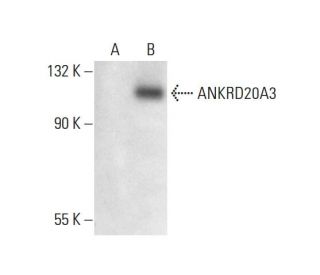

ANKRD20A Antikörper (B-9): sc-374250
- ANKRD20A Antikörper B-9 ist ein monoklonales IgG1 (kappa light chain) ANKRD20A Antikörper in einer Menge von 200 µg/ml
- ANKRD20A Antikörper (B-9) ist empfohlen für die Detektion von ANKRD20A1, ANKRD20A2, ANKRD20A3 and ANKRD20A4 aus der Spezies human per WB, IP, IF und ELISA
- ANKRD20A Antikörper (B-9) ist erhältlich als Konjugat mit Agarose für IP; HRP für WB, IHC(P) und ELISA; und entweder mit Phycoerythrin oder FITC für IF, IHC(P) und FCM
- auch erhältlich als Konjugat mit Alexa Fluor® 488, Alexa Fluor® 546, Alexa Fluor® 594 oder Alexa Fluor® 647 für IF, IHC(P) und FCM
- auch erhältlich als Konjugat mit Alexa Fluor® 680 oder Alexa Fluor® 790 für WB (NIR), IF und FCM
- m-IgGκ BP-HRP ist das bevorzugte sekundäre Nachweisreagenz für ANKRD20A Antikörper (B-9) für WB-Anwendungen. Dieses Reagenz wird jetzt in einem Paket mit ANKRD20A Antikörper (B-9) angeboten(siehe Bestellinformationen unten). Weitere m-IgGκ BP-Konjugate finden Sie in unserer vollständigen Liste der Maus-IgG-Bindungsproteine.

Der ANKRD20A-Antikörper (B-9) ist ein monoklonaler Maus IgG1 κ ANKRD20A-Antikörper (auch als ANKRD20A-Antikörper bezeichnet), der das ANKRD20A-Protein menschlichen Ursprungs mittels WB, IP, IF und ELISA detektiert. Der ANKRD20A-Antikörper (B-9) ist sowohl in Form des nicht konjugierten Anti-ANKRD20A-Antikörpers als auch in Form mehrerer Konjugate des Anti-ANKRD20A-Antikörpers, einschließlich Agarose, HRP, PE, FITC und mehrerer Alexa Fluor®-Konjugate, erhältlich. Ankyrine sind Membran-Adaptermoleküle, die wichtige Rollen bei der Verknüpfung integraler Membranproteine mit dem auf Spectrin basierenden Cytoskelettnetzwerk spielen. Mutationen von Ankyrin-Genen führen zu schweren genetischen Erkrankungen wie tödlichen Herzrhythmusstörungen und erblicher Spherozytose. ANKRD20A (ankyrin-Repeat-Domänen-enthaltenes Protein 20A) ist ein 823 Aminosäure-Protein, das fünf ANK-Repeats enthält. Das Gen, das ANKRD20A codiert, wird auf Chromosom 9 abgebildet, das aus etwa 145 Millionen Basen besteht und fast 900 Gene codiert. Da die distale Portion des 9p bei der Geschlechtsbestimmung eine Rolle spielt, kann die Deletion zur Entwicklung einer weiblichen mit männlichem X,Y-Genotyp führen. Mit dem Chromosom 9 sind die angeborene hämorrhagische Telangiektasie, die durch schädliche Gefäßfehler gekennzeichnet ist, und die familiäre Dysautonomie assoziiert. Darüber hinaus ist das Chromosom 9 mit dem Chromosom 22 in der Translokation verbunden, die zur aberranten Produktion des häufig in Leukämien gefundenen BCR-ABL-Fusionsproteins führt.
Alexa Fluor® ist ein Markenzeichen von Molecular Probes Inc., OR., USA
LI-COR® und Odyssey® sind Markenzeichen von LI-COR Biosciences
ANKRD20A Antikörper (B-9) Literaturhinweise:
- Ankyrine, multifunktionale Proteine, die an zahlreichen zellulären Prozessen beteiligt sind. | Hryniewicz-Jankowska, A., et al. 2002. Folia Histochem Cytobiol. 40: 239-49. PMID: 12219834
- DNA-Sequenz und Analyse des menschlichen Chromosoms 9. | Humphray, SJ., et al. 2004. Nature. 429: 369-74. PMID: 15164053
- Molekulare Evolution von Ankyrin: Funktionszuwachs bei Wirbeltieren durch Erwerb einer Obscurin/Titin-bindenden Domäne. | Hopitzan, AA., et al. 2006. Mol Biol Evol. 23: 46-55. PMID: 16135777
- Molekulare Evolution der Ankyrin-Genfamilie. | Cai, X. and Zhang, Y. 2006. Mol Biol Evol. 23: 550-8. PMID: 16280541
- BCR und seine Mutanten, die reziproken t(9;22)-assoziierten ABL/BCR-Fusionsproteine, regulieren in unterschiedlicher Weise das Zytoskelett und die Zellmotilität. | Zheng, X., et al. 2006. BMC Cancer. 6: 262. PMID: 17090304
- Genexpressions-Fingerprinting für humane hereditäre hämorrhagische Teleangiektasien. | Fernandez-L, A., et al. 2007. Hum Mol Genet. 16: 1515-33. PMID: 17420163
- Mögliche Rolle der Tubulin-Acetylierung und des Mikrotubuli-basierten Proteinhandels bei familiärer Dysautonomie. | Gardiner, J., et al. 2007. Traffic. 8: 1145-9. PMID: 17605759
Bestellinformation
| Produkt | Katalog # | EINHEIT | Preis | ANZAHL | Favoriten | |
ANKRD20A Antikörper (B-9) | sc-374250 | 200 µg/ml | $322.00 | |||
ANKRD20A (B-9): m-IgGκ BP-HRP Bundle | sc-552389 | 200 µg Ab; 40 µg BP | $361.00 | |||
ANKRD20A Antikörper (B-9) AC | sc-374250 AC | 500 µg/ml, 25% agarose | $424.00 | |||
ANKRD20A Antikörper (B-9) HRP | sc-374250 HRP | 200 µg/ml | $322.00 | |||
ANKRD20A Antikörper (B-9) FITC | sc-374250 FITC | 200 µg/ml | $336.00 | |||
ANKRD20A Antikörper (B-9) PE | sc-374250 PE | 200 µg/ml | $349.00 | |||
ANKRD20A Antikörper (B-9) Alexa Fluor® 488 | sc-374250 AF488 | 200 µg/ml | $364.00 | |||
ANKRD20A Antikörper (B-9) Alexa Fluor® 546 | sc-374250 AF546 | 200 µg/ml | $364.00 | |||
ANKRD20A Antikörper (B-9) Alexa Fluor® 594 | sc-374250 AF594 | 200 µg/ml | $364.00 | |||
ANKRD20A Antikörper (B-9) Alexa Fluor® 647 | sc-374250 AF647 | 200 µg/ml | $364.00 | |||
ANKRD20A Antikörper (B-9) Alexa Fluor® 680 | sc-374250 AF680 | 200 µg/ml | $364.00 | |||
ANKRD20A Antikörper (B-9) Alexa Fluor® 790 | sc-374250 AF790 | 200 µg/ml | $364.00 |