
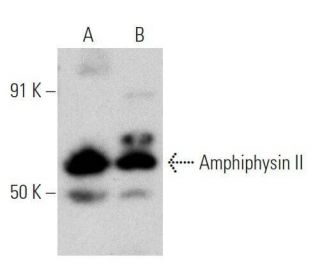
Anticorps Amphiphysin II (99D): sc-13575
- L'Anticorps Amphiphysin II (99D) est un monoclonal de souris IgG2b κ, cité dans 11 publications, fourni en 200 µg/ml
- dirigé contre l'exon 13 de Amphiphysin II de human
- recommandé pour la détection de Amphiphysin II splice variants 1-10 d'origine mouse, rat, human et avian par WB, IP, IF et IHC(P)
- 2b BP-HRP">m-IgG2b BP-HRP et m-IgGκ BP-HRP sont les réactifs de détection secondaire préférés pour l'anticorps Amphiphysin II (99D) pour les applications WB et IHC(P). Ces réactifs sont désormais proposés en lots avec l'anticorps Amphiphysin II (99D)(voir les informations relatives à la commande ci-dessous).

ACCÈS RAPIDE AUX LIENS
L'anticorps Amphiphysine II (99D) est un anticorps monoclonal IgG2b à chaîne légère kappa de souris qui détecte l'Amphiphysine II chez la souris, le rat, l'homme et les espèces aviaires par western blotting (WB), immunoprécipitation (IP), immunofluorescence (IF) et immunohistochimie. L'anticorps anti-Amphiphysine II (99D) est disponible sous une forme non conjuguée pour une utilisation expérimentale polyvalente. L'amphiphysine II est une protéine enrichie dans le cerveau qui joue un rôle important dans le recyclage des vésicules synaptiques, essentiel à la neurotransmission. L'anticorps monoclonal Amphiphysine II (99D) reconnaît une protéine qui fonctionne comme un dimère et présente un domaine BAR de flexion de la membrane, un domaine central de liaison à la Clathrine et aux adaptateurs, et un domaine SH3 en C-terminal. L'interaction entre l'amphiphysine II et la GTPase Dynamin, médiée par le domaine SH3, permet le recyclage des vésicules synaptiques dans les neurones en facilitant la liaison de la Dynamin aux puits recouverts de Clathrine, ce qui entraîne le bourgeonnement des vésicules. Une variante d'épissage de l'amphiphysine II, dépourvue d'interactions avec la clathrine ou les adaptateurs, est principalement exprimée dans les tissus musculaires et joue un rôle crucial dans la formation et la stabilisation du réseau de tubules T, démontrant ainsi divers rôles fonctionnels dans la dynamique cellulaire.
Alexa Fluor® est une marque déposée de Molecular Probes Inc., OR., USA
LI-COR® et Odyssey® sont marques déposées de LI-COR Biosciences
Anticorps Amphiphysin II (99D) Références:
- Intégrateur de pont 1 (BIN1): forme, fonction et maladie d'Alzheimer. | Tan, MS., et al. 2013. Trends Mol Med. 19: 594-603. PMID: 23871436
- L'amphiphysine 2 (BIN1) dans la physiologie et les maladies. | Prokic, I., et al. 2014. J Mol Med (Berl). 92: 453-63. PMID: 24590001
- Le rôle mécanique de l'intégrateur de pont 1 (BIN1) dans la maladie d'Alzheimer. | Gao, P., et al. 2021. Cell Mol Neurobiol. 41: 1431-1440. PMID: 32719966
- Absence d'association entre le polymorphisme rs744373 de l'intégrateur de pont 1 (BIN1) et la charge tau-PET chez des personnes âgées cognitivement intactes. | Schaeverbeke, J., et al. 2022. Alzheimers Dement (N Y). 8: e12227. PMID: 35229019
- BIN1 est un régulateur clé de l'activation pro-inflammatoire et liée à la neurodégénérescence dans la microglie. | Sudwarts, A., et al. 2022. Mol Neurodegener. 17: 33. PMID: 35526014
- Le Bridging Integrator 1 (BIN1, rs6733839) et le sexe sont des modérateurs des prédictions de santé vasculaire des trajectoires de vieillissement de la mémoire. | Heal, M., et al. 2022. J Alzheimers Dis. 89: 265-281. PMID: 35871342
- Le fragment 1 de l'intégrateur de pont accélère l'agrégation et la propagation de la protéine tau en améliorant l'endocytose médiée par la clathrine chez la souris. | Zhang, X., et al. 2024. PLoS Biol. 22: e3002470. PMID: 38206965
- Fonctions et défauts de l'amphiphysine 2 (BIN1) dans les muscles cardiaques et squelettiques. | Giraud, Q. and Laporte, J. 2024. Trends Mol Med. 30: 579-591. PMID: 38514365
Informations pour la commande
| Nom du produit | Ref. Catalogue | COND. | Prix HT | QTÉ | Favoris | |
Anticorps Amphiphysin II (99D) | sc-13575 | 200 µg/ml | $322.00 | |||
Amphiphysin II (99D): m-IgGκ BP-HRP Kit | sc-520630 | 200 µg Ab, 40 µg BP | $361.00 | |||
Amphiphysin II (99D): m-IgG2b BP-HRP Kit | sc-548843 | 200 µg Ab; 10 µg BP | $361.00 |