
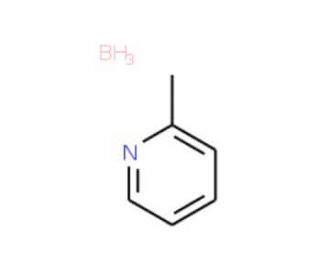

2-Picoline borane complex (CAS 3999-38-0)
See product citations (1)
QUICK LINKS
The 2-Picoline borane complex is a noteworthy compound used in various research applications, particularly in the fields of organic chemistry and materials science. It serves as a reducing agent in organic synthesis, where it is utilized for the reduction of carbonyl groups, including aldehydes and ketones, to their corresponding alcohols. The complex is also studied for its role in catalysis, especially in reactions that involve the transfer of hydride ions. Its mild reducing properties make it suitable for selective reduction reactions, which are critical in the synthesis of complex molecules. In addition to its synthetic applications, the 2-Picoline borane complex is involved in the development of novel boron-containing materials, which have potential applications in areas such as optoelectronics and nanotechnology. The stability and reactivity of this complex under various conditions are also of particular interest to researchers looking to design new chemical processes and products.
2-Picoline borane complex (CAS 3999-38-0) References
- Reductive amination of aldehyde 2,4-dinitorophenylhydrazones using 2-picoline borane and high-performance liquid chromatographic analysis. | Uchiyama, S., et al. 2009. Anal Chem. 81: 485-9. PMID: 19055423
- Robust and high-throughput sample preparation for (semi-)quantitative analysis of N-glycosylation profiles from plasma samples. | Ruhaak, LR., et al. 2012. Methods Mol Biol. 893: 371-85. PMID: 22665312
- Reductive amination of glutaraldehyde 2,4-dinitrophenylhydrazone using 2-picoline borane and high-performance liquid chromatographic analysis. | Uchiyama, S., et al. 2012. Analyst. 137: 4274-9. PMID: 22842342
- Structural glycomic analyses at high sensitivity: a decade of progress. | Alley, WR. and Novotny, MV. 2013. Annu Rev Anal Chem (Palo Alto Calif). 6: 237-65. PMID: 23560930
- Cilia-mimetic hairy surfaces based on end-immobilized nanocellulose colloidal rods. | Lokanathan, AR., et al. 2013. Biomacromolecules. 14: 2807-13. PMID: 23799635
- Automation of dimethylation after guanidination labeling chemistry and its compatibility with common buffers and surfactants for mass spectrometry-based shotgun quantitative proteome analysis. | Lo, A., et al. 2013. Anal Chim Acta. 788: 81-8. PMID: 23845485
- Discovery of a Novel Series of N-Phenylindoline-5-sulfonamide Derivatives as Potent, Selective, and Orally Bioavailable Acyl CoA:Monoacylglycerol Acyltransferase-2 Inhibitors. | Sato, K., et al. 2015. J Med Chem. 58: 3892-909. PMID: 25897973
- Active surfaces engineered by immobilizing protein-polymer nanoreactors for selectively detecting sugar alcohols. | Zhang, X., et al. 2016. Biomaterials. 89: 79-88. PMID: 26950167
- Enhanced trypsin on a budget: Stabilization, purification and high-temperature application of inexpensive commercial trypsin for proteomics applications. | Heissel, S., et al. 2019. PLoS One. 14: e0218374. PMID: 31246970
- Macrophage galactose-type lectin (MGL) is induced on M2 microglia and participates in the resolution phase of autoimmune neuroinflammation. | Ilarregui, JM., et al. 2019. J Neuroinflammation. 16: 130. PMID: 31248427
- Functionalization of Alginate with Extracellular Matrix Peptides Enhances Viability and Function of Encapsulated Porcine Islets. | Medina, JD., et al. 2020. Adv Healthc Mater. 9: e2000102. PMID: 32255552
- A general strategy for creating self-defending surfaces for controlled drug production for long periods of time. | Langowska, K., et al. 2014. J Mater Chem B. 2: 4684-4693. PMID: 32262280
- Late-Stage Solubilization of Poorly Soluble Peptides Using Hydrazide Chemistry. | Sato, K., et al. 2021. Org Lett. 23: 1653-1658. PMID: 33570416
- Characterization of multi-cationic aminopyrene-based tag for oligosaccharide labeling by capillary electrophoresis with laser-induced fluorescence detection. | Krenkova, J., et al. 2021. Electrophoresis. 42: 1333-1339. PMID: 33772804
- Expanding Glycomic Investigations through Thiol-Derivatized Glycans. | Hurst, RD., et al. 2023. Molecules. 28: PMID: 36838944
- Trifluoroacetaldehyde: A Useful Industrial Bulk Material For The Synthesis Of Trifluoromethylated Amino Compounds | Hideyuki Mimura, Kosuke Kawada, Tetsuya Yamashita, Takeshi Sakamoto, Yasuo Kikugawa. 2010. Journal Of Fluorine Chemistry. Volume 131, Issue 4: 477-486.
- A Challenging Synthesis Of The Highly Functionalized Echinocandin Asp9726: A Successor Of Micafungin | Shinya Yoshida*†, Joji Hayashida†, Yasuhiro Morinaga†, Shoji Mizobata†, Akihiro Okada‡, Kazumi Kawai§, Shinjirou Tanoue§, Tomohide Nakata†, Minoru Kitayama§, Atsushi Ohigashi†, Mitsutaka Matsuura§, Takumi Takahashi∥, Shigeru Ieda†, And Minoru Okada†. 2014. Org. Process Res. Dev. 18, 6: 725–738.
- Stabilization Of Enzymes By Multipoint Covalent Attachment On Aldehyde-Supports: 2-Picoline Borane As An Alternative Reducing Agent | Alejandro H. Orrego, Maria Romero-Fernández, María Del Carmen Millán-Linares, María Del Mar Yust, José M. Guisán and, And Javier Rocha-Martin. 2018. Catalysts. 8(8): 333.
Ordering Information
| Product Name | Catalog # | UNIT | Price | Qty | FAVORITES | |
2-Picoline borane complex, 5 g | sc-288295 | 5 g | $63.00 | |||
2-Picoline borane complex, 50 g | sc-288295A | 50 g | $526.00 |