
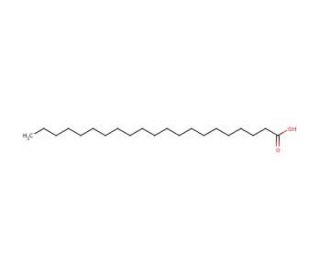

Heneicosanoic acid (CAS 2363-71-5)
Direktverknüpfungen
Heneicosansäure ist eine langkettige Fettsäure, die in experimentellen Anwendungen als Tensid fungiert. Sie hat die Fähigkeit, die Oberflächenspannung zu verringern und Emulsionen zu stabilisieren, was sie in verschiedenen Entwicklungsanwendungen nützlich macht. Auf molekularer Ebene interagiert die Henicosansäure aufgrund ihres amphiphilen Charakters mit der Grenzfläche zwischen zwei nicht mischbaren Phasen, z. B. Öl und Wasser. Dadurch kann sie an der Grenzfläche eine Monoschicht bilden, wodurch die für die Emulgierung erforderliche Energie gesenkt wird. Heneicosansäure kann die rheologischen Eigenschaften bestimmter Systeme verändern und das Fließverhalten und die Stabilität von Emulsionen beeinflussen. Ihr Wirkmechanismus beinhaltet die Adsorption an der Grenzfläche, wo sie sich umlagern und einen stabilen Film bilden kann, der zur Gesamtstabilität von Emulsionen beiträgt. Die Heneicosansäure spielt in experimentellen Anwendungen eine funktionelle Rolle, indem sie die Emulgierung erleichtert und die Grenzflächen stabilisiert.
Heneicosanoic acid (CAS 2363-71-5) Literaturhinweise
- Einsatz der Desorptions/Ionisations-Massenspektrometrie auf porösem Silizium für den Nachweis negativer Ionen für Fettsäuren. | Budimir, N., et al. 2006. Rapid Commun Mass Spectrom. 20: 680-4. PMID: 16447146
- Massenspektrometrie der Desorption/Ionisierung auf porösem Silizium (DIOS) von kationisierten Modellfettsäuren. | Budimir, N., et al. 2007. J Mass Spectrom. 42: 42-8. PMID: 17125152
- Studien zu den chemischen Bestandteilen von Gracilaria verrucosa. | Aydoğmuş, Z., et al. 2008. Nat Prod Res. 22: 1589-96. PMID: 19085413
- Plasmafettsäurezusammensetzung bei Patienten mit kontinuierlicher ambulanter Peritonealdialyse: ein erhöhtes Omega-6/Omega-3-Verhältnis und ein Mangel an essenziellen Fettsäuren. | Yerlikaya, FH., et al. 2011. Ren Fail. 33: 819-23. PMID: 21793790
- Ein neuartiges Lipopeptid aus einer Hautkommensale aktiviert die TLR2/CD36-p38 MAPK-Signalübertragung und erhöht die antibakterielle Abwehr gegen bakterielle Infektionen. | Li, D., et al. 2013. PLoS One. 8: e58288. PMID: 23472173
- Fettsäureprofil von gamma-bestrahlten und gekochten afrikanischen Ölbohnensamen (Pentaclethra macrophylla Benth). | Olotu, I., et al. 2014. Food Sci Nutr. 2: 786-91. PMID: 25493197
- Stoffwechselprodukte in der Follikelflüssigkeit und im Serum von Holstein-Kühen sind ein Indikator für die genetische Eignung für die Fruchtbarkeit. | Moore, SG., et al. 2017. Reprod Fertil Dev. 29: 658-669. PMID: 26511586
- Langkettige Alkane und Fettsäuren aus den Wachsen der Blattoberfläche von Ludwigia octovalvis als kurzfristiger Lockstoff und Stimulans für die Eiablage von Altica cyanea (Weber) (Coleoptera: Chrysomelidae). | Mitra, S., et al. 2017. Bull Entomol Res. 107: 391-400. PMID: 28132659
- Zusammensetzung der ätherischen Öle der Blüten von Carthamus Tinctorius L., die in Kasachstan angebaut werden. | Turgumbayeva, AA., et al. 2018. Ann Agric Environ Med. 25: 87-89. PMID: 29575869
- Erforschung von Mikroalgenarten für die gleichzeitige Abwasserreinigung und Biokraftstoffproduktion. | Jeong, D. and Jang, A. 2020. Environ Res. 188: 109772. PMID: 32544724
- Bienenbrot: Physikalisch-chemische Charakterisierung und Optimierung der Extraktion von Phenolgehalt. | Dranca, F., et al. 2020. Foods. 9: PMID: 32987873
- Die Unterschiede der Nährstoffkomponenten in essbaren und verfütterten Coix-Samen in verschiedenen Entwicklungsstadien auf der Grundlage einer kombinierten Analyse der Metabolomik. | Wei, X., et al. 2023. Molecules. 28: PMID: 37175169
- Übersicht über den Gehalt an konjugierter Linolsäure in Milchprodukten. | Lin, H., et al. 1995. J Dairy Sci. 78: 2358-65. PMID: 8747326
- Sphingomyelin-Veränderungen in der Ratten-Hirnrinde während einer fokalen Ischämie. | Kubota, M., et al. 1996. Neurol Res. 18: 337-41. PMID: 8875452
- Strukturelle Eigenschaften der Lipopolysaccharide von Rickettsia typhi und Rickettsia prowazekii und ihre chemische Ähnlichkeit mit dem im Weil-Felix-Test verwendeten Lipopolysaccharid von Proteus vulgaris OX19. | Amano, KI., et al. 1998. Infect Immun. 66: 923-6. PMID: 9488376
Bestellinformation
| Produkt | Katalog # | EINHEIT | Preis | ANZAHL | Favoriten | |
Heneicosanoic acid, 100 mg | sc-215127 | 100 mg | $48.00 | |||
Heneicosanoic acid, 1 g | sc-215127A | 1 g | $262.00 |