
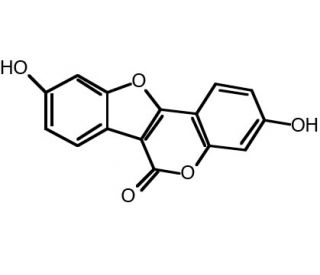

Coumestrol (CAS 479-13-0)
See product citations (2)
QUICK LINKS
Coumestrol is a phytoestrogen, a type of compound found in plants that mimics the hormone estrogen. It is primarily found in the seeds, leaves, and stems of legumes, such as alfalfa and clover. It is a highly potent inhibitor of 17 beta-HSD (17-beta-hydroxysteroid oxidoreductase), ER alpha, and ER beta. Research has demonstrated its ability to hinder the functioning of enzymes responsible for metabolizing lipids and carbohydrates, along with enzymes involved in hormone synthesis. Furthermore, Coumestrol has been observed to modulate the expression of genes that regulate cell proliferation, apoptosis, and cell cycle advancement. Studies have found anti-inflammatory, antioxidant, anti-cancer, anti-diabetic, neuroprotective, and cardioprotective effects of this compound.
Coumestrol (CAS 479-13-0) References
- Coumestrol has neuroprotective effects before and after global cerebral ischemia in female rats. | Canal Castro, C., et al. 2012. Brain Res. 1474: 82-90. PMID: 22824334
- Distribution of isoflavones and coumestrol in neglected tropical and subtropical legumes. | Leuner, O., et al. 2013. J Sci Food Agric. 93: 575-9. PMID: 22926873
- Effects of coumestrol administration to maternal mice during pregnancy and lactation on immunoblogulin A-secreting cells in mammary glands. | Wang, M., et al. 2013. Anim Sci J. 84: 322-7. PMID: 23590506
- Coumestrol induces senescence through protein kinase CKII inhibition-mediated reactive oxygen species production in human breast cancer and colon cancer cells. | Lee, YH., et al. 2013. Food Chem. 141: 381-8. PMID: 23768371
- 3D models of human ERα and ERβ complexed with coumestrol. | Chandsawangbhuwana, C. and Baker, ME. 2014. Steroids. 80: 37-43. PMID: 24315835
- Coumestrol treatment prevents Na+, K+ -ATPase inhibition and affords histological neuroprotection to male rats receiving cerebral global ischemia. | Castro, CC., et al. 2014. Neurol Res. 36: 198-206. PMID: 24512013
- Coumestrol induces mitochondrial biogenesis by activating Sirt1 in cultured skeletal muscle cells. | Seo, DB., et al. 2014. J Agric Food Chem. 62: 4298-305. PMID: 24712520
- Coumestrol suppresses hypoxia inducible factor 1α by inhibiting ROS mediated sphingosine kinase 1 in hypoxic PC-3 prostate cancer cells. | Cho, SY., et al. 2014. Bioorg Med Chem Lett. 24: 2560-4. PMID: 24768446
- Coumestrol inhibits carotid sinus baroreceptor activity by cAMP/PKA dependent nitric oxide release in anesthetized male rats. | Liu, H., et al. 2015. Biochem Pharmacol. 93: 42-8. PMID: 25449602
- Coumestrol suppresses proliferation of ES2 human epithelial ovarian cancer cells. | Lim, W., et al. 2016. J Endocrinol. 228: 149-60. PMID: 26698565
- A bioanalytical HPLC method for coumestrol quantification in skin permeation tests followed by UPLC-QTOF/HDMS stability-indicating method for identification of degradation products. | Bianchi, SE., et al. 2016. J Chromatogr B Analyt Technol Biomed Life Sci. 1020: 43-52. PMID: 27010353
- Cu(II)-coumestrol interaction leads to ROS-mediated DNA damage and cell death: a putative mechanism for anticancer activity. | Zafar, A., et al. 2016. J Nutr Biochem. 33: 15-27. PMID: 27260464
- Coumestrol modulates Akt and Wnt/β-catenin signaling during the attenuation of adipogenesis. | Jang, YJ., et al. 2016. Food Funct. 7: 4984-4991. PMID: 27868125
- The cytochromes P-448--a unique family of enzymes involved in chemical toxicity and carcinogenesis. | Ioannides, C. and Parke, DV. 1987. Biochem Pharmacol. 36: 4197-207. PMID: 3318843
- Estrogen-specific 17 beta-hydroxysteroid oxidoreductase type 1 (E.C. 1.1.1.62) as a possible target for the action of phytoestrogens. | Mäkelä, S., et al. 1995. Proc Soc Exp Biol Med. 208: 51-9. PMID: 7892295
Ordering Information
| Product Name | Catalog # | UNIT | Price | Qty | FAVORITES | |
Coumestrol, 10 mg | sc-205638 | 10 mg | $207.00 | |||
Coumestrol, 25 mg | sc-205638A | 25 mg | $321.00 |