
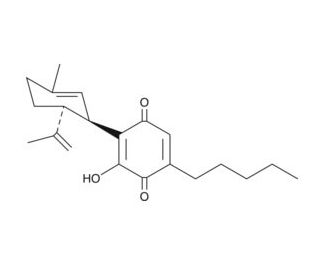

HU-331 (CAS 137252-25-6)
Veja citações de produtos (1)
Available in US only.
LINKS RÁPIDOS
O HU-331 é um canabinoide sintético que chama a atenção da comunidade de pesquisa principalmente por seu potencial como composto com alta afinidade pelos receptores de canabinoides. Ele é particularmente conhecido por seu papel no estudo do sistema endocanabinoide, uma rede complexa de receptores, fixadores endógenos e enzimas que regulam uma ampla gama de processos fisiológicos. Os pesquisadores utilizam o HU-331 em investigações com o objetivo de elucidar os efeitos dos canabinoides além das propriedades normalmente associadas ao tetrahidrocanabinol (THC). Ele atua como um potente inibidor da topoisomerase II, uma enzima essencial para a replicação do DNA e a progressão do ciclo celular, o que o torna uma ferramenta valiosa em estudos de proliferação celular e expressão gênica. A estrutura exclusiva do composto permite que os cientistas examinem os requisitos estruturais para a ligação e a atividade do receptor, contribuindo para o projeto de novas moléculas que podem interagir seletivamente com os receptores canabinoides.
HU-331 (CAS 137252-25-6) Referencias
- Uma quinona canabinóide inibe a angiogénese ao visar as células endoteliais vasculares. | Kogan, NM., et al. 2006. Mol Pharmacol. 70: 51-9. PMID: 16571653
- HU-331, um novo inibidor da topoisomerase II anticancerígena à base de canabinóides. | Kogan, NM., et al. 2007. Mol Cancer Ther. 6: 173-83. PMID: 17237277
- Uma quinona canabinóide anticancerígena, HU-331, é mais potente e menos cardiotóxica do que a doxorrubicina: um estudo comparativo in vivo. | Kogan, NM., et al. 2007. J Pharmacol Exp Ther. 322: 646-53. PMID: 17478614
- HU-331: uma quinona canabinóide, com propriedades citotóxicas pouco comuns e baixa toxicidade. | Peters, M. and Kogan, NM. 2007. Expert Opin Investig Drugs. 16: 1405-13. PMID: 17714026
- A apoptose de esplenócitos induzida pelo canabidiol hidroxiquinona é mediada predominantemente pela depleção de tióis. | Wu, HY. and Jan, TR. 2010. Toxicol Lett. 195: 68-74. PMID: 20184945
- Agentes antiproliferativos à base de ciclohexa-2,5-dieno-1,4-diona: conceção, síntese e avaliação citotóxica. | Petronzi, C., et al. 2013. J Exp Clin Cancer Res. 32: 24. PMID: 23631805
- O HU-331 é um inibidor catalítico da topoisomerase IIα. | Regal, KM., et al. 2014. Chem Res Toxicol. 27: 2044-51. PMID: 25409338
- O HU-331 e o canabidiol oxidado actuam como inibidores da topoisomerase IIα e β humanas. | Wilson, JT., et al. 2018. Chem Res Toxicol. 31: 137-144. PMID: 29272108
- Padrões de Estrutura-Atividade de Quinonas Monocíclicas: Síntese de Inibidores Catalíticos da Topoisomerase II com Potente Atividade Antiproliferativa. | Waugh, TM., et al. 2020. ChemMedChem. 15: 114-124. PMID: 31778038
- Cannabinoid Quinones - Uma revisão e novas observações. | Kogan, NM., et al. 2021. Molecules. 26: PMID: 33801057
- O produto de oxidação do canabidiol HU-331 é um potencial canabinóide-quinona anticancerígeno: uma revisão narrativa. | Trac, J., et al. 2021. J Cannabis Res. 3: 11. PMID: 33892826
- Cannabinoids as Potential Cancer Therapeutics: O enigma da concentração. | Carkaci-Salli, N., et al. 2023. Cannabis Cannabinoid Res.. PMID: 36944160
Informacoes sobre ordens
| Nome do Produto | Numero de Catalogo | UNID | Preco | Qde | FAVORITOS | |
HU-331, 1 mg | sc-205345 | 1 mg | $107.00 | |||
| EUA: Apenas disponível nos EUA | ||||||
HU-331, 5 mg | sc-205345A | 5 mg | $837.00 | |||
| EUA: Apenas disponível nos EUA | ||||||