
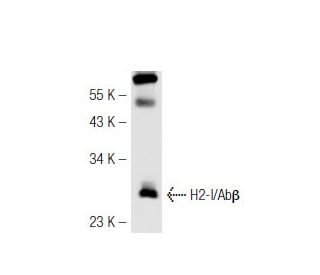

H2-I/Abβ (25-9-3): sc-52537. 小鼠 PBL 全细胞裂解液中 H2-I/Abβ 表达的 Western 印迹分析.
H2-I/Abβ 抗体 (25-9-3): sc-52537
- H2-I/Ab beta 抗体 25-9-3 是小鼠单克隆 IgM,H2-I/Abβ抗体,规格为100 µg/ml
- 针对mouse来源的C3H.SW脾细胞制备
- 推荐用于 mouse 来源的MHC class II H2-I/Abβ WB, IP 和 FCM检测
- 还可偶联藻红蛋白 用于IF, IHC(P) 和 FCM
- 目前,我们还没有完成H2-I/Abβ 抗体 (25-9-3)的首选二抗检测试剂的鉴定。这项工作正在进行中。

H2-I/Abβ 抗体(25-9-3)是一种小鼠单克隆 IgM 抗体,可通过免疫印迹(WB)、免疫沉淀(IP)和流式细胞术(FCM)检测小鼠来源的 H2-I/Ab beta 蛋白。抗 H2-I/Ab beta 抗体 (25-9-3) 以非结合形式提供。H2-I/Ab beta 蛋白作为主要组织相容性复合体(MHC)II 类分子的一个组成部分,在免疫系统中发挥着至关重要的作用,而主要组织相容性复合体(MHC)II 类分子对适应性免疫反应至关重要。MHC II 类分子主要位于 B 细胞、巨噬细胞和树突状细胞等抗原递呈细胞的表面,它们与外来肽结合并将其递呈给 CD4+ T 细胞。这种相互作用对激活 T 淋巴细胞至关重要,而 T 淋巴细胞能协调针对病原体的免疫反应。H2-I/Ab beta 呈递各种肽的能力受到其多态性的影响,从而可以对各种抗原做出量身定制的免疫反应。此外,干扰素-g 可以诱导 MHC II 类分子的表达,从而增强免疫系统应对感染的能力。了解 H2-I/Ab beta 的功能和重要性对于研究免疫反应和免疫学的潜在治疗应用至关重要。
仅限研究使用。不适用于诊断和治疗用途。
Alexa Fluor® 是Molecular Probes Inc., OR., USA的商标
LI-COR®和 Odyssey® 是LI-COR Biosciences的注册商标
H2-I/Abβ 抗体 (25-9-3) 参考文献:
- I-Abeta 基因的表达机制。 | Lloberas, J., et al. 1999. Microbes Infect. 1: 935-41. PMID: 10614012
- 对单一间接同种抗原表位(I-Ab/H-2Kd54-68)具有特异性的 T 细胞克隆的异质性介导了移植排斥反应。 | Honjo, K., et al. 2000. Transplantation. 70: 1516-24. PMID: 11118099
- 通过 MHC II 类分子呈现抗原:充分利用它们。 | Villadangos, JA. 2001. Mol Immunol. 38: 329-46. PMID: 11684289
- 通过基因疗法预防 1 型糖尿病。 | Tian, C., et al. 2004. J Clin Invest. 114: 969-78. PMID: 15467836
- 小鼠免疫反应 I-A beta 基因座的结构:I-A beta 基因和邻近 beta 链第二结构域外显子的序列。 | Larhammar, D., et al. 1983. Cell. 34: 179-88. PMID: 6411350
- 小鼠 MHC 抗原的单克隆抗体。III.与 H-2b 单倍型抗原反应的杂交瘤抗体揭示了同种型表达的基因控制。 | Ozato, K. and Sachs, DH. 1981. J Immunol. 126: 317-21. PMID: 6935293
- MHC II 类分子的组装, 运输和功能。 | Cresswell, P. 1994. Annu Rev Immunol. 12: 259-93. PMID: 8011283
- MHC II 类分子在不同细胞和功能区的表达受转录激活子 CIITA 的多个启动子的不同使用情况控制。 | Muhlethaler-Mottet, A., et al. 1997. EMBO J. 16: 2851-60. PMID: 9184229
- 小鼠主要组织相容性复合体 II 类 I-Abeta 基因的替代启动子:对 CpG 岛起源的影响。 | Macleod, D., et al. 1998. Mol Cell Biol. 18: 4433-43. PMID: 9671453
订购信息
| 产品名称 | 产品编号 | 规格 | 价格 | 数量 | 收藏夹 | |
H2-I/Abβ 抗体 (25-9-3) | sc-52537 | 100 µg/ml | $322.00 |