
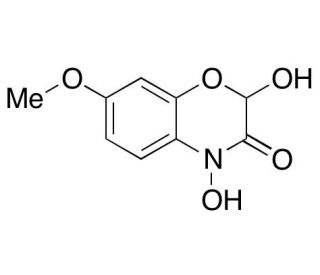

Molecular structure of DIMBOA, CAS Number: 15893-52-4
DIMBOA (CAS 15893-52-4)
Alternate Names:
(±)-2,4-Dihydroxy-7-methoxy-2H-1,4-benzoxazin-3(4H)-one; (±)-DIMBOA;
Application:
DIMBOA is a benzoxazinoid and antibiotic, part of the chemical defense system of the graminaceous plant family.
CAS Number:
15893-52-4
Molecular Weight:
211.17
Molecular Formula:
C9H9NO5
For Research Use Only. Not Intended for Diagnostic or Therapeutic Use.
* Refer to Certificate of Analysis for lot specific data.
QUICK LINKS
Ordering Information
Description
Technical Information
Safety Information
SDS & Certificate of Analysis
DIMBOA is a benzoxazinoid that can be found in graminaceous plant sources, including maize, wheat, and rye. DIMBOA has antibiotic activity. In addition to antibiotic activity, DIMBOA has growth inhibitory properties against many strains of studied bacteria and fungi. DIMBOA has potent free-radical scavenging ability, and a weaker iron (III) ions reducing activity.
DIMBOA (CAS 15893-52-4) References
- Allelopathy, DIMBOA production and genetic variability in accessions of Triticum speltoides. | Quader, M., et al. 2001. J Chem Ecol. 27: 747-60. PMID: 11446298
- Elucidation of the final reactions of DIMBOA-glucoside biosynthesis in maize: characterization of Bx6 and Bx7. | Jonczyk, R., et al. 2008. Plant Physiol. 146: 1053-63. PMID: 18192444
- Species-specific glucosylation of DIMBOA in larvae of the rice Armyworm. | Sasai, H., et al. 2009. Biosci Biotechnol Biochem. 73: 1333-8. PMID: 19502734
- The maize benzoxazinone DIMBOA reacts with glutathione and other thiols to form spirocyclic adducts. | Dixon, DP., et al. 2012. Phytochemistry. 77: 171-8. PMID: 22342783
- In vitro evaluation of the antioxidant and antimicrobial activity of DIMBOA [2,4-dihydroxy-7-methoxy-2H-1,4-benzoxazin-3(4H)-one]. | Gleńsk, M., et al. 2016. Nat Prod Res. 30: 1305-8. PMID: 26166773
- 2,4-dihydroxy-7-methoxy-2H-1,4-benzoxazin-3(4H)-one (DIMBOA) inhibits trichothecene production by Fusarium graminearum through suppression of Tri6 expression. | Etzerodt, T., et al. 2015. Int J Food Microbiol. 214: 123-128. PMID: 26276561
- Transcriptome differential co-expression reveals distinct molecular response of fall-armyworm strains to DIMBOA. | Silva-Brandão, KL., et al. 2021. Pest Manag Sci. 77: 518-526. PMID: 32815313
- Enantioselective Response of Wheat Seedlings to Imazethapyr: From the Perspective of Fe and the Secondary Metabolite DIMBOA. | Huang, J., et al. 2022. J Agric Food Chem. 70: 5516-5525. PMID: 35476430
- Alternative transcript splicing regulates UDP-glucosyltransferase-catalyzed detoxification of DIMBOA in the fall armyworm (Spodoptera frugiperda). | Israni, B., et al. 2022. Sci Rep. 12: 10343. PMID: 35725775
- Potential Effect of DIMBOA (2,4-Dihydroxy-7-methoxy-1,4-benzoxazin-3-one) on Alleviating the Autotoxic Coumarin Stress in Alfalfa (Medicago sativa) Seedlings. | Li, X., et al. 2022. Life (Basel). 12: PMID: 36556505
- Genetic Variation, DIMBOA Accumulation, and Candidate Gene Identification in Maize Multiple Insect-Resistance. | Niu, Y., et al. 2023. Int J Mol Sci. 24: PMID: 36768464
- A deletion in an indole synthase gene is responsible for the DIMBOA-deficient phenotype of bxbx maize. | Melanson, D., et al. 1997. Proc Natl Acad Sci U S A. 94: 13345-50. PMID: 9371848
Ordering Information
| Product Name | Catalog # | UNIT | Price | Qty | FAVORITES | |
DIMBOA, 10 mg | sc-498391 | 10 mg | $357.00 | |||
DIMBOA, 50 mg | sc-498391B | 50 mg | $1617.00 | |||
DIMBOA, 100 mg | sc-498391A | 100 mg | $2647.00 |