
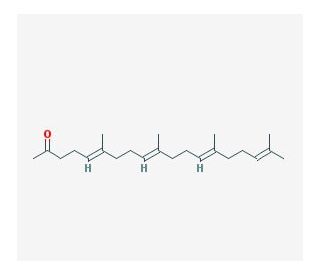

Geranylgeranylacetone (CAS 6809-52-5)
See product citations (2)
QUICK LINKS
Geranylgeranylacetone, often examined in the context of cellular protection mechanisms, is a substance of interest due to its ability to induce the expression of heat shock proteins (HSPs). In biochemical research, this compound is used to study stress response pathways and the upregulation of cytoprotective proteins. Investigations into geranylgeranylacetone′s role in HSP induction have provided insights into molecular chaperone functions and their importance in maintaining cellular homeostasis. Additionally, it is utilized in the study of protein misfolding, where the increased expression of HSPs can be a significant factor in cellular resistance to toxic protein aggregates. Beyond its role in protein dynamics, geranylgeranylacetone is also explored for its impact on lipid metabolism and signaling pathways, offering a broader understanding of its effects on cellular health and function.
Geranylgeranylacetone (CAS 6809-52-5) References
- Geranylgeranylacetone, an inducer of the 70-kDa heat shock protein (HSP70), elicits unfolded protein response and coordinates cellular fate independently of HSP70. | Endo, S., et al. 2007. Mol Pharmacol. 72: 1337-48. PMID: 17702888
- Protective effect of geranylgeranylacetone via enhancement of HSPB8 induction in desmin-related cardiomyopathy. | Sanbe, A., et al. 2009. PLoS One. 4: e5351. PMID: 19399179
- HSP70 confers protection against indomethacin-induced lesions of the small intestine. | Asano, T., et al. 2009. J Pharmacol Exp Ther. 330: 458-67. PMID: 19458285
- Geranylgeranylacetone suppresses colitis‑related mouse colon carcinogenesis. | Inoue, T., et al. 2015. Oncol Rep. 33: 1769-74. PMID: 25672375
- Geranylgeranylacetone Suppresses N-Methyl-N-nitrosourea-Induced Photoreceptor Cell Loss in Mice. | Koriyama, Y., et al. 2016. Adv Exp Med Biol. 854: 237-43. PMID: 26427417
- Geranylgeranylacetone Ameliorates Intestinal Radiation Toxicity by Preventing Endothelial Cell Dysfunction. | Han, NK., et al. 2017. Int J Mol Sci. 18: PMID: 28991157
- Geranylgeranylacetone exerts neuroprotective roles through medicating the phosphatidylinositol-3 kinase/Akt signaling pathway in an intracerebral hemorrhage rat model. | Guo, S., et al. 2018. Int J Neurosci. 128: 893-898. PMID: 29098920
- Geranylgeranylacetone prevents stress-induced decline of leptin secretion in mice. | Itai, M., et al. 2018. J Med Invest. 65: 103-109. PMID: 29593178
- Geranylgeranylacetone blocks the reinstatement of morphine-conditioned place preference. | Guo, N., et al. 2018. Neuropharmacology. 143: 63-70. PMID: 30240785
- Geranylgeranylacetone decreases the production of hepatitis B virus-related antigen by comprehensive downregulation of mRNA transcription activity. | Haraguchi, M., et al. 2021. J Gastroenterol Hepatol. 36: 1979-1987. PMID: 33393671
- Geranylgeranylacetone attenuates cerebral ischemia-reperfusion injury in rats through the augmentation of HSP 27 phosphorylation: a preliminary study. | Matsuo, K., et al. 2021. BMC Neurosci. 22: 9. PMID: 33557752
- Geranylgeranylacetone promotes human osteosarcoma cell apoptosis by inducing the degradation of PRMT1 through the E3 ubiquitin ligase CHIP. | Jiang, L., et al. 2021. J Cell Mol Med. 25: 7961-7972. PMID: 34155784
- Inhibition of Geranylgeranylacetone on cholecystokinin-B receptor, BDNF and dopamine D1 receptor induced by morphine. | Guo, N., et al. 2022. Biochem Biophys Res Commun. 588: 23-28. PMID: 34942530
- Geranylgeranylacetone-induced heat shock protein70 expression reduces retinal ischemia-reperfusion injury through PI3K/AKT/mTOR signaling. | Zhang, L., et al. 2023. Exp Eye Res. 229: 109416. PMID: 36801237
Ordering Information
| Product Name | Catalog # | UNIT | Price | Qty | FAVORITES | |
Geranylgeranylacetone, 10 mg | sc-252851 | 10 mg | $66.00 | |||
Geranylgeranylacetone, 100 mg | sc-252851A | 100 mg | $158.00 |