
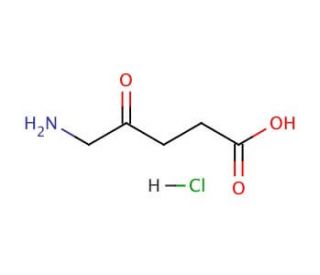

Molecular structure of 5-Aminolevulinic Acid Hydrochloride Salt, CAS Number: 5451-09-2
5-Aminolevulinic Acid Hydrochloride Salt (CAS 5451-09-2)
See product citations (2)
Alternate Names:
5-Aminolevulinic Acid Hydrochloride Salt is also known as 5-ALA.
Application:
5-Aminolevulinic Acid Hydrochloride Salt is a naturally occurring amino acid and precursor of tetrapyrroles.
CAS Number:
5451-09-2
Purity:
≥98%
Molecular Weight:
167.59
Molecular Formula:
C5H9NO3•HCl
For Research Use Only. Not Intended for Diagnostic or Therapeutic Use.
* Refer to Certificate of Analysis for lot specific data.
QUICK LINKS
Ordering Information
Product Citations
Description
Technical Information
Safety Information
SDS & Certificate of Analysis
5-Aminolevulinic Acid Hydrochloride Salt (5-ALA HCl) is a naturally occurring amino acid and a precursor of tetrapyrroles in the biosynthesis of chlorophyll and heme. It is considered an antineoplastic photosensitizer. 5-Aminolevulinic Acid Hydrochloride Salt converts to protoporphyrins within tissue upon exposure to light, which produces byproducts in the form of reactive oxygen species. It is known to have anti-inflammatory, antioxidant, and anti-tumor activities. Researchers study the effects of 5-Aminolevulinic Acid Hydrochloride Salt on various biological processes, such as inflammation, cell proliferation, and gene expression.
5-Aminolevulinic Acid Hydrochloride Salt (CAS 5451-09-2) References
- Biosynthesis, biotechnological production and applications of 5-aminolevulinic acid. | Sasaki, K., et al. 2002. Appl Microbiol Biotechnol. 58: 23-9. PMID: 11831472
- 5-aminolevulinic acid alleviates the salinity-induced changes in Brassica napus as revealed by the ultrastructural study of chloroplast. | Naeem, MS., et al. 2012. Plant Physiol Biochem. 57: 84-92. PMID: 22695221
- Effects of exogenous 5-aminolevulinic acid on PIP1 and NIP aquaporin gene expression in seedlings of cucumber cultivars subjected to salinity stress. | Yan, F., et al. 2014. Genet Mol Res. 13: 2563-73. PMID: 24535911
- Physiological and metabolic effects of 5-aminolevulinic acid for mitigating salinity stress in creeping bentgrass. | Yang, Z., et al. 2014. PLoS One. 9: e116283. PMID: 25551443
- A New Strategy for Production of 5-Aminolevulinic Acid in Recombinant Corynebacterium glutamicum with High Yield. | Yang, P., et al. 2016. Appl Environ Microbiol. 82: 2709-2717. PMID: 26921424
- Traditional and novel tools to probe the mitochondrial metabolism in health and disease. | Zhang, Y. and Avalos, JL. 2017. Wiley Interdiscip Rev Syst Biol Med. 9: PMID: 28067471
- 5-aminolevulinic acid improves salt tolerance mediated by regulation of tetrapyrrole and proline metabolism in Brassica napus L. seedlings under NaCl stress. | Xiong, JL., et al. 2018. Plant Physiol Biochem. 124: 88-99. PMID: 29353686
- 5-Aminolevulinic Acid (ALA) Alleviated Salinity Stress in Cucumber Seedlings by Enhancing Chlorophyll Synthesis Pathway. | Wu, Y., et al. 2018. Front Plant Sci. 9: 635. PMID: 29868088
- Synergetic effects of 5-aminolevulinic acid and Ascophyllum nodosum seaweed extracts on Asparagus phenolics and stress related genes under saline irrigation. | Al-Ghamdi, AA. and Elansary, HO. 2018. Plant Physiol Biochem. 129: 273-284. PMID: 29906777
- Hydrogen peroxide as a mediator of 5-aminolevulinic acid-induced Na+ retention in roots for improving salt tolerance of strawberries. | Wu, WW., et al. 2019. Physiol Plant. 167: 5-20. PMID: 30891756
- Mechanistic studies on Pyrobaculum calidifontis porphobilinogen synthase (5-aminolevulinic acid dehydratase). | Azim, N., et al. 2019. Bioorg Chem. 91: 103117. PMID: 31377385
- 5-Aminolevulinic Acid Improves Morphogenesis and Na+ Subcellular Distribution in the Apical Cells of Cucumis sativus L. Under Salinity Stress. | Wu, Y., et al. 2021. Front Plant Sci. 12: 636121. PMID: 33815443
- Root Exposure to 5-Aminolevulinic Acid (ALA) Affects Leaf Element Accumulation, Isoprene Emission, Phytohormonal Balance, and Photosynthesis of Salt-Stressed Arundo donax. | Brilli, F., et al. 2022. Int J Mol Sci. 23: PMID: 35457125
- Production of 5-aminolevulinic acid from hydrolysates of cassava residue and fish waste by engineered Bacillus cereus PT1. | Luo, Y., et al. 2023. Microb Biotechnol. 16: 381-391. PMID: 35920136
- The Effect Of Age And Various Chemicals On The Lag Phase Of Chlorophyll Synthesis In Dark Grown Bean Seedlings | Edward C. Sisler and William H. Klein. 1963. Physiologia Plantarum. 16: 315.
Inhibitor of:
INSIG-1.Activator of:
ACAT-2, AKR1B7, ALAS-E, ASA, C20orf3, COX10, CYP4V3, Fdx1, ISCA1, Mitochondrial Topo I, MMAB, MRM1, MRP-L41, OTTMUSG00000016453, p20-ARC, PCCA, PECI, PMPCB, TMEM14A, Tom40, Tom40B, Transcobalamin I, and UROD.Ordering Information
| Product Name | Catalog # | UNIT | Price | Qty | FAVORITES | |
5-Aminolevulinic Acid Hydrochloride Salt, 1 g | sc-262399 | 1 g | $41.00 | |||
5-Aminolevulinic Acid Hydrochloride Salt, 5 g | sc-262399A | 5 g | $110.00 | |||
5-Aminolevulinic Acid Hydrochloride Salt, 25 g | sc-262399B | 25 g | $320.00 | |||
5-Aminolevulinic Acid Hydrochloride Salt, 100 g | sc-262399C | 100 g | $1400.00 |