
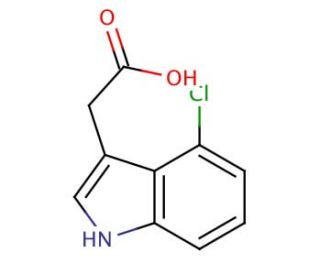

Molecular structure of 4-Chloroindole-3-acetic Acid, CAS Number: 2519-61-1
4-Chloroindole-3-acetic Acid (CAS 2519-61-1)
Alternate Names:
4-Chloroindoleacetic Acid; 4-Chloro-1H-indole-3-acetic Acid
Application:
4-Chloroindole-3-acetic Acid is a potent candidate for new rooting promoters without estrogenic activity
CAS Number:
2519-61-1
Molecular Weight:
209.63
Molecular Formula:
C10H8ClNO2
For Research Use Only. Not Intended for Diagnostic or Therapeutic Use.
* Refer to Certificate of Analysis for lot specific data.
QUICK LINKS
Ordering Information
Description
Technical Information
Safety Information
SDS & Certificate of Analysis
Belonging to the group of auxins, 4-Chloroindole-3-acetic acid is a plant hormone that plays a role in stimulating root formation. Through its ability to increase auxin levels within the plant′s tissues. Additionally, 4-Chloroindole-3-acetic acid acts as an intramolecular hydrogen donor and has the capability to engage in hydrogen bonding with other molecules. It possesses a receptor binding site and a cyclic peptide backbone, enabling it to function as either a transcription factor or an enzyme inhibitor.
4-Chloroindole-3-acetic Acid (CAS 2519-61-1) References
- Synthesis and biological activities of 4-chloroindole-3-acetic acid and its esters. | Katayama, M. 2000. Biosci Biotechnol Biochem. 64: 808-15. PMID: 10830497
- Hormone and seed-specific regulation of pea fruit growth. | Ozga, JA., et al. 2002. Plant Physiol. 128: 1379-89. PMID: 11950986
- Specificity of auxin regulation of gibberellin 20-oxidase gene expression in pea pericarp. | Ngo, P., et al. 2002. Plant Mol Biol. 49: 439-48. PMID: 12090620
- Seed and Hormonal Regulation of Gibberellin 20-Oxidase Expression in Pea Pericarp. | Van Huizen, R., et al. 1997. Plant Physiol. 115: 123-128. PMID: 12223795
- Influence of Auxin and Gibberellin on in Vivo Protein Synthesis during Early Pea Fruit Growth. | Van Huizen, R., et al. 1996. Plant Physiol. 112: 53-59. PMID: 12226372
- Pollination-, development-, and auxin-specific regulation of gibberellin 3beta-hydroxylase gene expression in pea fruit and seeds. | Ozga, JA., et al. 2003. Plant Physiol. 131: 1137-46. PMID: 12644664
- The effect of auxins (IAA and 4-Cl-IAA) on the redox activity and medium pH of Zea mays L. root segments. | Lekacz, H. and Karcz, W. 2006. Cell Mol Biol Lett. 11: 376-83. PMID: 16847555
- Biosynthesis of the halogenated auxin, 4-chloroindole-3-acetic acid. | Tivendale, ND., et al. 2012. Plant Physiol. 159: 1055-63. PMID: 22573801
- A mutation affecting the synthesis of 4-chloroindole-3-acetic acid. | Ross, JJ., et al. 2012. Plant Signal Behav. 7: 1533-6. PMID: 23073010
- Evidence That Chlorinated Auxin Is Restricted to the Fabaceae But Not to the Fabeae. | Lam, HK., et al. 2015. Plant Physiol. 168: 798-803. PMID: 25971549
- The single evolutionary origin of chlorinated auxin provides a phylogenetically informative trait in the Fabaceae. | Lam, HK., et al. 2016. Plant Signal Behav. 11: e1197467. PMID: 27302610
- Regulation of ethylene-related gene expression by indole-3-acetic acid and 4-chloroindole-3-acetic acid in relation to pea fruit and seed development. | Jayasinghege, CPA., et al. 2017. J Exp Bot. 68: 4137-4151. PMID: 28922757
- TIR1 auxin receptors are implicated in the differential response to 4-Cl-IAA and IAA in developing pea fruit. | Jayasinghege, CPA., et al. 2019. J Exp Bot. 70: 1239-1253. PMID: 30715391
- Catabolism of indole-3-acetic acid and 4- and 5-chloroindole-3-acetic acid in Bradyrhizobium japonicum. | Jensen, JB., et al. 1995. J Bacteriol. 177: 5762-6. PMID: 7592320
- Seed and 4-chloroindole-3-acetic acid regulation of gibberellin metabolism in pea pericarp. | van Huizen, R., et al. 1995. Plant Physiol. 109: 1213-7. PMID: 8539289
Ordering Information
| Product Name | Catalog # | UNIT | Price | Qty | FAVORITES | |
4-Chloroindole-3-acetic Acid, 1 g | sc-396046 | 1 g | $379.00 | |||
4-Chloroindole-3-acetic Acid, 2 g | sc-396046A | 2 g | $567.00 |