
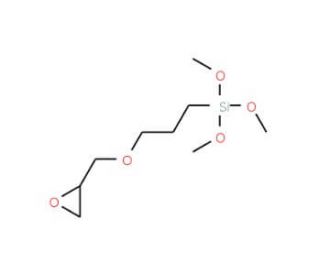

(3-Glycidyloxypropyl)trimethoxysilane (CAS 2530-83-8)
QUICK LINKS
(3-Glycidoxypropyl)trimethoxysilane, also referred to as GPTS, represents a silane-based compound extensively employed in various scientific applications. Its versatility enables its utilization in the synthesis of polymers, adhesives, and coatings. (3-Glycidyloxypropyl)trimethoxysilane comprises three essential components: an organic group, a silicon atom, and three methoxy groups. These constituents facilitate the formation of diverse siloxane structures, rendering (3-Glycidyloxypropyl)trimethoxysilane highly adaptable. (3-Glycidyloxypropyl)trimethoxysilane finds utility in the creation of silica-based materials. Its versatility extends further, contributing to the development of polymers exhibiting enhanced mechanical properties and participating in the synthesis of nanomaterials like nanocomposites and nanofibers. The mechanism underlying the effectiveness of (3-Glycidyloxypropyl)trimethoxysilane lies in its ability to form siloxane structures. Depending on the reaction conditions, (3-Glycidyloxypropyl)trimethoxysilane can generate a spectrum of siloxane configurations, including linear, branched, and cyclic structures.
(3-Glycidyloxypropyl)trimethoxysilane (CAS 2530-83-8) References
- Hybrid molecularly imprinted poly(methacrylic acid-TRIM)-silica chemically modified with (3-glycidyloxypropyl)trimethoxysilane for the extraction of folic acid in aqueous medium. | de Oliveira, FM., et al. 2016. Mater Sci Eng C Mater Biol Appl. 59: 643-651. PMID: 26652418
- Capture of cervical exfoliative cells on a glass slide coated by 3-glycidyloxypropyl trimethoxysilane and poly-L-lysine. | Xing, GW., et al. 2012. J Pharm Anal. 2: 174-179. PMID: 29403739
- Preparation and Characterization of pH Sensitive Chitosan/3-Glycidyloxypropyl Trimethoxysilane (GPTMS) Hydrogels by Sol-Gel Method. | Li, CP., et al. 2020. Polymers (Basel). 12: PMID: 32532065
- Chemical functionalization of nano fibrillated cellulose by glycidyl silane coupling agents: A grafted silane network characterization study. | Cabrera, IC., et al. 2020. Int J Biol Macromol. 165: 1773-1782. PMID: 33075339
- Effect of Electrical Stimulation Conditions on Neural Stem Cells Differentiation on Cross-Linked PEDOT:PSS Films. | Sordini, L., et al. 2021. Front Bioeng Biotechnol. 9: 591838. PMID: 33681153
- Red and Green Quantum Dot Color Filter for Full-Color Micro-LED Arrays. | Zhao, B., et al. 2022. Micromachines (Basel). 13: PMID: 35457900
- Surface treatment of cotton using β-cyclodextrins sol–gel method | Wang, C. X., & Chen, S. L. 2006. Applied surface science. 252(18): 6348-6352.
- An assessment of the corrosion protection of AA2024-T3 treated with vinyltrimethoxysilane/(3-glycidyloxypropyl) trimethoxysilane | Dalmoro, V., dos Santos, J. H. Z., Alemán, C., & Azambuja, D. S. 2015. Corrosion Science. 92: 200-208.
- Intercalation, characterization and release behavior of imidacloprid into layered hydroxide salts by coupling of (3-glycidyloxypropyl) trimethoxysilane | Liu, J., Wang, J., & Zhang, X. 2018. Colloids and Surfaces A: Physicochemical and Engineering Aspects. 553: 42-49.
- Ultrathin g-C3N4 films supported on Attapulgite nanofibers with enhanced photocatalytic performance | Xu, Y., Zhang, L., Yin, M., Xie, D., Chen, J., Yin, J.,.. & Wang, X. 2018. Applied Surface Science. 440: 170-176.
- The effects of silane coupling agents on the mechanical properties of basalt fiber reinforced poly (butylene terephthalate) composites | Arslan, C., & Dogan, M. 2018. Composites Part B: Engineering. 146: 145-154.
- Supported choline hydroxide (ionic liquid) on mesoporous silica as heterogeneous catalyst for Knoevenagel condensation reactions | del Hierro, I., Perez, Y., & Fajardo, M. 2018. Microporous and Mesoporous Materials. 263: 173-180.
- Silanization mechanism of silica nanoparticles in bitumen using 3-aminopropyl triethoxysilane (APTES) and 3-glycidyloxypropyl trimethoxysilane (GPTMS) | Mousavi, M., & Fini, E. 2020. ACS Sustainable Chemistry & Engineering. 8(8): 3231-3240.
Ordering Information
| Product Name | Catalog # | UNIT | Price | Qty | FAVORITES | |
(3-Glycidyloxypropyl)trimethoxysilane, 25 g | sc-283759A | 25 g | $36.00 | |||
(3-Glycidyloxypropyl)trimethoxysilane, 100 g | sc-283759 | 100 g | $51.00 | |||
(3-Glycidyloxypropyl)trimethoxysilane, 250 g | sc-283759B | 250 g | $82.00 | |||
(3-Glycidyloxypropyl)trimethoxysilane, 1 kg | sc-283759C | 1 kg | $163.00 | |||
(3-Glycidyloxypropyl)trimethoxysilane, 4 kg | sc-283759D | 4 kg | $388.00 |