
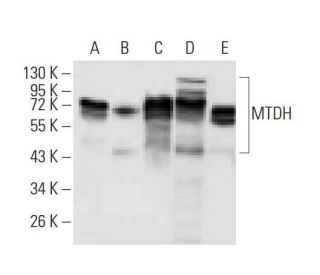


MTDH Anticorpo (2F11C3D4): sc-517220
- MTDH Anticorpo 2F11C3D4é um anticorpo monoclonal produzido em camundongo IgG1 MTDH anticorpo, citado em 23 publicações, fornecido em 50 µg/0.5 ml
- elevada contra uma proteína recombinante correspondente aos aminoácidos 378-579 de MTDH de origem human
- recomendado para a detecção de MTDH of human origin by WB, IP, IF, IHC(P), FCM and ELISA
- O m-IgG Fc BP-HRP é o reagente de deteção secundário preferido para MTDH Antibody (2F11C3D4) para aplicações WB e IHC(P). Este reagente é agora oferecido num pacote com MTDH Antibody (2F11C3D4)(ver informações de encomenda abaixo).

LINKS RÁPIDOS
VEJA TAMBÉM
O anticorpo MTDH (2F11C3D4) é um anticorpo monoclonal IgG1 de camundongo que detecta a proteína MTDH de origem humana por western blotting (WB), imunoprecipitação (IP), imunofluorescência (IF), imunohistoquímica com secções incluídas em parafina (IHCP), citometria de fluxo (FCM) e ensaio de imunoabsorção enzimática (ELISA). O anticorpo anti-MTDH (2F11C3D4) está disponível num formato não conjugado. A MTDH, ou proteína de adesão a metástases, também conhecida como proteína AEG1 (astrocyte elevated gene-1) ou proteína CEACAM1 co-isolada rica em lisina (LYRIC), é uma proteína de membrana de passagem única com 582 aminoácidos que desempenha um papel fundamental na progressão do cancro. A MTDH localiza-se principalmente na membrana do retículo endoplasmático, mas pode se translocar do citoplasma para o núcleo em resposta ao fator de necrose tumoral alfa (TNFα), evidenciando o envolvimento em vias de sinalização celular. A MTDH interage com várias proteínas, incluindo o fator de transcrição NFκB, que a MTDH ativa para promover o crescimento independente de fixação de astrócitos e melanócitos imortalizados, processos essenciais no desenvolvimento de tumores. Adicionalmente, a MTDH aumenta a sementeira de células tumorais no endotélio dos órgãos alvo, tornando a MTDH num importante agente de metástases. A expressão de MTDH é notavelmente elevada em vários cancros e encontra-se em níveis elevados em tecidos como o coração, o músculo esquelético, a língua e o intestino delgado, sublinhando a sua importância tanto na fisiologia normal como nos estados de doença.
Alexa Fluor® é uma marca comercial da Molecular Probes Inc., OR., EUA
LI-COR® e Odyssey® são marcas registadas da LI-COR Biosciences
Referencias do MTDH Anticorpo (2F11C3D4):
- Clonagem e caraterização do AEG-1 (astrocyte elevated gene-1) induzido pelo VIH-1. | Kang, DC., et al. 2005. Gene. 353: 8-15. PMID: 15927426
- Ativação da via do fator nuclear kappaB pelo astrocyte elevated gene-1: implicações para a progressão tumoral e metástases. | Emdad, L., et al. 2006. Cancer Res. 66: 1509-16. PMID: 16452207
- O gene-1 elevado dos astrócitos: novas perspectivas sobre um novo gene envolvido na progressão tumoral, metástases e neurodegeneração. | Emdad, L., et al. 2007. Pharmacol Ther. 114: 155-70. PMID: 17397930
- O knockdown do astrocyte-elevated gene-1 inibe a progressão do cancro da próstata através da regulação positiva da atividade do FOXO3a. | Kikuno, N., et al. 2007. Oncogene. 26: 7647-55. PMID: 17563745
- Base molecular da ativação do fator nuclear kappaB pelo astrocyte elevated gene-1. | Sarkar, D., et al. 2008. Cancer Res. 68: 1478-84. PMID: 18316612
- A sobreexpressão de LYRIC/AEG-1 modula os níveis da proteína BCCIPalpha em células tumorais da próstata. | Ash, SC., et al. 2008. Biochem Biophys Res Commun. 371: 333-8. PMID: 18440304
- O Astrocyte elevated gene-1 é um novo marcador de prognóstico para a progressão do cancro da mama e para a sobrevivência global dos doentes. | Li, J., et al. 2008. Clin Cancer Res. 14: 3319-26. PMID: 18519759
- A ativação da MTDH através do ganho genómico 8q22 promove a quimiorresistência e a metástase do cancro da mama de mau prognóstico. | Hu, G., et al. 2009. Cancer Cell. 15: 9-20. PMID: 19111877
Informacoes sobre ordens
| Nome do Produto | Numero de Catalogo | UNID | Preco | Qde | FAVORITOS | |
MTDH Anticorpo (2F11C3D4) | sc-517220 | 50 µg/0.5 ml | $322.00 | |||
Pacote do MTDH (2F11C3D4): m-IgG Fc BP-HRP | sc-541098 | 100 µg Ab; 10 µg BP | $361.00 |