
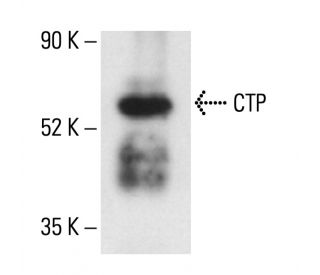


CTP Antibody (C-12): sc-518244
- CTP Antibody (C-12) is a mouse monoclonal IgA κ provided at 200 µg/ml
- specific for an epitope mapping between amino acids 102-129 of CTP of human origin
- recommended for detection of CTP of human origin by WB, IP, IF and ELISA
- m-IgGκ BP-HRP is the preferred secondary detection reagent for CTP Antibody (C-12) for WB applications. This reagent is now offered in a bundle with CTP Antibody (C-12) (see ordering information below). For additional m-IgGκ BP conjugates see our complete list of Mouse IgG Binding Proteins.

QUICK LINKS
SEE ALSO...
CTP Antibody (C-12) is a mouse monoclonal IgA kappa light chain antibody specific for an epitope mapping between amino acids 102-129 of CTP of human origin by western blotting (WB), immunoprecipitation (IP), immunofluorescence (IF), and enzyme-linked immunosorbent assay (ELISA). CTP monoclonal antibody (C-12) is available in a non-conjugated form, designed for versatile applications in research. Citrate transport protein (CTP), also known as Tricarboxylate transport protein, or SLC25A1, is a crucial 311 amino acid mitochondrial multi-pass membrane protein that plays a vital role in transporting citrate across the mitochondrial inner membrane. This transport is essential as citrate serves as a key carbon source for the biosynthesis of sterols and fatty acids, thereby significantly influencing the bioenergetics of hepatic cells. The importance of CTP is underscored by involvement in various metabolic pathways, and alterations in function have been linked to conditions such as type I diabetes and certain cancers. Additionally, the gene encoding CTP is located in a chromosomal region often deleted in patients with DiGeorge syndrome, a disorder that leads to immune deficiencies and other serious health issues. CTP is predominantly expressed in adult tissues such as the ovary, gut, liver, and testis, as well as in fetal organs including the kidney, lung, brain, and liver, highlighting a critical role in both development and metabolism. These characteristics make anti-CTP antibody (C-12) a valuable tool for investigating mitochondrial citrate transport and impact on metabolic pathways and cellular bioenergetics.
Alexa Fluor® is a trademark of Molecular Probes Inc., OR., USA
LI-COR® and Odyssey® are registered trademarks of LI-COR Biosciences
CTP Antibody (C-12) References:
- Kinetic evidence for the uniport mechanism hypothesis in the mitochondrial tricarboxylate transport system. | De Palma, A., et al. 2005. J Bioenerg Biomembr. 37: 279-87. PMID: 16341772
- Conjugated linoleic acid and hepatic lipogenesis in mouse: role of the mitochondrial citrate carrier. | Ferramosca, A., et al. 2006. J Lipid Res. 47: 1994-2003. PMID: 16816327
- The mitochondrial citrate transport protein: evidence for a steric interaction between glutamine 182 and leucine 120 and its relationship to the substrate translocation pathway and identification of other mechanistically essential residues. | Ma, C., et al. 2006. Biochim Biophys Acta. 1757: 1271-6. PMID: 16904062
- The yeast mitochondrial citrate transport protein: identification of the Lysine residues responsible for inhibition mediated by Pyridoxal 5'-phosphate. | Remani, S., et al. 2008. J Bioenerg Biomembr. 40: 577-85. PMID: 19002576
- Probing the effect of transport inhibitors on the conformation of the mitochondrial citrate transport protein via a site-directed spin labeling approach. | Mayor, JA., et al. 2010. J Bioenerg Biomembr. 42: 99-109. PMID: 20354774
- The yeast mitochondrial citrate transport protein: molecular determinants of its substrate specificity. | Aluvila, S., et al. 2010. J Biol Chem. 285: 27314-27326. PMID: 20551333
- Quantitative metabolic flux analysis reveals an unconventional pathway of fatty acid synthesis in cancer cells deficient for the mitochondrial citrate transport protein. | Jiang, L., et al. 2017. Metab Eng. 43: 198-207. PMID: 27856334
- The mitochondrial tricarboxylate transport protein. cDNA cloning, primary structure, and comparison with other mitochondrial transport proteins. | Kaplan, RS., et al. 1993. J Biol Chem. 268: 13682-90. PMID: 8514800
- Cloning, genomic organization, and chromosomal localization of human citrate transport protein to the DiGeorge/velocardiofacial syndrome minimal critical region. | Goldmuntz, E., et al. 1996. Genomics. 33: 271-6. PMID: 8660975
- Localization of the human mitochondrial citrate transporter protein gene to chromosome 22Q11 in the DiGeorge syndrome critical region. | Heisterkamp, N., et al. 1995. Genomics. 29: 451-6. PMID: 8666394
- The human mitochondrial citrate transporter gene (SLC20A3) maps to chromosome band 22q11 within a region implicated in DiGeorge syndrome, velo-cardio-facial syndrome and schizophrenia. | Stoffel, M., et al. 1996. Hum Genet. 98: 113-5. PMID: 8682495
- Organization and sequence of the human gene for the mitochondrial citrate transport protein. | Iacobazzi, V., et al. 1997. DNA Seq. 7: 127-39. PMID: 9254007
Ordering Information
| Product Name | Catalog # | UNIT | Price | Qty | FAVORITES | |
CTP Antibody (C-12) | sc-518244 | 200 µg/ml | $322.00 | |||
CTP Antibody (C-12): m-IgGκ BP-HRP Bundle | sc-551615 | 200 µg Ab; 40 µg BP | $361.00 |