
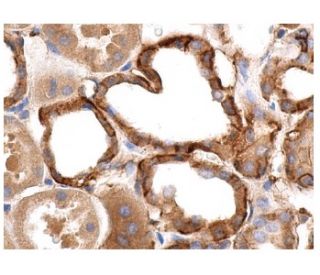
CD9 Antibody (C-4): sc-13118
- CD9 Antibody (C-4) is a mouse monoclonal IgG1 κ CD9 antibody, cited in 323 publications, provided at 200 µg/ml
- raised against amino acids 101-210 of CD9 of human origin
- CD9 Antibody (C-4) is recommended for detection of CD9 of mouse, rat and human origin by WB, IP, IF, IHC(P), FCM and ELISA
- Anti-CD9 Antibody (C-4) is available conjugated to agarose for IP; HRP for WB, IHC(P) and ELISA; and to either phycoerythrin or FITC for IF, IHC(P) and FCM
- also available conjugated to Alexa Fluor® 488, Alexa Fluor® 546, Alexa Fluor® 594 or Alexa Fluor® 647 for WB (RGB), IF, IHC(P) and FCM, and for use with RGB fluorescent imaging systems, such as iBright™ FL1000, FluorChem™, Typhoon, Azure and other comparable systems
- also available conjugated to Alexa Fluor® 680 or Alexa Fluor® 790 for WB (NIR), IF and FCM; for use with Near-Infrared (NIR) detection systems, such as LI-COR®Odyssey®, iBright™ FL1000, FluorChem™, Typhoon, Azure and other comparable systems
- also available conjugated to Alexa Fluor® 405 for IF, IHC(P) and FCM
- m-IgG Fc BP-HRP and m-IgG1 BP-HRP are the preferred secondary detection reagents for CD9 Antibody (C-4) for WB and IHC(P) applications. These reagents are now offered in bundles with CD9 Antibody (C-4) (see ordering information below).

QUICK LINKS
SEE ALSO...
CD9 Antibody (C-4) is a mouse monoclonal IgG1 kappa light chain antibody raised against amino acids 101-210 of human CD9, reactive with mouse, rat, and human species, and validated for applications including western blotting (WB), immunoprecipitation (IP), immunofluorescence (IF), immunohistochemistry, flow cytometry (FCM), and enzyme-linked immunosorbent assay (ELISA). CD9, also known as Tetraspanin-29 or p24, is a type IV transmembrane glycoprotein with four transmembrane domains and is widely expressed on the surface of various cell types, including early B cells, eosinophils, basophils, activated T cells, and platelets. CD9 is integral to cell-cell adhesion, particularly during immune responses and cellular communication. Additionally, CD9 plays a significant role in signal transduction, interacting with low molecular weight GTP-binding proteins to influence intracellular signaling pathways. CD9 is also implicated in the regulation of cell migration, adhesion, and fusion, processes that are critical in immune function, tissue repair, and development. CD9 is associated with a range of pathological conditions and is expressed on non-T acute lymphoblastic leukemia cells and some acute myeloid and chronic lymphoid leukemias, highlighting CD9′s importance as a marker for certain hematological malignancies. As a major component of the platelet surface, CD9 is essential in platelet aggregation and clot formation. Anti-CD9 antibody (C-4) is a reliable tool for studying the function and regulatory mechanisms of this key glycoprotein in health and disease. CD9 (C-4) antibody is available in both non-conjugated and conjugated forms, including agarose, horseradish peroxidase (HRP), phycoerythrin (PE), fluorescein isothiocyanate (FITC), and Alexa Fluor® options, providing flexibility for a wide range of experimental applications.
Alexa Fluor® is a trademark of Molecular Probes Inc., OR., USA
LI-COR® and Odyssey® are registered trademarks of LI-COR Biosciences
CD9 Antibody (C-4) References:
- CD9 antigen on acute non-lymphoid leukemia cells: preferential expression by promyelocytic (M3) subtype. | Ferrero, D., et al. 1991. Leuk Res. 15: 457-61. PMID: 1861531
- Evidence that the signal-initiating membrane protein CD9 is associated with small GTP-binding proteins. | Seehafer, JG. and Shaw, AR. 1991. Biochem Biophys Res Commun. 179: 401-6. PMID: 1909120
- cDNA cloning and expression of platelet p24/CD9. Evidence for a new family of multiple membrane-spanning proteins. | Lanza, F., et al. 1991. J Biol Chem. 266: 10638-45. PMID: 2037603
- CD9-regulated adhesion. Anti-CD9 monoclonal antibody induce pre-B cell adhesion to bone marrow fibroblasts through de novo recognition of fibronectin. | Masellis-Smith, A. and Shaw, AR. 1994. J Immunol. 152: 2768-77. PMID: 7511626
- The ins and outs of the transmembrane 4 superfamily. | Wright, MD. and Tomlinson, MG. 1994. Immunol Today. 15: 588-94. PMID: 7531445
- Analysis of CD9, CD32 and p67 signalling: use of degranulated platelets indicates direct involvement of CD9 and p67 in integrin activation. | Slupsky, JR., et al. 1997. Br J Haematol. 96: 275-86. PMID: 9029013
- Upregulation of CD9 expression during TPA treatment of K562 cells. | Le Naour, F., et al. 1997. Leukemia. 11: 1290-7. PMID: 9264383
- Nomenclature and characterization of leukocyte differentiation antigens in ruminants. | Naessens, J., et al. 1997. Immunol Today. 18: 365-8. PMID: 9267076
Ordering Information
| Product Name | Catalog # | UNIT | Price | Qty | FAVORITES | |
CD9 Antibody (C-4) | sc-13118 | 200 µg/ml | $322.00 | |||
CD9 Antibody (C-4): m-IgG Fc BP-HRP Bundle | sc-526538 | 200 µg Ab; 10 µg BP | $361.00 | |||
CD9 Antibody (C-4): m-IgG1 BP-HRP Bundle | sc-531911 | 200 µg Ab; 20 µg BP | $361.00 | |||
CD9 Antibody (C-4) AC | sc-13118 AC | 500 µg/ml, 25% agarose | $424.00 | |||
CD9 Antibody (C-4) HRP | sc-13118 HRP | 200 µg/ml | $322.00 | |||
CD9 Antibody (C-4) FITC | sc-13118 FITC | 200 µg/ml | $336.00 | |||
CD9 Antibody (C-4) PE | sc-13118 PE | 200 µg/ml | $349.00 | |||
CD9 Antibody (C-4) Alexa Fluor® 488 | sc-13118 AF488 | 200 µg/ml | $364.00 | |||
CD9 Antibody (C-4) Alexa Fluor® 546 | sc-13118 AF546 | 200 µg/ml | $364.00 | |||
CD9 Antibody (C-4) Alexa Fluor® 594 | sc-13118 AF594 | 200 µg/ml | $364.00 | |||
CD9 Antibody (C-4) Alexa Fluor® 647 | sc-13118 AF647 | 200 µg/ml | $364.00 | |||
CD9 Antibody (C-4) Alexa Fluor® 680 | sc-13118 AF680 | 200 µg/ml | $364.00 | |||
CD9 Antibody (C-4) Alexa Fluor® 790 | sc-13118 AF790 | 200 µg/ml | $364.00 | |||
CD9 Antibody (C-4) Alexa Fluor® 405 | sc-13118 AF405 | 200 µg/ml | $364.00 |