
Date published: 2026-6-10

1-800-457-3801

SCBT Portrait Logo
Seach Input

uMtCK Antibody (25-L): sc-130364

4.0(1)
Write a reviewAsk a question

Datasheets
  • uMtCK Antibody (25-L) is a mouse monoclonal IgG2a κ provided at 100 µg/ml
  • raised against recombinant uMtCK of human origin
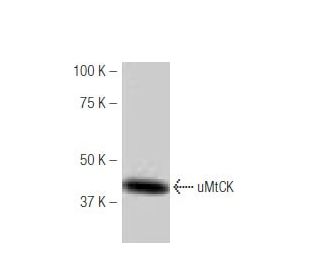
  • recommended for detection of uMtCK of human origin by WB and IP
  • At present, we have not yet completed the identification of the preferred secondary detection reagent(s) for uMtCK Antibody (25-L). This work is in progress.
    Gene Editing Promo Banner

    QUICK LINKS

    SEE ALSO...

    uMtCK Antibody (25-L) is a mouse monoclonal IgG2a antibody that detects uMtCK in human samples through western blotting (WB) and immunoprecipitation (IP) applications. uMtCK, or human cytoplasmic CK-Mitochondrial, is a 416 amino acid isoform of creatine kinase that plays a crucial role in cellular energy metabolism, particularly within the mitochondria. uMtCK is essential for maintaining ATP levels in tissues with high energy demands, such as cardiac and skeletal muscle, by facilitating the transfer of phosphate groups between creatine and adenosine nucleotides. uMtCK functions are vital for sustaining cellular activities, especially during periods of increased energy consumption, as uMtCK helps to regulate calcium homeostasis and supports the energetic regulation of calcium pumps. Dysregulation of uMtCK has been implicated in various pathological conditions, including heart disease and neurodegenerative disorders, making uMtCK a significant target for research in understanding energy metabolism and its impact on cellular health. anti-uMtCK antibody (25-L) is an invaluable tool for researchers investigating the role of this important protein in human health and disease.

    For Research Use Only. Not Intended for Diagnostic or Therapeutic Use.

    Alexa Fluor® is a trademark of Molecular Probes Inc., OR., USA

    LI-COR® and Odyssey® are registered trademarks of LI-COR Biosciences

    uMtCK Antibody (25-L) References:

    1. ASB9 interacts with ubiquitous mitochondrial creatine kinase and inhibits mitochondrial function.  |  Kwon, S., et al. 2010. BMC Biol. 8: 23. PMID: 20302626
    2. Expression of leucine-rich repeat kinase 2 (LRRK2) inhibits the processing of uMtCK to induce cell death in a cell culture model system.  |  Cui, J., et al. 2011. Biosci Rep. 31: 429-37. PMID: 21370995
    3. Overexpression of ubiquitous mitochondrial creatine kinase (uMtCK) accelerates tumor growth by inhibiting apoptosis of breast cancer cells and is associated with a poor prognosis in breast cancer patients.  |  Qian, XL., et al. 2012. Biochem Biophys Res Commun. 427: 60-6. PMID: 22982673
    4. High ubiquitous mitochondrial creatine kinase expression in hepatocellular carcinoma denotes a poor prognosis with highly malignant potential.  |  Uranbileg, B., et al. 2014. Int J Cancer. 134: 2189-98. PMID: 24174293
    5. The Expression of Ubiquitous Mitochondrial Creatine Kinase Is Downregulated as Prostate Cancer Progression.  |  Amamoto, R., et al. 2016. J Cancer. 7: 50-9. PMID: 26722360
    6. Insights into the Phosphoryl Transfer Mechanism of Human Ubiquitous Mitochondrial Creatine Kinase.  |  Li, Q., et al. 2016. Sci Rep. 6: 38088. PMID: 27909311
    7. Mitochondrial Creatine Kinase is Decreased in the Serum of Idiopathic Parkinson's Disease Patients.  |  Xu, J., et al. 2019. Aging Dis. 10: 601-610. PMID: 31165004
    8. Ubiquitous mitochondrial creatine kinase promotes the progression of gastric cancer through a JNK-MAPK/JUN/HK2 axis regulated glycolysis.  |  Mi, Y., et al. 2023. Gastric Cancer. 26: 69-81. PMID: 36114400
    9. Downregulated miRNA-491-3p accelerates colorectal cancer growth by increasing uMtCK expression.  |  Tang, X., et al. 2022. PeerJ. 10: e14285. PMID: 36518289
    10. Context-dependent roles for ubiquitous mitochondrial creatine kinase CKMT1 in breast cancer progression.  |  Ayyappan, V., et al. 2024. Cell Rep. 43: 114121. PMID: 38615320

    Ordering Information

    Product NameCatalog #UNITPriceQtyFAVORITES

    uMtCK Antibody (25-L)

    sc-130364
    100 µg/ml
    $339.00
