
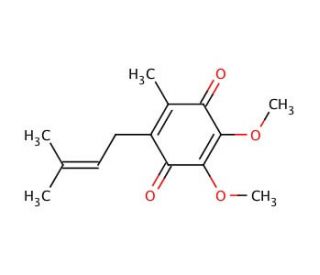

Ubiquinone-5 (CAS 727-81-1)
QUICK LINKS
Ubiquinone-5 is a lipid-soluble molecule that functions as an electron carrier in the electron transport chain of cellular respiration. It plays a role in transferring electrons from complex I and complex II to complex III, ultimately contributing to the generation of ATP. Ubiquinone-5 is involved in the oxidation-reduction reactions within the inner mitochondrial membrane, shuttling electrons and participating in the production of a proton gradient. This molecule acts as a coenzyme, facilitating the transfer of electrons from NADH and succinate to cytochrome c, which is important for ATP synthesis. At the molecular level, ubiquinone-5 undergoes reversible reduction and oxidation reactions, allowing it to transfer electrons and participate in the energy conversion process. Its mechanism of action involves interacting with various protein complexes and enzymes within the electron transport chain, enabling the efficient transfer of electrons and the production of ATP.
Ubiquinone-5 (CAS 727-81-1) References
- Bioenergetics in clinical medicine: prevention by forms of coenzyme Q of the inhibition by adriamycin of coenzyme Q10-enzymes in mitochondria of the myocardium. | Kishi, T., et al. 1976. Proc Natl Acad Sci U S A. 73: 4653-6. PMID: 1070015
- Electrochemical properties of natural organic matter (NOM), fractions of NOM, and model biogeochemical electron shuttles. | Nurmi, JT. and Tratnyek, PG. 2002. Environ Sci Technol. 36: 617-24. PMID: 11878375
- The second coenzyme Q1 binding site of bovine heart NADH: coenzyme Q oxidoreductase. | Nakashima, Y., et al. 2002. J Bioenerg Biomembr. 34: 89-94. PMID: 12018892
- Coenzyme Q1-catalyzed luminol chemiluminescent assay for rapid antimicrobial susceptibility testing of Mycobacterium bovis. | Yamashoji, S. 2003. Microbiol Immunol. 47: 191-8. PMID: 12725288
- Chemiluminescent assay for detection of viable microorganisms. | Yamashoji, S., et al. 2004. Anal Biochem. 333: 303-8. PMID: 15450806
- Coenzyme Q(1) depletes NAD(P)H and impairs recycling of ascorbate in astrocytes. | Dragan, M., et al. 2006. Brain Res. 1078: 9-18. PMID: 16499885
- Manipulating respiratory levels in Escherichia coli for aerobic formation of reduced chemical products. | Zhu, J., et al. 2011. Metab Eng. 13: 704-12. PMID: 22001430
- Menaquinone analogs inhibit growth of bacterial pathogens. | Schlievert, PM., et al. 2013. Antimicrob Agents Chemother. 57: 5432-7. PMID: 23959313
- The effects of mitochondrial complex I blockade on ATP and permeability in rat pulmonary microvascular endothelial cells in culture (PMVEC) are overcome by coenzyme Q1 (CoQ1). | Bongard, RD., et al. 2015. Free Radic Biol Med. 79: 69-77. PMID: 25452141
- Anthocyanins as substrates for mitochondrial complex I - protective effect against heart ischemic injury. | Skemiene, K., et al. 2015. FEBS J. 282: 963-71. PMID: 25586661
- Ubiquinone-5 is reduced by superoxide in the aerobic state by NADPH oxidase of guinea pig macrophages. | Nakamura, M., et al. 1985. FEBS Lett. 186: 215-8. PMID: 2989007
- Rational design, synthesis and biological evaluation of ubiquinone derivatives as IDO1 inhibitors. | Ding, Y., et al. 2019. Bioorg Chem. 89: 102870. PMID: 31103493
- New Insights Into the Antibacterial Mechanism of Cryptotanshinone, a Representative Diterpenoid Quinone From Salvia miltiorrhiza Bunge. | Chen, BC., et al. 2021. Front Microbiol. 12: 647289. PMID: 33717044
- Partial purification and properties of respiratory chain-linked l-glycerol 3-phosphate dehydrogenase from a marine bacterium, Vibrio alginolyticus. | Unemoto, T., et al. 1981. J Biochem. 90: 619-28. PMID: 6796567
- Inhibition of mitochondrial and Paracoccus denitrificans NADH-ubiquinone reductase by oxacarbocyanine dyes. A structure-activity study. | Anderson, WM., et al. 1993. Biochem Pharmacol. 45: 2115-22. PMID: 8512593
Ordering Information
| Product Name | Catalog # | UNIT | Price | Qty | FAVORITES | |
Ubiquinone-5, 2 mg | sc-205876 | 2 mg | $112.00 |