
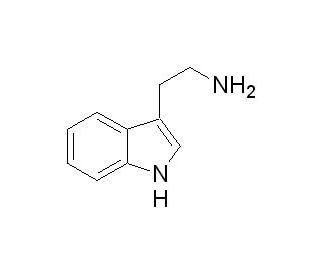

Tryptamine (CAS 61-54-1)
See product citations (1)
QUICK LINKS
Tryptamine, an organic compound found abundantly in plants and animals, holds significance as an alkaloid—a nitrogen-containing compound that exerts physiological effects on the body. Its most well-known role lies in being a key component in the synthesis of serotonin, a neurotransmitter essential for regulating mood, appetite, and sleep. In the realm of scientific research, tryptamine proves invaluable due to its diverse applications. As a common neurotransmitter agonist, it readily binds to and activates neurotransmitter receptors, allowing researchers to investigate the effects of various neurotransmitters on the body. Moreover, tryptamine serves as a neurotransmitter antagonist, binding to and inhibiting neurotransmitter activity, enabling the study of antagonist effects on the body. Furthermore, as an antidepressant, tryptamine exhibits the ability to increase serotonin levels in the brain, contributing to its therapeutic potential. Upon binding to serotonin receptors in the brain, tryptamine triggers a signal transduction pathway, leading to the release of neurotransmitters like dopamine and norepinephrine. These neurotransmitters subsequently engage with other neurons in the brain, resulting in a multitude of effects. Overall, tryptamine, with its multifaceted properties, plays a vital role in scientific research. It acts as a neurotransmitter agonist and antagonist, facilitating the study of neurotransmitter effects and interactioning with serotonin receptors.
Tryptamine (CAS 61-54-1) References
- Tryptamine induces tryptophanyl-tRNA synthetase-mediated neurodegeneration with neurofibrillary tangles in human cell and mouse models. | Paley, EL., et al. 2007. Neuromolecular Med. 9: 55-82. PMID: 17114825
- Tryptamine-induced tryptophanyl-tRNAtrp deficiency in neurodifferentiation and neurodegeneration interplay: progenitor activation with neurite growth terminated in Alzheimer's disease neuronal vesicularization and fragmentation. | Paley, EL. 2011. J Alzheimers Dis. 26: 263-98. PMID: 21628792
- Tryptamine and dimethyltryptamine inhibit indoleamine 2,3 dioxygenase and increase the tumor-reactive effect of peripheral blood mononuclear cells. | Tourino, MC., et al. 2013. Cell Biochem Funct. 31: 361-4. PMID: 23754498
- Tryptamine induces axonopathy and mitochondriopathy mimicking neurodegenerative diseases via tryptophanyl-tRNA deficiency. | Paley, EL., et al. 2013. Curr Alzheimer Res. 10: 987-1004. PMID: 24117115
- Determination of tryptamine in foods using square wave adsorptive stripping voltammetry. | Costa, DJ., et al. 2016. Talanta. 154: 134-40. PMID: 27154658
- Gut Microbiota-Derived Tryptophan Metabolites Modulate Inflammatory Response in Hepatocytes and Macrophages. | Krishnan, S., et al. 2018. Cell Rep. 23: 1099-1111. PMID: 29694888
- Gut Microbiota-Produced Tryptamine Activates an Epithelial G-Protein-Coupled Receptor to Increase Colonic Secretion. | Bhattarai, Y., et al. 2018. Cell Host Microbe. 23: 775-785.e5. PMID: 29902441
- Effect of orange juice and tryptamine on the behavior and c-fos expression of Wistar rats. | Vázquez-Luna, A., et al. 2019. Metab Brain Dis. 34: 519-525. PMID: 30604026
- Tryptamine accumulation caused by deletion of MrMao-1 in Metarhizium genome significantly enhances insecticidal virulence. | Tong, X., et al. 2020. PLoS Genet. 16: e1008675. PMID: 32271756
- The biogenic amine tryptamine, unlike β-phenylethylamine, shows in vitro cytotoxicity at concentrations that have been found in foods. | Del Rio, B., et al. 2020. Food Chem. 331: 127303. PMID: 32562979
- WRKY1-mediated regulation of tryptophan decarboxylase in tryptamine generation for withanamide production in Withania somnifera (Ashwagandha). | Jadaun, JS., et al. 2020. Plant Cell Rep. 39: 1443-1465. PMID: 32789542
- Hypoxia Routes Tryptophan Homeostasis Towards Increased Tryptamine Production. | Mohapatra, SR., et al. 2021. Front Immunol. 12: 590532. PMID: 33679737
- Can the Intake of a Synthetic Tryptamine be Detected Only by Blood Plasma Analysis? A Clinical Toxicology Case Involving 4-HO-MET. | Wagmann, L., et al. 2022. J Anal Toxicol. 46: 567-572. PMID: 34100553
- Revealing the presence of tryptamine new psychoactive substances using fused 'neutral loss' spectra derived from DART high-resolution mass spectra. | Ventura, MI., et al. 2022. Talanta. 246: 123417. PMID: 35576755
- Tryptamine, a Microbial Metabolite in Fermented Rice Bran Suppressed Lipopolysaccharide-Induced Inflammation in a Murine Macrophage Model. | Agista, AZ., et al. 2022. Int J Mol Sci. 23: PMID: 36232510
Ordering Information
| Product Name | Catalog # | UNIT | Price | Qty | FAVORITES | |
Tryptamine, 5 g | sc-206065 | 5 g | $24.00 | |||
Tryptamine, 25 g | sc-206065A | 25 g | $72.00 | |||
Tryptamine, 100 g | sc-206065B | 100 g | $235.00 | |||
Tryptamine, 250 g | sc-206065C | 250 g | $468.00 |