
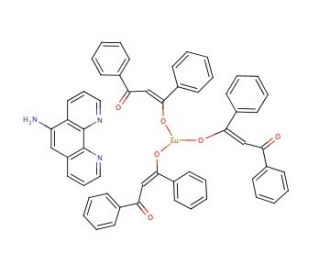

Tris(dibenzoylmethane) mono(5-amino-1,10-phenanthroline)europium (lll) (CAS 352546-68-0)
QUICK LINKS
SLC4A2 inhibitors are a specific class of chemical compounds that target and inhibit the activity of the SLC4A2 protein. The SLC4A2 gene encodes for a protein known as anion exchanger 2 (AE2), which is part of the solute carrier family 4. This family of proteins is primarily involved in the transport of bicarbonate (HCO3-) across cell membranes, playing a crucial role in maintaining pH balance and ionic homeostasis within various tissues. SLC4A2, in particular, facilitates the exchange of chloride ions (Cl-) with bicarbonate ions, thus contributing significantly to the regulation of intracellular pH. Inhibition of SLC4A2 can disrupt this exchange process, leading to alterations in cellular pH levels and ionic equilibrium. Structurally, SLC4A2 inhibitors are diverse, often designed to interact specifically with the active site or regulatory domains of the AE2 protein, thereby blocking its function. These inhibitors can be small molecules or larger compounds, each varying in their mechanism of binding and inhibition potency. By targeting the SLC4A2 protein, these compounds can influence the transport activities that depend on the proper functioning of the AE2-mediated ion exchange. The study and development of SLC4A2 inhibitors are essential for understanding the physiological and biochemical processes regulated by AE2. This includes exploring the broader impacts of ion transport inhibition on cellular activities such as signal transduction, volume regulation, and overall cellular metabolism. Research into these inhibitors provides insights into the fundamental workings of cellular homeostasis and the intricate balance of ions within the cellular environment.
Tris(dibenzoylmethane) mono(5-amino-1,10-phenanthroline)europium (lll) (CAS 352546-68-0) References
- Low-cost optical lifetime assisted ratiometric glutamine sensor based on glutamine binding protein. | Lam, H., et al. 2008. Anal Biochem. 383: 61-7. PMID: 18786501
- On the design of low-cost fluorescent protein biosensors. | Tolosa, L. 2009. Adv Biochem Eng Biotechnol. 116: 143-57. PMID: 19347267
- A novel bifunctional europium complex as a potential fluorescent label for DNA detection. | Qin, PZ., et al. 2010. Analyst. 135: 2144-9. PMID: 20585687
- Dual optical sensor for oxygen and temperature based on the combination of time domain and frequency domain techniques. | Lam, H., et al. 2011. Talanta. 84: 65-70. PMID: 21315899
- Lanthanide complexes with phenanthroline-based ligands: insights into cell death mechanisms obtained by microscopy techniques. | Cabral Campello, MP., et al. 2019. Dalton Trans. 48: 4611-4624. PMID: 30888352
- Self-assembled magnetic luminescent hybrid micelles containing rare earth Eu for dual-modality MR and optical imaging. | Yan, K., et al. 2014. J Mater Chem B. 2: 546-555. PMID: 32261536
- Surface chemical reactions on self-assembled silane based monolayers. | Wang, L., et al. 2021. Chem Soc Rev. 50: 6507-6540. PMID: 34100051
- Ratiometric fluorescent semiconducting polymer dots for temperature sensing. | He, S. and Wu, S. 2023. Analyst. 148: 863-868. PMID: 36651278
- Europium Complex Covalently Grafted on Si(100) Surfaces, Engineered with Covalent Polystyrene Nanostructures | Domenico A. Cristaldi†, Salvatrice Millesi†, Placido Mineo†‡, and Antonino Gulino*†. 2013. The Journal of Physical Chemistry C. 117, 31,: 16213–16220.
Ordering Information
| Product Name | Catalog # | UNIT | Price | Qty | FAVORITES | |
Tris(dibenzoylmethane) mono(5-amino-1,10-phenanthroline)europium (lll), 100 mg | sc-255708 | 100 mg | $250.00 |