
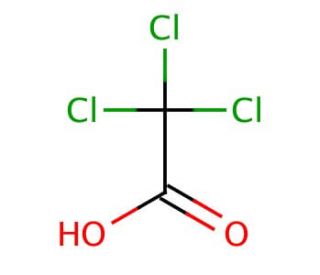

Trichloroacetic acid (CAS 76-03-9)
See product citations (3)
QUICK LINKS
Trichloroacetic acid (TCA) is a compound with notable significance in scientific research due to its diverse properties and wide-ranging applications across various disciplines. One of its primary mechanisms of action lies in its role as a protein precipitant. Trichloroacetic acid′s ability to denature proteins by disrupting hydrogen bonding and hydrophobic interactions makes it invaluable in the extraction and purification of proteins from biological samples. In research laboratories, TCA is commonly used to precipitate proteins from cell lysates and tissue homogenates, facilitating their separation from other cellular components. Moreover, trichloroacetic acid finds extensive use in molecular biology and biochemistry for the precipitation of nucleic acids, particularly RNA. Its capacity to selectively precipitate RNA molecules while leaving DNA intact enables the isolation and purification of RNA for downstream applications such as reverse transcription and gene expression analysis. Additionally, research efforts have explored its potential in environmental science, where it serves as a reagent for the determination and quantification of certain organic compounds in water and soil samples. Furthermore, trichloroacetic acid has been investigated for its role in chemical synthesis, particularly in the preparation of esters and amides. Overall, trichloroacetic acid continues to be a versatile tool in scientific investigations, owing to its diverse functionalities and broad utility in research applications spanning protein and nucleic acid purification, environmental analysis, and organic synthesis.
Trichloroacetic acid (CAS 76-03-9) References
- The effect of dichloroacetic acid and trichloroacetic acid on DNA methylation and cell proliferation in B6C3F1 mice. | Ge, R., et al. 2001. J Biochem Mol Toxicol. 15: 100-6. PMID: 11284051
- Solubilization of trichloroacetic acid (TCA) precipitated microbial proteins via naOH for two-dimensional electrophoresis. | Nandakumar, MP., et al. 2003. J Proteome Res. 2: 89-93. PMID: 12643547
- Efficient precipitation and accurate quantitation of detergent-solubilized membrane proteins. | Chang, YC. 1992. Anal Biochem. 205: 22-6. PMID: 1443557
- Determination hematotoxic and hepatotoxic effects of trichloroacetic acid at sublethal dosage in rats. | Celik, I. and Temur, A. 2009. Food Chem Toxicol. 47: 1324-6. PMID: 19286448
- Trichloroacetic acid-induced protein precipitation involves the reversible association of a stable partially structured intermediate. | Rajalingam, D., et al. 2009. Protein Sci. 18: 980-93. PMID: 19388015
- Contribution of trichloroacetic acid to liver tumors observed in perchloroethylene (perc)-exposed mice. | Sweeney, LM., et al. 2009. Toxicology. 260: 77-83. PMID: 19464572
- Liquid chromatography electrospray ionization tandem mass spectrometry analysis method for simultaneous detection of trichloroacetic acid, dichloroacetic acid, S-(1,2-dichlorovinyl)glutathione and S-(1,2-dichlorovinyl)-L-cysteine. | Kim, S., et al. 2009. Toxicology. 262: 230-8. PMID: 19549554
- Universal sample preparation method integrating trichloroacetic acid/acetone precipitation with phenol extraction for crop proteomic analysis. | Wu, X., et al. 2014. Nat Protoc. 9: 362-74. PMID: 24434803
- Protein assay for dilute solutions. | Cabib, E. and Polacheck, I. 1984. Methods Enzymol. 104: 415-6. PMID: 6717293
- Carcinogenic activity of dichloroacetic acid and trichloroacetic acid in the liver of female B6C3F1 mice. | Pereira, MA. 1996. Fundam Appl Toxicol. 31: 192-9. PMID: 8789785
Ordering Information
| Product Name | Catalog # | UNIT | Price | Qty | FAVORITES | |
Trichloroacetic acid, 250 g | sc-203414 | 250 g | $102.00 |