
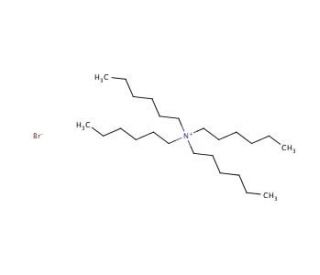

Tetrahexylammonium bromide (CAS 4328-13-6)
QUICK LINKS
Tetrahexylammonium bromide (THAB) is an organic compound, specifically a quaternary ammonium salt. This colorless solid is easily soluble in water and boasts diverse applications in both research and industry. Its use in scientific investigations has revealed a wide range of biochemical and physiological effects. In scientific research, Tetrahexylammonium bromide has been employed as a valuable reagent in the synthesis of various organic compounds, including polymers. Furthermore, it has played a significant role in the production of nanoparticles, which find application in medical imaging techniques. Notably, Tetrahexylammonium bromide has been utilized in cell culture applications, where it has proven effective in inducing cell death in specific cell types. The mechanism of action behind Tetrahexylammonium bromide′s effectiveness lies in its ability to disrupt the cell membrane. By interacting with the membrane lipids, Tetrahexylammonium bromide induces the formation of pores, facilitating the entry of ions and other molecules into the cell, ultimately leading to cell death. Tetrahexylammonium bromide (THAB) stands as a versatile organic compound with a plethora of uses in scientific research, enabling advancements in organic synthesis, nanoparticle production, and cell culture applications, all while demonstrating a unique mechanism of action with its impact on cell membranes.
Tetrahexylammonium bromide (CAS 4328-13-6) References
- Validated HPLC method for determination of sennosides A and B in senna tablets. | Sun, SW. and Su, HT. 2002. J Pharm Biomed Anal. 29: 881-94. PMID: 12093522
- Effect of a cationic guest on the characteristics of the molecular capsule of resorcinarene: a diffusion NMR study. | Avram, L. and Cohen, Y. 2003. Org Lett. 5: 1099-102. PMID: 12659583
- Adsorption of tetraalkylammonium ions on microporous and mesoporous activated carbons prepared from vinylidene chloride copolymer. | Tamai, H., et al. 2004. J Colloid Interface Sci. 275: 44-7. PMID: 15158378
- Synthesis of multi-walled carbon nanotubes by spray-pyrolysis using a new iron organometallic complex as catalytic agent. | Valenzuela-Muñiz, AM., et al. 2008. J Nanosci Nanotechnol. 8: 6456-60. PMID: 19205221
- Collisions of DCl with a solution covered with hydrophobic and hydrophilic ions: tetrahexylammonium bromide in glycerol. | Brastad, SM., et al. 2009. J Phys Chem A. 113: 7422-30. PMID: 19366237
- Inkjet printed LED based pH chemical sensor for gas sensing. | O'Toole, M., et al. 2009. Anal Chim Acta. 652: 308-14. PMID: 19786197
- Surfactant-promoted reactions of Cl2 and Br2 with Br- in glycerol. | Faust, JA., et al. 2013. J Phys Chem B. 117: 12602-12. PMID: 24044668
- Reactions of N2O5 with Salty and Surfactant-Coated Glycerol: Interfacial Conversion of Br- to Br2 Mediated by Alkylammonium Cations. | Shaloski, MA., et al. 2017. J Phys Chem A. 121: 3708-3719. PMID: 28425716
- Multielement Determination of Trace Heavy Metals in Water by Microwave-Induced Plasma Atomic Emission Spectrometry after Extraction in Unconventional Single-Salt Aqueous Biphasic System. | Smirnova, SV., et al. 2018. Anal Chem. 90: 6323-6331. PMID: 29668252
- Experimental Depth Profiles of Surfactants, Ions, and Solvent at the Angstrom Scale: Studies of Cationic and Anionic Surfactants and Their Salting Out. | Zhao, X., et al. 2020. J Phys Chem B. 124: 2218-2229. PMID: 32075369
- Competing Segregation of Br- and Cl- to a Surface Coated with a Cationic Surfactant: Direct Measurements of Ion and Solvent Depth Profiles. | Zhao, X., et al. 2020. J Phys Chem A. 124: 11102-11110. PMID: 33325710
- Improvement of Extractive Alkylation Gas Chromatography of Short-chain Carboxylic Acids in Aqueous Solution. | Ueda, S., et al. 2021. Anal Sci. 37: 1559-1564. PMID: 33967182
- Antiproliferative and antibacterial potential of tetrahexylammonium bromide-based ionic liquids. | Popescu, R., et al. 2021. Exp Ther Med. 22: 672. PMID: 33986837
- Diffusion NMR Reveals the Structures of the Molecular Aggregates of Resorcin[4]arenes and Pyrogallol[4]arenes in Aromatic and Chlorinated Solvents. | Horin, I., et al. 2022. J Phys Chem Lett. 13: 10666-10670. PMID: 36354303
- HPLC-fluorescence determination of bile acids in pharmaceuticals and bile after derivatization with 2-bromoacetyl-6-methoxynaphthalene. | Cavrini, V., et al. 1993. J Pharm Biomed Anal. 11: 761-70. PMID: 8257742
Ordering Information
| Product Name | Catalog # | UNIT | Price | Qty | FAVORITES | |
Tetrahexylammonium bromide, 5 g | sc-251185 | 5 g | $23.00 |