
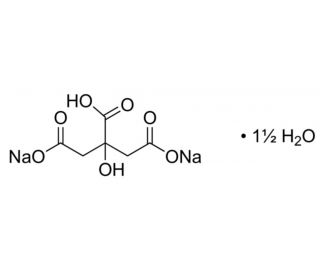

Sodium hydrogencitrate sesquihydrate 的分子结构, CAS编号: 6132-05-4
Sodium hydrogencitrate sesquihydrate (CAS 6132-05-4)
备用名:
Citric acid disodium salt, Disodium hydrogen citrate sesquihydrate
CAS号码:
6132-05-4
分子量:
263.11
分子式:
C6H6Na2O7•1/2H2O
仅供科研使用。不可用于诊断或治疗。
* 参考分析证明 大量特定数据 (包括水 含量).
快捷链接
订购信息
描述
技术信息
安全信息
安全技术说明书和分析证明书
柠檬酸氢钠倍半水合物以其络合和螯合能力而闻名,是各种研究领域的研究对象,包括分析化学和环境科学。这种化合物对金属阳离子的亲和力使其在软化和稳定溶液中的金属离子方面特别有用,这对于防止不希望的沉淀和保持金属盐的溶解性至关重要。在分析应用中,它用于缓冲溶液中以保持pH值,这是许多酶和生化反应的关键因素。该化合物还因其可能在土壤修复中的潜在用途而受到关注,它可以帮助重金属的活化和提取,有助于污染场地的净化。此外,柠檬酸氢钠倍半水合物的螯合性能在金属有机框架(MOFs)的合成中得到了利用,MOFs因其气体储存、分离能力和催化潜力而受到广泛研究。
Sodium hydrogencitrate sesquihydrate (CAS 6132-05-4) 参考文献
- 基于离子液体的分散液-液微萃取技术用于提取香蕉中的农药。 | Ravelo-Pérez, LM., et al. 2009. J Chromatogr A. 1216: 7336-45. PMID: 19700165
- 评估从农业, 观赏植物和森林土壤中提取农药的改良 QuEChERS 方法。 | Asensio-Ramos, M., et al. 2010. Anal Bioanal Chem. 396: 2307-19. PMID: 20127321
- 利用快速, 简便, 廉价, 有效, 坚固, 安全的萃取和高分辨率质谱(混合线性离子阱-轨道阱)对动物组织中的 22 种磺胺类药物及其代谢物进行多残留分析。 | Abdallah, H., et al. 2014. J Chromatogr A. 1355: 61-72. PMID: 24958033
- 安大略省西南部与商业玉米田相关的地表水和土壤中的新烟碱类杀虫剂残留量。 | Schaafsma, A., et al. 2015. PLoS One. 10: e0118139. PMID: 25710560
- 安大略省西南部曾对作物使用过种子处理剂的田地中土壤尘埃和相关母质土壤中的新烟碱类杀虫剂残留量。 | Limay-Rios, V., et al. 2016. Environ Toxicol Chem. 35: 303-10. PMID: 26395849
- 利用高分辨率精确质谱技术转变气相色谱质谱农药分析模式。 | Uclés, S., et al. 2017. J Chromatogr A. 1501: 107-116. PMID: 28434710
- 利用气相色谱-轨道阱质谱分析果蔬类婴儿食品中的农药残留。 | Lozano, A., et al. 2018. J AOAC Int. 101: 374-382. PMID: 29141710
- 磷酸氢钙和柠檬酸钠在水中的复溶。柠檬酸钙的自发过饱和度提高了钙的生物利用率。 | Vavrusova, M., et al. 2018. J Food Drug Anal. 26: 330-336. PMID: 29389571
- Luna Experience®(氟虫腈+戊唑醇)和毒死蜱在四季豆(Phaseolus vulgaris L.)上的残留动态和风险评估。 | Katna, S., et al. 2018. Environ Sci Pollut Res Int. 25: 27594-27605. PMID: 30054838
- 利用 QuEChERS-气相色谱串联质谱法分析干果中的多类农药。 | Varela-Martínez, DA., et al. 2019. Food Chem. 297: 124961. PMID: 31253315
- 蜂箱内化学残留物的分布及其向蜜蜂雏蜂的转移。 | Murcia Morales, M., et al. 2020. Sci Total Environ. 710: 136288. PMID: 31927284
- 家庭煮饭对农药残留的影响。 | Medina, MB., et al. 2021. Food Chem. 342: 128311. PMID: 33051103
- 利用响应面法和可取函数法优化大米烹饪方法,最大限度地降低农药浓度。 | Medina, MB., et al. 2021. Food Chem. 352: 129364. PMID: 33657482
- 优化微 QuEChERS 萃取与气相色谱-质谱联用技术,快速测定贻贝样品中的邻苯二甲酸酯。 | Carro, N., et al. 2023. Anal Methods. 15: 1836-1845. PMID: 36974432
订购信息
| 产品名称 | 产品编号 | 规格 | 价格 | 数量 | 收藏夹 | |
Sodium hydrogencitrate sesquihydrate, 250 g | sc-236906 | 250 g | $36.00 | |||
Sodium hydrogencitrate sesquihydrate, 1 kg | sc-236906A | 1 kg | $141.00 | |||
Sodium hydrogencitrate sesquihydrate, 5 kg | sc-236906B | 5 kg | $467.00 |