
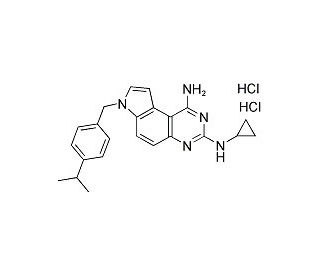

Molecular structure of SCH 79797 dihydrochloride, CAS Number: 1216720-69-2
SCH 79797 dihydrochloride (CAS 1216720-69-2)
See product citations (13)
Alternate Names:
N3-Cyclopropyl-7-[[4-(1-methylethyl)phenyl]methyl]-7H-pyrrolo[3,2-f]quinazoline-1,3-diamine dihydrochloride
Application:
SCH 79797 dihydrochloride is a strong, selective non-peptide Thrombin R inhibitor
CAS Number:
1216720-69-2
Purity:
≥99%
Molecular Weight:
444.40
Molecular Formula:
C23H25N5•2HCl
For Research Use Only. Not Intended for Diagnostic or Therapeutic Use.
* Refer to Certificate of Analysis for lot specific data.
QUICK LINKS
Ordering Information
Product Citations
Description
Technical Information
Safety Information
SDS & Certificate of Analysis
SCH 79797 dihydrochloride is a nonpeptide selective inhibitor of Thrombin R (PAR1), a thrombin-activated receptor. PARs have been described as G protein-coupled receptors that regulate endothelial nitric oxide synthase activity via phosphorylation of the enzyme at various sites. SCH 79797 dihydrochloride has also been reported to contain a high affinity for thrombin receptor-activating peptides, such as alpha-thrombin.
SCH 79797 dihydrochloride (CAS 1216720-69-2) References
- Inhibition of cellular action of thrombin by N3-cyclopropyl-7-[[4-(1-methylethyl)phenyl]methyl]-7H-pyrrolo[3, 2-f]quinazoline-1,3-diamine (SCH 79797), a nonpeptide thrombin receptor antagonist. | Ahn, HS., et al. 2000. Biochem Pharmacol. 60: 1425-34. PMID: 11020444
- A role for proteinase-activated receptor 2 and PKC-epsilon in thrombin-mediated induction of decay-accelerating factor on human endothelial cells. | Lidington, EA., et al. 2005. Am J Physiol Cell Physiol. 289: C1437-47. PMID: 16079188
- Tumor-derived matrix metalloproteinase-1 targets endothelial proteinase-activated receptor 1 promoting endothelial cell activation. | Goerge, T., et al. 2006. Cancer Res. 66: 7766-74. PMID: 16885380
- SCH 79797, a selective PAR1 antagonist, limits myocardial ischemia/reperfusion injury in rat hearts. | Strande, JL., et al. 2007. Basic Res Cardiol. 102: 350-8. PMID: 17468933
- Role of protease-activated receptor-1 in endothelial nitric oxide synthase-Thr495 phosphorylation. | Watts, VL. and Motley, ED. 2009. Exp Biol Med (Maywood). 234: 132-9. PMID: 19064940
- Serine protease inhibition reduces post-ischemic granulocyte recruitment in mouse intestine. | Gobbetti, T., et al. 2012. Am J Pathol. 180: 141-52. PMID: 22067907
- Inhibition of airway epithelial-to-mesenchymal transition and fibrosis by kaempferol in endotoxin-induced epithelial cells and ovalbumin-sensitized mice. | Gong, JH., et al. 2014. Lab Invest. 94: 297-308. PMID: 24378645
- Protease-activated receptor 2 (PAR2) is upregulated by Acanthamoeba plasminogen activator (aPA) and induces proinflammatory cytokine in human corneal epithelial cells. | Tripathi, T., et al. 2014. Invest Ophthalmol Vis Sci. 55: 3912-21. PMID: 24876278
- Expression of proteinase-activated receptor (PAR)-2 in monocytes from allergic patients and potential molecular mechanism. | Ge, S., et al. 2016. Cell Biol Toxicol. 32: 529-542. PMID: 27423452
- SCH 79797, a selective PAR1 antagonist, protects against ischemia/reperfusion-induced arrhythmias in the rat hearts. | Mohamed, OY., et al. 2016. Eur Rev Med Pharmacol Sci. 20: 4796-4800. PMID: 27906419
- The Synthetic Curcumin Derivative CNB-001 Attenuates Thrombin-Stimulated Microglial Inflammation by Inhibiting the ERK and p38 MAPK Pathways. | Akaishi, T., et al. 2020. Biol Pharm Bull. 43: 138-144. PMID: 31902919
- A Dual-Mechanism Antibiotic Kills Gram-Negative Bacteria and Avoids Drug Resistance. | Martin, JK., et al. 2020. Cell. 181: 1518-1532.e14. PMID: 32497502
- Thrombin alters the synthesis and processing of CYR61/CCN1 in human corneal stromal fibroblasts and myofibroblasts through multiple distinct mechanisms. | Andreae, EA., et al. 2020. Mol Vis. 26: 540-562. PMID: 32818017
- The suppression effect of SCH-79797 on Streptococcus mutans biofilm formation. | Zhang, L., et al. 2022. J Oral Microbiol. 14: 2061113. PMID: 35480051
- Activation of a Bacterial Mechanosensitive Channel, MscL, Underlies the Membrane Permeabilization of Dual-Targeting Antibacterial Compounds. | Wray, R., et al. 2022. Antibiotics (Basel). 11: PMID: 35884223
Inhibitor of:
PAR-2, and Thrombin R.Ordering Information
| Product Name | Catalog # | UNIT | Price | Qty | FAVORITES | |
SCH 79797 dihydrochloride, 10 mg | sc-203693 | 10 mg | $354.00 | |||
SCH 79797 dihydrochloride, 50 mg | sc-203693A | 50 mg | $1418.00 |