
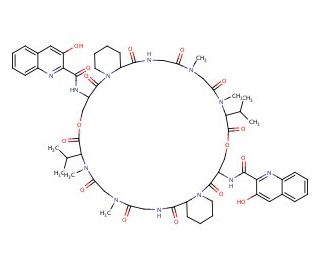

Sandramycin (CAS 100940-65-6)
LINK RAPIDI
La sandramicina, un membro della famiglia degli antibiotici antraciclici, ha suscitato un notevole interesse nella ricerca scientifica per le sue potenti proprietà antitumorali e il suo particolare meccanismo d'azione. Questo composto esercita i suoi effetti citotossici intercalandosi nei filamenti di DNA e inibendo la topoisomerasi II, un enzima critico coinvolto nei processi di replicazione e riparazione del DNA. Interferendo con la scissione e la rilegatura del DNA mediate dalla topoisomerasi II, la sandramicina induce rotture del DNA a doppio filamento e impedisce la sintesi del DNA, portando infine all'arresto del ciclo cellulare e all'apoptosi delle cellule tumorali. La ricerca ha ulteriormente spiegato le caratteristiche strutturali della sandramicina e le sue interazioni di legame con il DNA e la topoisomerasi II, fornendo approfondimenti sul suo meccanismo d'azione e sul potenziale per lo sviluppo di nuovi agenti antitumorali. Inoltre, la sandramicina è stata studiata in regimi di terapia combinata con altri agenti antitumorali, con l'obiettivo di potenziarne l'efficacia e minimizzare gli effetti avversi. Inoltre, gli studi hanno esplorato il potenziale degli analoghi e dei derivati della sandramicina come scaffold per lo sviluppo di nuovi farmaci antitumorali con migliori proprietà farmacologiche e ridotta tossicità. Nel complesso, la sandramicina rappresenta uno strumento prezioso per la ricerca sul cancro, offrendo spunti per strategie antitumorali mirate al DNA e fungendo da potenziale composto guida per la ricerca sul cancro.
Sandramycin (CAS 100940-65-6) Referenze
- Proprietà di legame al DNA di analoghi chiave della sandramicina: esame sistematico del cromoforo di intercalazione. | Boger, DL. and Saionz, KW. 1999. Bioorg Med Chem. 7: 315-21. PMID: 10218823
- [Un ceppo di actinomicete C3905 che produce l'antibiotico antitumorale sandramicina dall'Antartide]. | Hu, J., et al. 2000. Wei Sheng Wu Xue Bao. 40: 646-51. PMID: 12549061
- Prodotti naturali bisintercalatori con potenziali applicazioni terapeutiche: isolamento, determinazione della struttura, studi sintetici e biologici. | Dawson, S., et al. 2007. Nat Prod Rep. 24: 109-26. PMID: 17268609
- Studio delle proprietà di legame al DNA di molecole organiche mediante modelli di relazione quantitativa struttura-attività (QSAR). | Verma, RP. and Hansch, C. 2008. J Pharm Sci. 97: 88-110. PMID: 17722103
- Sintesi totale della sandramicina e dei suoi analoghi attraverso un assemblaggio multicomponente. | Katayama, K., et al. 2014. Org Lett. 16: 428-31. PMID: 24341513
- Sintesi e valutazione biologica della quinaldopeptina. | Katayama, K., et al. 2014. J Org Chem. 79: 2580-90. PMID: 24555872
- Sandramicina, un nuovo antibiotico antitumorale prodotto da un Nocardioides sp. Produzione, isolamento, caratterizzazione e proprietà biologiche. | Matson, JA. and Bush, JA. 1989. J Antibiot (Tokyo). 42: 1763-7. PMID: 2621159
- Analisi completa della sequenza genomica di Kribbella sp. CA-293567 e identificazione dei cluster di geni biosintetici delle kribbellicheline A e B e della sandramicina. | Sánchez-Hidalgo, M., et al. 2023. Microorganisms. 11: PMID: 36838228
- Sandramicina, un nuovo antibiotico antitumorale prodotto da un Nocardioides sp. II. Determinazione della struttura. | Matson, JA., et al. 1993. J Antibiot (Tokyo). 46: 162-6. PMID: 8436549
- Sintesi di analoghi chiave della sandramicina: esame sistematico del cromoforo intercalare. | Boger, DL., et al. 1998. Bioorg Med Chem. 6: 85-102. PMID: 9502108
Informazioni ordini
| Nome del prodotto | Codice del prodotto | UNITÀ | Prezzo | Quantità | Preferiti | |
Sandramycin, 1 mg | sc-202333 | 1 mg | $465.00 |