
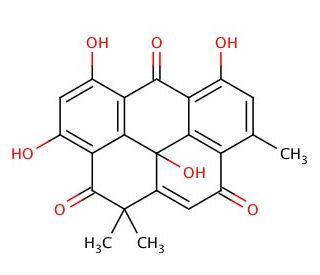

Resistoflavine (CAS 29706-96-5)
Direktverknüpfungen
Resistoflavin ist ein natürliches Pigment, das als Phenoxazinon eingestuft wird und aus bestimmten Stämmen von Actinobakterien, einschließlich der Streptomyces-Spezies, stammt. Diese Verbindung weist einen besonderen Wirkmechanismus auf, der in erster Linie auf ihrer Interaktion mit Nukleinsäuren beruht; sie lagert sich in die DNA-Struktur ein und stört dadurch die normale DNA-Funktion. Die Einlagerung von Resistoflavin zwischen den Basenpaaren der DNA-Stränge kann die DNA-Replikation und die Transkriptionsprozesse behindern, die für das Überleben und die Vermehrung der Zellen entscheidend sind. Aufgrund seiner Fähigkeit, an die DNA zu binden, wurde Resistoflavin in der biophysikalischen und biochemischen Forschung ausgiebig verwendet, um die Dynamik der DNA-Interaktion mit kleinen Molekülen und die Auswirkungen solcher Interaktionen auf die Zellfunktionen zu untersuchen. Diese Untersuchungen helfen aufzuklären, wie Zellen auf DNA-bindende Verbindungen reagieren, und tragen zu einem tieferen Verständnis der molekularen Grundlagen der Regulierung der Genexpression und der Stabilität der DNA-Struktur bei. Darüber hinaus machen die photophysikalischen Eigenschaften von Resistoflavin, wie z. B. die Fluoreszenz bei der Bindung an die DNA, es zu einem nützlichen Werkzeug bei der Entwicklung von diagnostischen Tests und molekularbiologischen Techniken, bei denen die Verfolgung und Visualisierung der DNA erforderlich ist. Diese Forschung trägt dazu bei, unser Wissen über zelluläre Mechanismen auf molekularer Ebene zu erweitern und unsere Fähigkeit zu verbessern, biologische Systeme effektiv zu manipulieren und zu beobachten.
Resistoflavine (CAS 29706-96-5) Literaturhinweise
- Resistoflavin, eine zytotoxische Verbindung aus einem marinen Aktinomyceten, Streptomyces chibaensis AUBN1/7. | Gorajana, A., et al. 2007. Microbiol Res. 162: 322-7. PMID: 16580188
- Interaktionsstudien von Resistomycin aus Streptomyces aurantiacus AAA5 mit Kalbsthymus-DNA und Rinderserumalbumin. | Vijayabharathi, R., et al. 2012. Spectrochim Acta A Mol Biomol Spectrosc. 89: 294-300. PMID: 22285949
- Isolierung, Identifizierung, Optimierung und Metabolitenprofilierung von Streptomyces sparsus VSM-30. | Managamuri, U., et al. 2017. 3 Biotech. 7: 217. PMID: 28669076
- Medizinische Zwecke: Bioaktive Metaboliten aus Meeresorganismen. | Li, T., et al. 2019. Mini Rev Med Chem. 19: 138-164. PMID: 28969543
- Resistomycin unterdrückt das Wachstum von Prostatakrebszellen durch Auslösung von oxidativem Stress, mitochondrialer Apoptose und Zellzyklus-Arrest. | Aloufi, AS., et al. 2023. Molecules. 28: PMID: 38067602
- [Wirkung der Antibiotika Resistomycin und Resistoflavin auf Wachstum, Nukleinsäure- und Proteinsynthese in Bacillus subtilis.] | Haupt, I. and Eckardt, K. 1972. Z Allg Mikrobiol. 12: 575-81. PMID: 4197364
- Optimierung der Resistomycin-Produktion, gereinigt aus Streptomyces aurantiacus AAA5, mit Hilfe der Response-Surface-Methodik | Vijayabharathi, R.Brunthadevi, P.Sathyabama, S., et al. 2012. Journal of Biochemical Technology. 3(4): 402-408.
Bestellinformation
| Produkt | Katalog # | EINHEIT | Preis | ANZAHL | Favoriten | |
Resistoflavine, 1 mg | sc-202311 | 1 mg | $231.00 |