
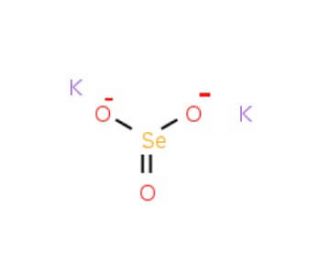

Potassium selenite (CAS 10431-47-7)
QUICK LINKS
Potassium selenite plays a pivotal role in various research applications, particularly in the study of cellular processes and antioxidative mechanisms. This inorganic compound, consisting of potassium ions and selenite anions, serves as a source of selenium in experiments aimed at understanding selenium′s biological role, including its incorporation into selenoproteins and its function in the enzymatic activities that protect cells from oxidative damage. In biochemical research, potassium selenite is often used to investigate the effects of selenium at the molecular level, such as its influence on gene expression, protein synthesis, and its regulatory roles in cellular redox status. The compound′s ability to donate selenium is for studying the synthesis of selenoproteins, which are essential for maintaining cellular homeostasis and protecting against oxidative stress. Furthermore, potassium selenite′s role in research extends to the exploration of its impact on cell cycle regulation and apoptosis, providing insights into the mechanisms by which selenium can affect cellular growth and survival pathways. Through these applications, potassium selenite remains an indispensable tool in the elucidation of selenium′s multifaceted roles in biology and biochemistry.
Potassium selenite (CAS 10431-47-7) References
- Methylation of inorganic and organic selenium by the bacterial thiopurine methyltransferase. | Ranjard, L., et al. 2002. J Bacteriol. 184: 3146-9. PMID: 12003960
- Relative toxicity of organic and inorganic compounds of selenium to newly hatched zebrafish (Brachydanio rerio). | Niimi, AJ. and LaHam, QN. 1976. Can J Zool. 54: 501-9. PMID: 1260570
- Hydroponic cultivation offers a practical means of producing selenium-enriched garlic. | Tsuneyoshi, T., et al. 2006. J Nutr. 136: 870S-872S. PMID: 16484583
- Selenium burn of the eye; report of a case, with review of the literature. | MIDDLETON, JM. 1947. Arch Ophthal. 38: 806-11. PMID: 18919408
- Functional characterization of Vibrio alginolyticus twin-arginine translocation system: its roles in biofilm formation, extracellular protease activity, and virulence towards fish. | He, H., et al. 2011. Curr Microbiol. 62: 1193-9. PMID: 21170534
- Characterization of selenium speciation in selenium-enriched button mushrooms (Agaricus bisporus) and selenized yeasts (dietary supplement) using X-ray absorption near-edge structure (XANES) spectroscopy. | Prange, A., et al. 2019. J Trace Elem Med Biol. 51: 164-168. PMID: 30466927
- [Availability Changes in Different Exogenous Selenium Fertilizers in Soil and Their Effects on Selenium Accumulation in Wheat]. | Wei, W., et al. 2023. Huan Jing Ke Xue. 44: 1003-1011. PMID: 36775623
- Metabolic inhibition of iodide transport in choroid plexus and ciliary body by tellurium and selenium. | Agnew, WF., et al. 1974. Microvasc Res. 8: 156-63. PMID: 4437405
- Toxicity of inorganic selenium salts to chick embryos. | Halverson, AW., et al. 1965. Toxicol Appl Pharmacol. 7: 675-9. PMID: 5866806
- A common pathway for the activation of several molybdoenzymes in Escherichia coli K12. | Giordano, G., et al. 1984. Biochim Biophys Acta. 798: 216-25. PMID: 6370312
Ordering Information
| Product Name | Catalog # | UNIT | Price | Qty | FAVORITES | |
Potassium selenite, 25 g | sc-272103 | 25 g | $223.00 |