
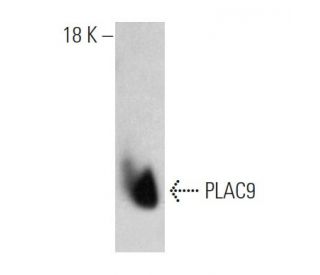

PLAC9 Antibody (F7): sc-517453
- PLAC9 Antibody (F7) is a mouse monoclonal IgG2a κ provided at 100 µg/ml
- raised against a recombinant protein corresponding to amino acids 23-97 of PLAC9 of human origin
- recommended for detection of PLAC9 of human origin by WB, IP, IF, IHC(P) and ELISA
- At present, we have not yet completed the identification of the preferred secondary detection reagent(s) for PLAC9 Antibody (F7). This work is in progress.

QUICK LINKS
PLAC9 Antibody (F7) is a mouse monoclonal IgG2a kappa light chain antibody that detects PLAC9 of human origin by western blotting (WB), immunoprecipitation (IP), immunofluorescence (IF), immunohistochemistry with paraffin-embedded sections (IHCP), and enzyme-linked immunosorbent assay (ELISA). Anti-PLAC9 antibody (F7) is available in a non-conjugated form, allowing for versatile applications in various experimental settings. PLAC9, or placenta-specific 9, is a 97 amino acid protein primarily expressed in the placenta, playing a crucial role in placental development and function, which is vital for fetal growth and nutrient exchange. PLAC9 expression is particularly important during pregnancy, as PLAC9 is involved in regulating trophoblast differentiation and placental angiogenesis, processes essential for a healthy pregnancy outcome. Human PLAC9 shares 73% identity with its mouse counterpart and is encoded by a gene located on human chromosome 10q22.3, a region that harbors nearly 1,200 genes associated with various biological functions. PLAC9′s significance extends beyond its structural role; PLAC9 is implicated in several pathological conditions when dysregulated, highlighting the importance of studying this protein in both developmental biology and reproductive health.
Alexa Fluor® is a trademark of Molecular Probes Inc., OR., USA
LI-COR® and Odyssey® are registered trademarks of LI-COR Biosciences
PLAC9 Antibody (F7) References:
- Report of the third international workshop on human chromosome 10 mapping and sequencing 1999. | Deloukas, P., et al. 2000. Cytogenet Cell Genet. 90: 1-12. PMID: 11060438
- Chromosome 10. | Gilbert, F. 2001. Genet Test. 5: 69-82. PMID: 11336406
- Molecular cell biology of Charcot-Marie-Tooth disease. | Berger, P., et al. 2002. Neurogenetics. 4: 1-15. PMID: 12030326
- Plac8 and Plac9, novel placental-enriched genes identified through microarray analysis. | Galaviz-Hernandez, C., et al. 2003. Gene. 309: 81-9. PMID: 12758124
- First report of ovarian dysgerminoma in Cowden syndrome with germline PTEN mutation and PTEN-related 10q loss of tumor heterozygosity. | Cho, MY., et al. 2008. Am J Surg Pathol. 32: 1258-64. PMID: 18594467
- Genome-wide association study identifies ANXA11 as a new susceptibility locus for sarcoidosis. | Hofmann, S., et al. 2008. Nat Genet. 40: 1103-6. PMID: 19165924
- Mutation update for the CSB/ERCC6 and CSA/ERCC8 genes involved in Cockayne syndrome. | Laugel, V., et al. 2010. Hum Mutat. 31: 113-26. PMID: 19894250
- Jackson-Weiss and Crouzon syndromes are allelic with mutations in fibroblast growth factor receptor 2. | Jabs, EW., et al. 1994. Nat Genet. 8: 275-9. PMID: 7874170
Ordering Information
| Product Name | Catalog # | UNIT | Price | Qty | FAVORITES | |
PLAC9 Antibody (F7) | sc-517453 | 100 µg/ml | $322.00 |