
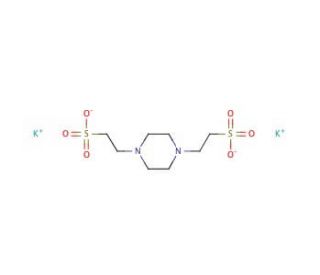

PIPES dipotassium salt (CAS 108321-27-3)
QUICK LINKS
PIPES dipotassium salt, recognized as Piperazine-N,N′-bis(2-ethanesulfonic acid) dipotassium salt, is a crucial buffer agent widely employed in the realms of cell biology and biochemistry research. This derivative of the PIPES buffering system possesses excellent buffering capabilities predominantly within the pH range of 6.1 to 7.5, ensuring that environments remain stable and suitable for sensitive biological processes. The mechanism of action of PIPES dipotassium salt lies in its ability to maintain consistent pH levels by resisting changes in hydrogen ion concentrations, a feature that is vital during experiments that are sensitive to pH fluctuations such as enzymatic reactions and cell cultures. This buffer is particularly valued for its low metal ion binding affinity, which is critical in experiments where the presence of metal ions can lead to undesirable side effects or interference with molecular interactions. In research, PIPES dipotassium salt is often chosen for its compatibility with biological systems, ensuring minimal disruption to cellular integrity or function. It is extensively used in protein isolation procedures, electrophoresis, and other biochemical assays where precise pH control is necessary to avoid protein denaturation or degradation. Additionally, its minimal UV absorbance makes it an excellent choice for use in spectrophotometric assays and other applications where optical clarity is required, thus supporting the acquisition of accurate and reliable experimental data. The widespread use of PIPES dipotassium salt in laboratory settings underscores its effectiveness and reliability as a buffering agent, facilitating the maintenance of optimal conditions for a variety of scientific investigations.
PIPES dipotassium salt (CAS 108321-27-3) References
- Membrane ruffling and macropinocytosis in A431 cells require cholesterol. | Grimmer, S., et al. 2002. J Cell Sci. 115: 2953-62. PMID: 12082155
- Inositol (1,4,5)-trisphosphate receptor links to filamentous actin are important for generating local Ca2+ signals in pancreatic acinar cells. | Turvey, MR., et al. 2005. J Cell Sci. 118: 971-80. PMID: 15713744
- Agonist-evoked inositol trisphosphate receptor (IP3R) clustering is not dependent on changes in the structure of the endoplasmic reticulum. | Chalmers, M., et al. 2006. Biochem J. 394: 57-66. PMID: 16274363
- Relationship between hydrogen consumption, dehalogenation, and the reduction of sulfur oxyanions by Desulfomonile tiedjei. | DeWeerd, KA., et al. 1991. Appl Environ Microbiol. 57: 1929-34. PMID: 1892383
- Microtubule bundle formation driven by ATP: the effect of concentrations of kinesin, streptavidin and microtubules. | Kawamura, R., et al. 2010. Nanotechnology. 21: 145603. PMID: 20215659
- Controlled clockwise-counterclockwise motion of the ring-shaped microtubules assembly. | Kakugo, A., et al. 2011. Biomacromolecules. 12: 3394-9. PMID: 21905668
- Effects of endogenous cannabinoid anandamide on excitation-contraction coupling in rat ventricular myocytes. | Al Kury, LT., et al. 2014. Cell Calcium. 55: 104-18. PMID: 24472666
- Imaging plasmodesmata with high-resolution scanning electron microscopy. | Barton, DA. and Overall, RL. 2015. Methods Mol Biol. 1217: 55-65. PMID: 25287195
- How calcium causes microtubule depolymerization. | O'Brien, ET., et al. 1997. Cell Motil Cytoskeleton. 36: 125-35. PMID: 9015201
- Direct synthesis of N, S co-doped porous carbons using novel organic potassium salts as activators for efficient CO2 adsorption | Hongmin Cui, Jinsong Shi, Jianguo Xu, Nanfu Yan, Yuewei Liu. 2023. Fuel. 342.
Ordering Information
| Product Name | Catalog # | UNIT | Price | Qty | FAVORITES | |
PIPES dipotassium salt, 100 g | sc-258019 | 100 g | $265.00 | |||
PIPES dipotassium salt, 500 g | sc-258019A | 500 g | $536.00 |